
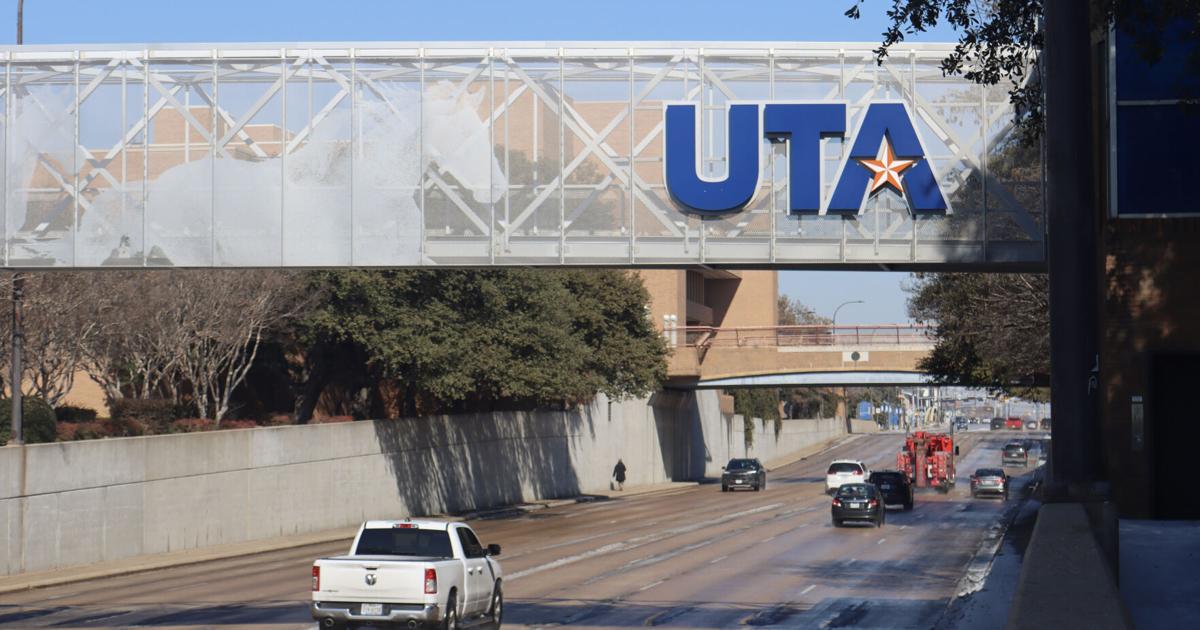

Cars drive under the north bridge over Cooper Street, which connects east and west campus, Jan. 28.
More than 200 UTA employees will leave campus by the end of May as part of a buyout program, according to data obtained by The Shorthorn through an open records request.
The departures — which include employees in long-standing administrative and leadership positions — reflect budget cuts being made across campus amid federal policy changes affecting higher education funding nationwide.
Two hundred nine employees in various faculty and staff positions across 94 departments will be leaving. Sixty-three faculty members and 146 staff members accepted a buyout. There were 234 total applicants.
UTA currently has approximately 5,200 employees, according to an email from university spokesman Jeff Caplan.
UTA President Jennifer Cowley announced the buyouts in January in a university-wide email, which stated the offerings were cost-saving measures as UTA faces “significant shifts in federal funding and policy.”
Employees taking a buyout, formally known as the Voluntary Separation Program, will receive an immediate lump-sum payment.
The buyouts will impact departments across campus in varying degrees. The Department of Computer Science and Engineering and the vice president for development’s office will each lose seven employees, more than any other department. The computer science and engineering employees set to leave account for 233.9 total years of service, more than any department impacted by buyouts.
Other notable departures include six employees each from University Analytics and the Department of Mechanical and Aerospace Engineering, five from the Art and Art History Department and the UTA Police, and four from the departments of Physics, Communication and Accounting.
The employee with the most years of service that accepted a buyout was a professor of computer science and engineering who is leaving after 48 years.
In a statement to The Shorthorn, Hong Jiang, Computer Science and Engineering department chair, said the group set to leave includes former chairs and founding faculty members of the department. Beyond the seven individuals taking a buyout, one employee has also retired.
“These individuals have held vital leadership roles both within our department and across the university, making their departure a significant loss for the UTA community,” Jiang said. “While their presence will be deeply missed, we are confident in our commitment to building on the foundation they established.”
The Shorthorn filed an open records request Feb. 26 for a list of buyout applicants and a list of those approved for a buyout. Applications closed Feb. 23, but it is not clear whether more employees have been approved for a buyout since the records request.
Like many other universities nationwide, UTA is adjusting expenses amid changes to federal funding under the Trump administration and declines in international enrollment and tuition. The university faced a projected $44.2 million budget decrease from fiscal year 2025 to 2026, according to the 2026 UT System budget.
Caplan said UTA has adjusted to the funding loss with several measures, including a hiring pause, targeted staffing adjustments and operational efficiencies, like energy-saving plans in university buildings.
The next step for the university is “targeted organizational adjustments,” which will realign UTA’s structure, resources and investments, Caplan said.
Other universities across Dallas-Fort Worth and nationwide have also grappled with financial pressures. In February, the University of North Texas announced a buyout program and realignments to its budget after facing a projected $45 million deficit for the current fiscal year.
Last summer, 599 Duke University employees accepted buyouts — 5% of the institution’s full-time staff, according to the Associated Press.
Caplan said UTA has not yet determined how much money the buyouts will save long-term.
@PMalkomes