
For the performing arts, the message has been “adapt or die” in recent years.
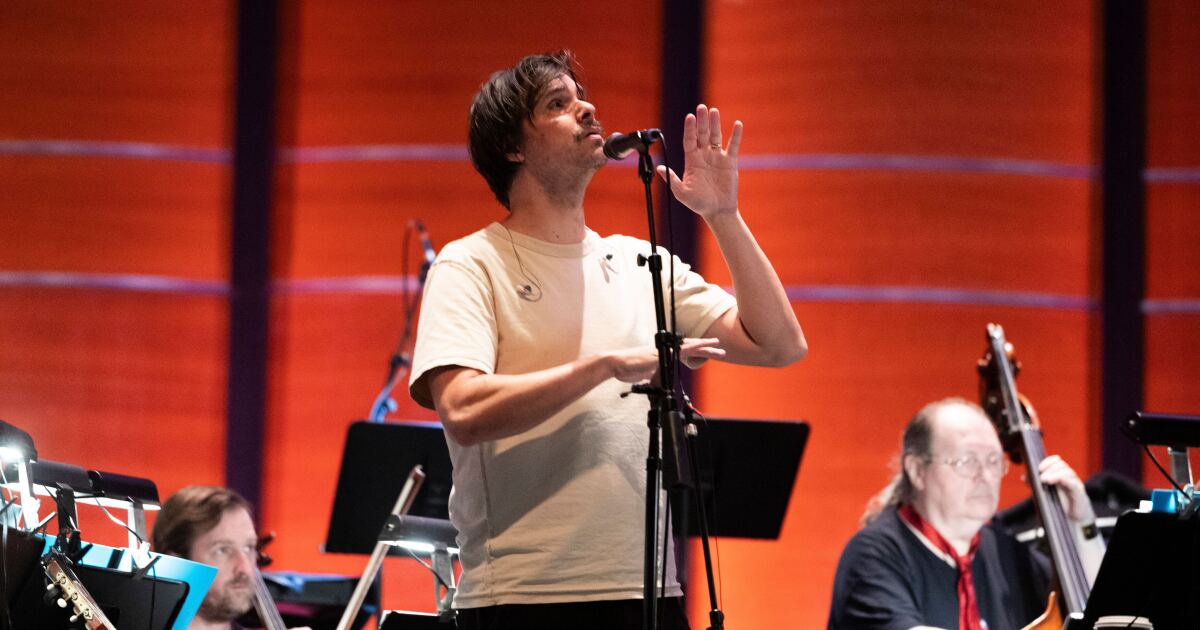
“As an orchestra, we have to be careful not to get sucked into the sands of history and make sure that we’re moving forward and creating a living, breathing art form,” Justus Zimmerman, CEO of the Austin Symphony Orchestra, said during a recent rehearsal.
One way it’s doing that is by working with the Dirty Projectors to bring to life the indie rock band’s latest album, Song of the Earth. Musicians from across the country will gather on stage at the Long Center to perform the piece Thursday night.
“Part of this collaboration is about saying classical music isn’t just old dead music. It’s new, it’s happening, it’s being created today,” Zimmerman said. “We’re still adapting; we’re still creating new experiences.”
Song of the Earth is new for the band, too.
“I almost don’t know how to describe it. … I think it’s gonna be indescribable,” Zimmerman said. “ I think people have a perception of what a symphony is. People have a perception of what the Dirty Projectors are. This is gonna be different from both of those things.”
The show is the headlining performance of Fusebox Festival, a biennial event that brings five days of live performances in visual art, film, literature and music across the city.
Listen to a conversation with Ron Berry, founder and co-artistic director of Fusebox Festival
Ron Berry, founder and co-artistic director of the festival, said this collaboration will be unique to Austin.
“It’ll have these really cool harmonies that [Dirty Projectors] are known for,” he said. “But then that’ll be accompanied by and textured with this incredible orchestral music.”
It takes lots of moving pieces to get this show together. There are the musicians in the symphony, band members, expert percussionists and conductor Peter Bay.
“It has a big sound, epic in scale,” Berry said. “And it’s really expensive to do this thing, it’s a big undertaking. … It just might not ever happen again.”
Adapt or die
Classical music is having a moment, and the Austin Symphony is living up to the city’s claim to fame.
“We need to prove that the ‘Live Music Capital’ goes all the way down,” Zimmerman said. “It includes classical music; it includes orchestral music.”
While older generations are “very into classical music,” Zimmerman said, it’s hard to get Gen X and millennials into the music hall. He, himself, is a millennial.
But the younger generation is on board — in part, he says, because of their exposure to video games and movie soundtracks.
Lorianne Willett
/
KUT News
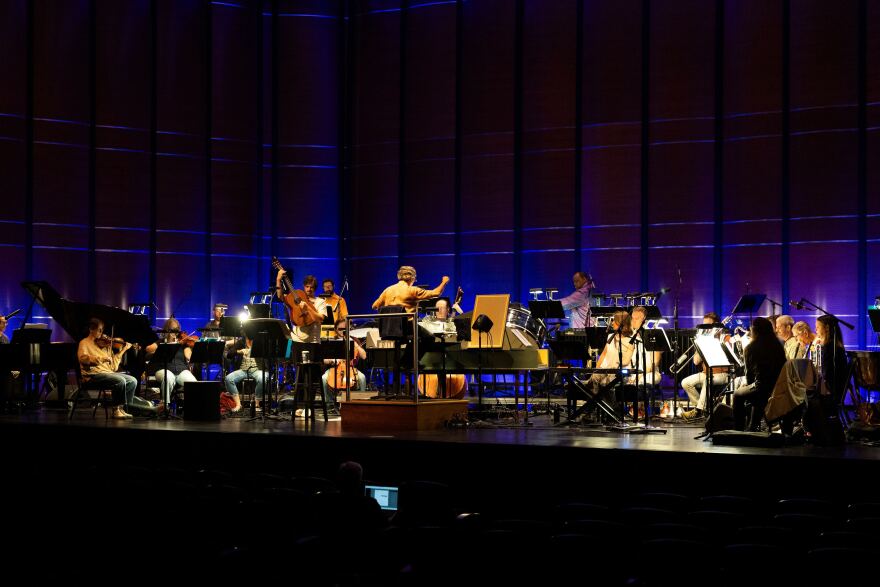
The Austin Symphony Orchestra and Dirty Projectors will perform the album Song of the Earth at the Long Center on Thursday night.
“When I meet Gen Z folks, they have so much more of a grounding in orchestral music than I ever did growing up,” he said. “Growing up, nobody listened to movie soundtracks, or the people that did were weird. Now, it’s totally acceptable as a legit form of art.”
The Austin Symphony has been adapting to this interest. As part of its Butler Pops Series, you can watch a movie while the orchestra plays the score live. So far, the symphony has performed during Star Wars, Home Alone and Pirates of the Caribbean.
“It takes your breath away,” Zimmerman said. “People sit for the whole credits and listen to all the music, and then the screen goes up and they see this giant orchestra on stage. You can hear the audience just kind of erupt.”
He said events like these – and the one the symphony is hosting with Dirty Projectors – are what’s keeping orchestras center stage.
‘Song of the Earth’
David Longstreth, who founded Dirty Projectors, composed the new album. He said the show will include a string quintet, a wind and brass quintet, three percussionists and three female vocalists. Longstreth will also sing and play the guitar.
“[Dirty Projectors] has been my vehicle for music. It’s gone through many different incarnations,” he said. “Song of the Earth is maybe the wildest of the incarnations yet.”
Much of the inspiration behind the album came during the COVID-19 pandemic while Longstreth was on lockdown in his Los Angeles home.
“In that strange, suspended place,” he said, “I think a lot of us felt sort of floating, or like, estranged from what had been our prior routines and selves.”
On top of that, 2020 brought record-setting wildfires throughout the state of California.
“At one point, when my wife was pregnant, the smoke in our neighborhood was inescapable,” he said. “It was an experience that made a big impression on both of us.”
He wanted to distill those feelings – his relationship with nature and with things out of his control – into music.
“We’re at the mercy of Earth,” Longstreth said. “We have this fantasy of having created civilization on top of it, but perhaps that is all a bit more tenuous and fragile than we might’ve imagined.”
The album has moments of wonder, mystery and relief. There are also moments of anger, danger and anxiety.
“Art is pointless,” Longstreth said. “I think that we have to choose it, and I’m so excited that Austin is choosing this.”