
EDITOR’S NOTE: April is Parkinson’s Awareness Month, and an estimated 15,000 people in North Texas are living with the disease, according to the Dallas Area Parkinson’s Society.
=====
For one Arlington man, a new incision‑free treatment brought relief in a matter of seconds.
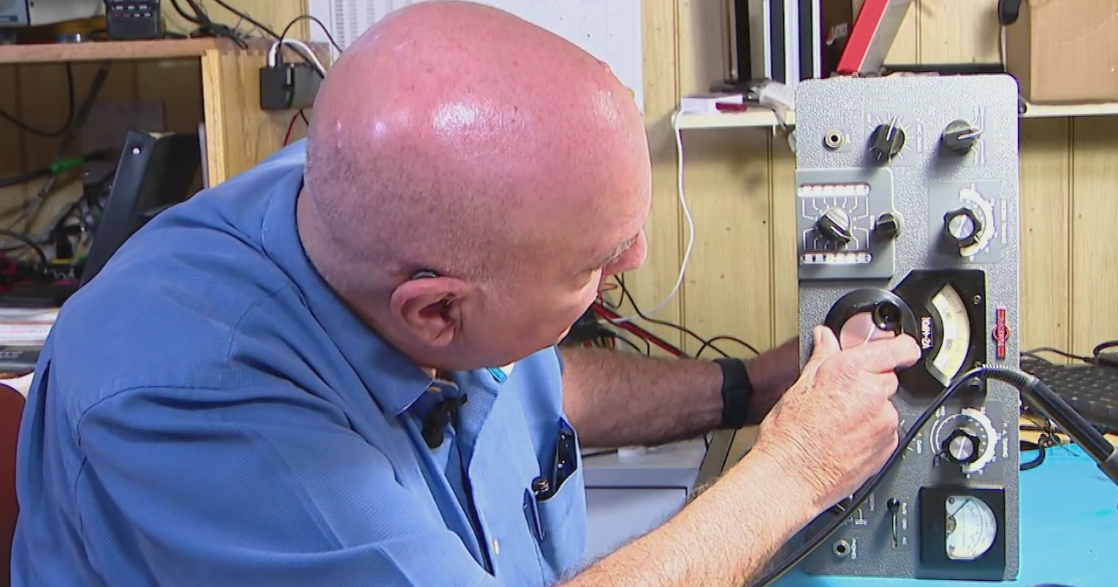
Retired salesman and Air Force veteran Bud Levell, 72, has spent most of his life repairing old radios, machines and anything with wires. The work has always required steady hands – something Parkinson’s slowly took from him.
“I lost my sense of smell 11 or 12 years ago. That’s usually the first symptom,” Levell said. “And under certain stressful conditions, I had a little tremor in the right hand.”
New treatment offers new hope
As his symptoms worsened, Levell came across an article about a new ultrasound‑based treatment.
“Someone sent me a text with a link to a magazine article that was talking about this ultrasound process,” he said. “I read it and said, ‘This sounds good.'”
That link eventually led him to UT Southwestern Medical Center, where doctors determined he was a strong candidate for Magnetic Resonance‑guided focused ultrasound. The FDA recently approved an expanded version of the treatment that targets more Parkinson’s symptoms, including tremors and slowed movement.
“We’re using a higher energy to destroy small tracts in the brain, or small bundles of nerves,” said Dr. Bhavya R. Shah, who leads the focused ultrasound program at UT Southwestern.
Shah says the procedure targets a precise area deep in the brain – about the size of a grain of rice – without the need for an incision.
“We’re navigating to a future where therapies of the brain may be incisionless,” he said. “That in itself is exciting.”
Immediate results bring emotional moment
For Levell, the results were immediate. After the procedure, doctors asked how his tremor felt.
“My answer was simple,” he said. “What tremor?”
The moment was emotional. “It felt good. It felt really nice to be able to say that,” Levell said. “To be able to hold this hand and do this…”
Now, for the first time in nine years, Levell is back at his workbench repairing radios — something he once feared he’d lost forever.
As his hands grow steady again, Levell hopes others living with Parkinson’s find strength in their own journey.
“Does God have a plan for me with Parkinson’s? Yeah,” he said. “What is it? I don’t know, but I’m going to depend on God. I’m going to live as well as I can.”