
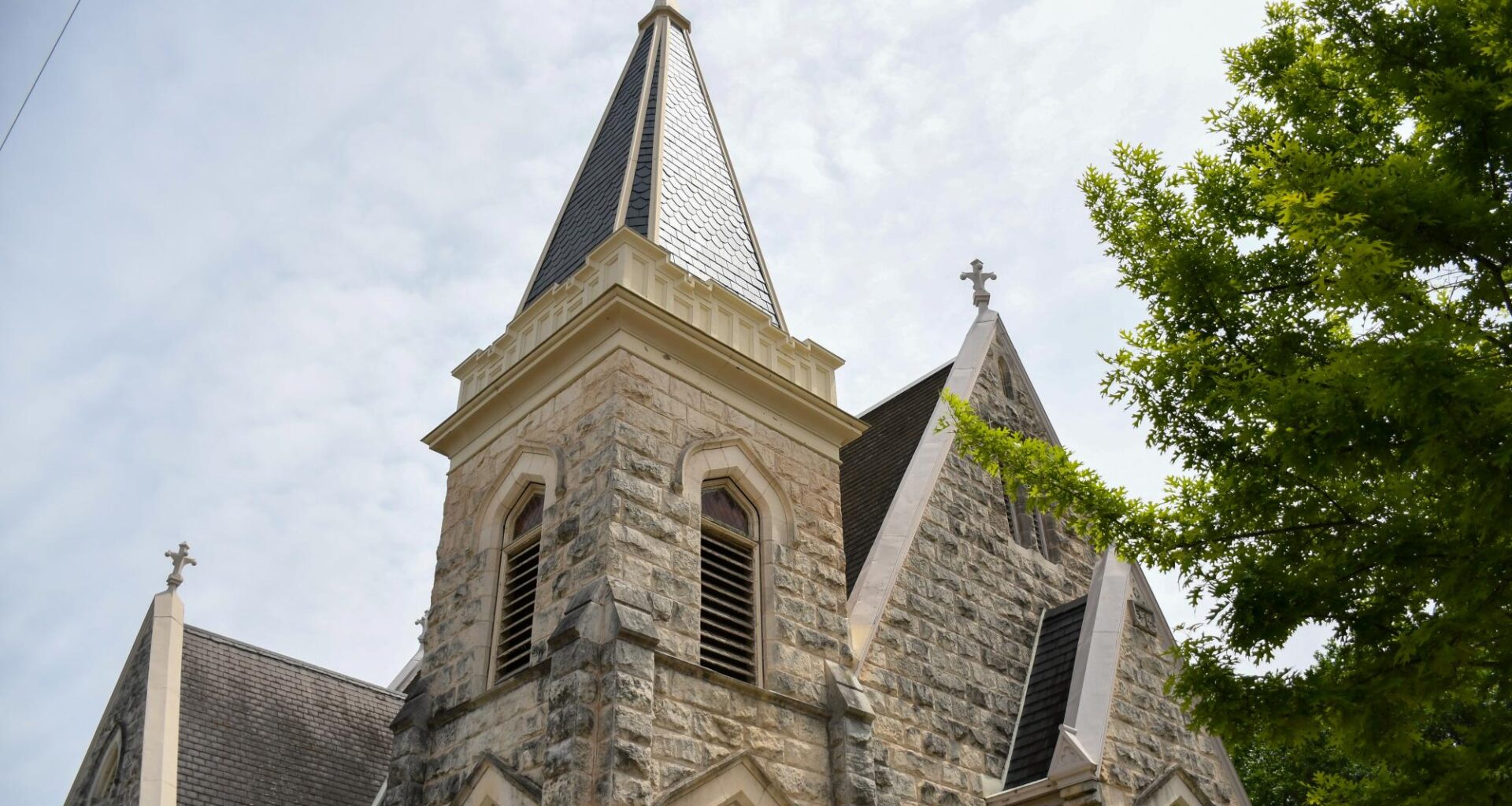
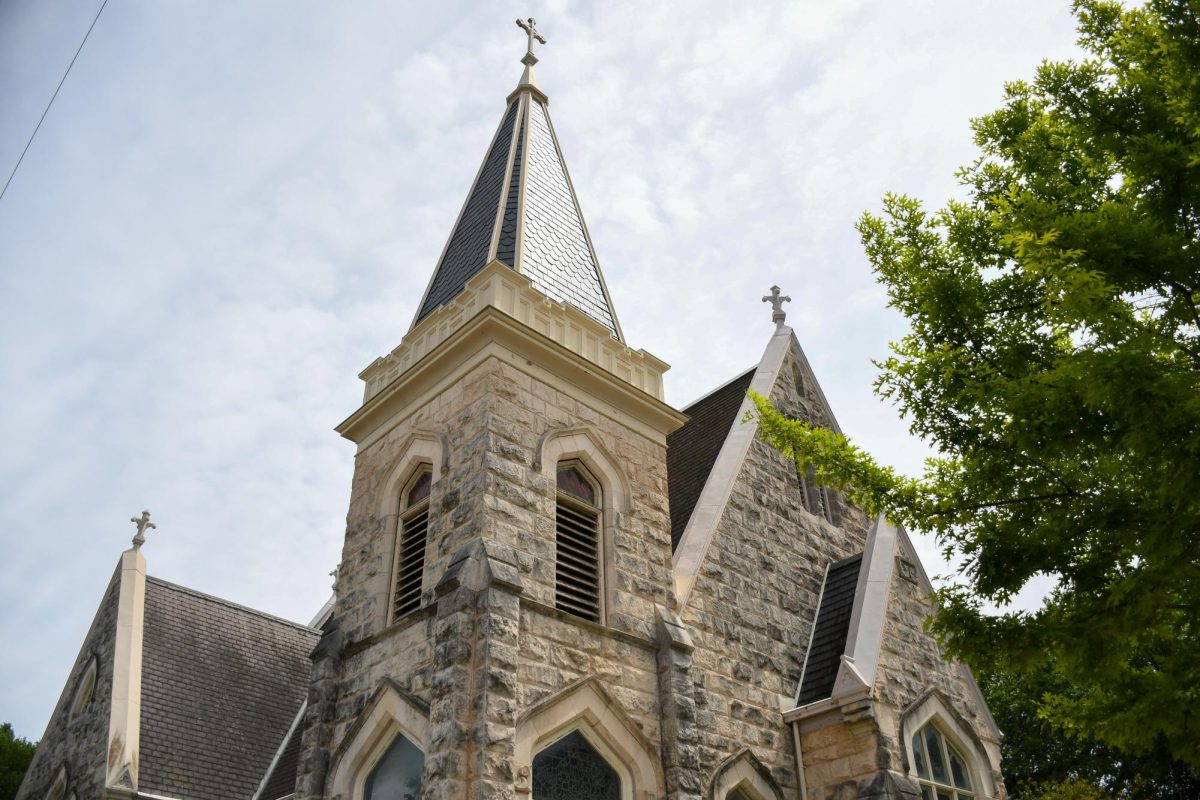
The All Saints’ Episcopal Church is pictured on April 7.
As students rush by the white plastic tables that line Speedway, hurrying from one class to the next, colorful arrays of signs and food line the road, many promoting religious organizations. On Guadalupe Street alone, at least three tan brick churches with red roofs stand. Venturing further into West Campus, students are greeted with the hand-drawn “Shalom Y’all” sign on Texas Hillel’s windows or the yellow house and pink bushes where the Nueces Mosque stands.
As young adults through generations have transitioned into college life, many have looked to faith groups to stay connected to their homes. Daily and weekly religious practices have been linked with greater reported life satisfaction and a decrease in depressive symptoms of people in their 20s, according to a 2018 study from Harvard T.H. Chan School of Public Health.
“Even secular studies show that if you have community in college, you’re more likely to graduate, be happy, all those things,” said David McMinn, pastor and executive director of Texas Wesley United Methodist campus ministry. “And we just want faith to be part of that.”
UT’s religious history
Religious groups have been a part of UT’s campus since its early days. At first, these groups were primarily Christian denomination churches. Over time, new communities arose, catering to different religions and groups around and within UT.
Just four years after UT opened in 1883, Reverend J.E. Stovall began services in Honey Chapel, a building on the UT campus owned by the Northern Methodist Episcopal Church. The church, now known as University United Methodist Church, moved to its current location on Guadalupe Street in 1909, according to its website.
The church is a large stone building located on Guadalupe Street. Six doors lean against the church’s walls, painted with each color of the rainbow. They are labeled with the words “Gods’ doors are open to all.”
“This church has also had a long history of being a progressive witness in this community,” said Megan Otto, director of campus young adult and senior adult ministries at UUMC. “People that were fighting for rights and going to protests and were really trying to be on the cutting edge of being as inclusive and as important as possible … that’s a great legacy to have.”
Another church near campus, All Saints’ Episcopal, was built in 1900. The church was affiliated with the first residence hall for female UT students, Grace Hall, which opened in 1897, according to the church’s website. Both the chapel and residence hall were built by Rev. George and Grace Kinsolving, who wanted to create a space for female students to live and receive religious instruction. Although Grace Hall was demolished in 1968, the chapel remained.
The church was created specifically to serve students. And it has done exactly that for over a century. By 1910, All Saints’ Episcopal Church regularly hosted student groups from UT, said Reverend Noah Stansbury, campus commissioner for Texas Canterbury, the ministry at All Saints’ Episcopal.
“It blows my mind to think about that — all the stories that have been told here, all the people who have walked through these doors, all the lives that have been changed,” Stansbury said.
UT did not have an official religious studies program until 2007. In the early 1900s, local churches raised money for “Bible Chairs,” or religious figures outside of the University who offered Christian religion classes to students.
“For a long time here, there was no way to study religion because many public universities felt there was a kind of broad consensus that universities were not a place where you could ‘teach religion,’” UT history professor Jennifer Graber said.
Texas Wesley United Methodist Campus Ministry was founded as a “Bible Chair” in the 1920s and has since evolved into a ministry located in West Campus. McMinn said pastors in Protestant and Catholic churches taught Bible and marriage classes to students up until around the 1970s.
Texas Hillel, a Jewish student organization, began meeting at an old house on West Avenue in 1927, according to the organization’s website. Hillel had to relocate to a loft off the Texas Theater building on Guadalupe Street due to a fire in the 1930s. As the Jewish student population grew, the Jewish community made donations to support the building of the current Hillel building, located on San Antonio Street. Other Jewish organizations arose later, such as the Chabad Jewish Student Organization, which began in 1970.
After World War II, Protestants built churches around campus to serve people inside and outside the university, according to Graber. More campus ministries, dedicated to bringing Christian students together in a faith-based environment, emerged during this time.
“There began to be a focus, especially among Protestant evangelicals, but eventually also Roman Catholics, to make sure they’re doing outreach to both high school and college-age students,” Graber said.
This focus on outreach was part of a larger movement in the ‘60s. Groups like Youth for Christ set up chapters across the country, including Texas, aiming to teach young people about Christianity, according to Graber.
In 1977, a group of Muslim UT students initiated efforts to convert an old house into the first mosque in Austin on Nueces Street. Before this, Muslims gathered at a local Methodist church, according to the Pluralism Project Archive at Harvard University, which researches and interprets religious history in America. The mosque still stands, though it is undergoing reconstruction to expand the space. The Nueces Mosque is also the first student-led mosque in North America.
Expanding and diversifying religious institutions
Many religious organizations saw themselves as creating change on campus in the early days, Graber said. Today, those efforts have expanded as organizations focus on increasing diversity and inclusivity in their communities.
“I think (early founders of religious groups at UT) saw themselves as stewards of the religious life of students on this campus, and the religious life of students looks really different than it did when they started,” Graber said.
Texas Gospel Fellowship, established at UT in 2001, is a Black Christian student ministry. It is part of a larger Christian organization called InterVarsity, which offers Christian ministries for students of different ethnicities.
Donovan Douglas, a mechanical engineering senior, has found a faith-based community through TGF. This is his second year leading the organization. He said the organization aims to create a welcoming and safe environment for students of all faith backgrounds.
“We’d like to be a safe space for Black students on campus who have questions about God, have questions about faith or just want to find a faith-based community,” Douglas said.
Douglas said while no religious organization is perfect for everyone, the important thing is finding a space that makes you feel comfortable. He said he found that comfortable space in TGF.
“(TGF) has been such an important part of my life … The moment I came to TGF, I was just filled with love,” Douglas said. “So many people there are my friends for life now. … I’ve said this several times to them, but it really is like a second family.”
Like TGF, OneWay South Asian InterVarsity is a branch of InterVarsity at UT. Elizabeth Johnson, a Plan II and psychology freshman, said that a cottage prayer with OneWay reminded her of the value of her community after the shooting on Sixth Street. Johnson described how they lay out blankets, sang, prayed and read Bible verses together.
“It was the first time we’ve done it in two years or so, but it was because of everything that’s been going on,” Johnson said. “I think everyone felt so much lighter afterwards. Everything felt really divided; South Asians were getting targeted, too. Everyone was kind of on edge.”
Kishen Misra, a business honors and finance sophomore, is a member of Hindu YUVA, a student organization dedicated to preserving and practicing Hindu cultural and spiritual practices. The organization arrived at UT in 2010, according to the Vivekananda House. Misra has met many of his friends through the organization, he said.
“(For) me, Hindu YUVA is a place where I can connect with my culture and my faith,” Misra said.
Mariam Daghestani, a Plan II and nutritional sciences sophomore, said she found community through Muslim Student Association and Nueces Mosque. This community has been especially valuable during Ramadan, the holiest month in the Islamic calendar where Muslims fast from sunrise to sunset, she said. During Ramadan, the Nueces Mosque hosted iftars, where people break their fast together, and morning prayers before sunrise.
“(During morning prayers,) it’s pitch black, and you’re waking up all alone,” Daghestani said. “And then you go to Nueces, you find that it’s lively and bubbly and people are awake and having that same fervor for Ramadan that you have.”
Texas Wesley Methodist hosts many small groups, including Recovering from Religion and an LGBTQ+ support group, McMinn said. McMinn emphasized the importance of community and creating spaces that support struggling students.
“Inclusive love is our cornerstone, in the sense of we want this to be a place for everyone, no matter what belief, what background,” McMinn said. “We want to be able to offer general opportunities for people to grow in faith together, and then more (specifically) if you have specific needs. … If you have community in college, you’re more likely to graduate, be happy, all those things.”
Building community in a politically charged environment
While religious diversity has increased across UT, a politically charged environment leads some communities to continue to feel unsafe on campus.
According to an American Jewish Committee 2025 report, 42% of American Jewish college students report experiencing antisemitism during their time on campus. Additionally, almost one-third of American Jews say they have been the personal target of antisemitism. At UT specifically, the Texas Hillel building was vandalized in late 2023 and March 2024.
“A place where students feel emotionally and physically safe is also important,” said Rabbi Stephanie Max, executive director of Texas Hillel. “So they can do the fun things and the silly things and the meaningful things without having to feel afraid.”
The Council on American-Islamic Relations reported they received 8,683 discrimination complaints involving Muslims in the United States in 2025, the highest number recorded since CAIR began tracking these incidents in 1996. According to Graber, there have been “some real conflicts about the presence of Islam in Texas.” Texas politicians excluded Islamic schools from the state’s new voucher program, and in Austin, three local mosques, including Nueces Mosque, were vandalized in May 2025.
“Muslims have been under a microscope,” Daghestani said. “Being a student in these times is very challenging, not only to figure out your beliefs, but figure out how those fall in line with your religion and how that works. But I think MSA has created a space for me to understand where I stand in all of this.”
The University Interfaith Council also aims to create an emotionally and physically safe network for students of all religions. The Council consists of religious leaders, some religious students and a representative from the University. According to Stansbury, the chair of the University Interfaith Council, the earliest reference to the Council appears in 2007. Today, the organization includes several religious organizations, including Texas Canterbury, Texas Hillel, UUMC, Texas Wesley and Nueces Mosque.
The Council has two main events: an interfaith dinner in the fall and a breakfast with the University President in the spring, said McMinn, a member of the council. The council also attends UT Remembers, an annual event that honors members of the UT community who passed away the previous year.
“There’s a mutual benefit to the University having a connection to (the University Interfaith Council),” Stansbury said. “One of the reasons that we do this interfaith work and try to provide opportunities for students to get outside of their silo, outside of their bubble, whatever it may be, is (that it is) actually a super important part of trying to form well-rounded people.”
The council hopes to unite students of many faiths.
“All of our faith communities, we don’t agree on everything, obviously, but there’s a lot we do agree on,” McMinn said. “There’s a lot we can come together on, and (one thing) all of us 100% agree on is the inherent value of human worth, that every person deserves dignity.”