
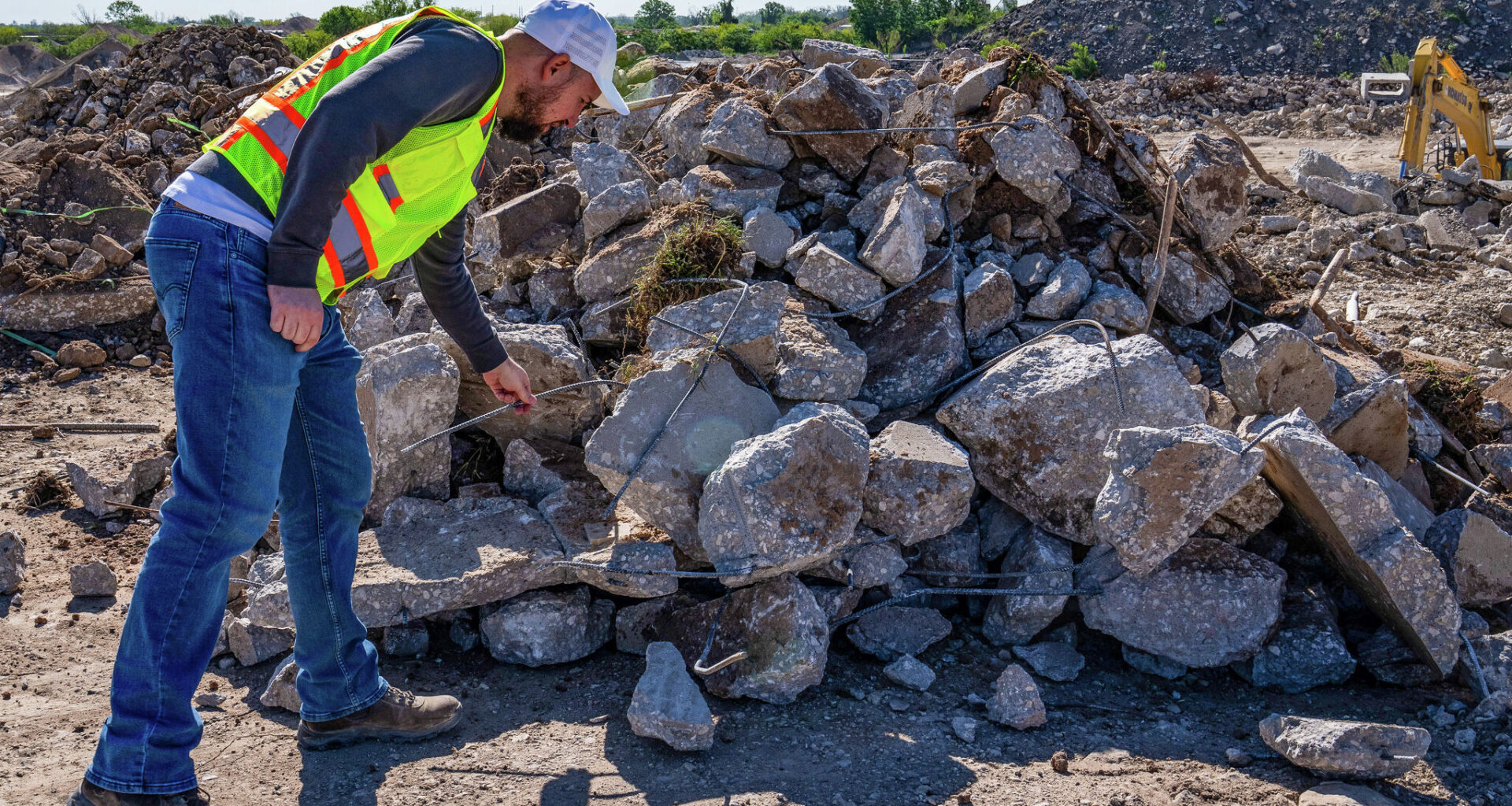
Will Fortney of RedSpark Website & Digital Marketing displays a piece of rebar at TexRock Aggregate Materials in Austin, Tuesday, April 7, 2026.
Mikala Compton/Austin American-Statesman
The Austin area is in the midst of a major construction boom. Crews across the city and throughout Central Texas are tearing up roads to make room for bigger roads and knocking down bridges to build bigger bridges.

All that demolition leaves behind tons of concrete, asphalt, limestone and rebar. Where does it go? Instead of heading to a landfill, much of it ends up in a giant pile in East Austin outside Paul Gregory’s office window.
Article continues below this ad
Gregory ownsTexRock Aggregate Materials, a recycling yard about 4 ½ miles from Austin’s largest ongoing road construction project — a complete rebuild of Interstate 35 through the city. For 11 hours a day, six days a week, dump trucks roll in carrying rubble from that project and others in the area.
The company crushes and processes the debris into new materials that are shipped back out to road crews, often to the same job site it came from.
“Essentially, I-35 will be demolished, brought here, crushed, brought back to the job site, and made into a new highway,” Gregory said in an interview.
Standing on aggregate materials, founder Paul Gregory discusses the process of concrete recycling at TexRock Aggregate Materials in Austin, Tuesday, April 7, 2026.
Mikala Compton/Austin American-Statesman
Each day, TexRock receives about 1,500 tons of concrete from demolition work around town. The material is dumped into a big pile, then fed into a series of machines that pull out the rebar and crush the concrete into smaller pieces. Once small enough, the pieces fall through screens and are sorted by size. Rebar is sold for scrap, while the crushed concrete is moved into separate piles to be sold. Asphalt and limestone go through a similar process.
Article continues below this ad
“We’re not just making big rocks into little rocks,” Gregory said. “It has to have a certain gradation of fine, middle-sized and large-sized rock, and it has to have low clay content.”
Those specifications are strict. Gregory’s crew conducts its own testing, and the Texas Department of Transportation also sends samples to a lab to ensure the material meets requirements. A highway, Gregory said, is “like a big layer cake,” with each layer requiring a different type of aggregate.
TexRock sells 18 different products, “and there is a science to each one,” Gregory said.
Article continues below this ad
On a busy day, TexRock might send 250 truckloads of recycled material through the gate — 4,000 tons of stuff that would otherwise wind up in a landfill.
Founder Paul Gregory discusses the process of concrete recycling at TexRock Aggregate Materials in Austin, Tuesday, April 7, 2026.
Mikala Compton/Austin American-Statesman
TexRock has been operating since 2024, and business has grown alongside the region’s development boom. It’s a competitive, low-margin industry, Gregory said, with several companies offering similar services in Austin. But TexRock’s proximity to downtown gives it an edge, allowing contractors to save on transportation costs.
Gregory boiled down his pitch this way: “It’s cheaper, closer and meets your [specifications]. Come get it.”
Article continues below this ad
Aggregate recyclers maintain what Gregory called a “symbiotic relationship” with the demolition and construction industries. Demo crews have a place to dump their rubble, while construction contractors can buy materials that are both cheaper and more sustainable than newly mined, or “virgin,” aggregate.
“These products are needed, and it’s saving landfill space. It’s not producing greenhouse gasses,” Gregory said. “To me, it’s the highest form of recycling. You’re doing the right thing, and yeah, we make a little money along the way.”
Statewide, the state Department of Transportation uses about 1 million tons of recycled concrete each year. The agency says the practice provides both environmental and economic benefits.
“Reusing one million tons of recycled concrete in new pavement reduces greenhouse gas emissions by the equivalent of 46,000 metric tons of carbon dioxide,” according to TxDOT’s website.
Article continues below this ad
A machine sorts through and breaks down concrete at TexRock Aggregate Materials in Austin, Tuesday, April 7, 2026.
Mikala Compton/Austin American-Statesman
That demand, coupled with Central Texas’ rapid growth, suggests steady work ahead for Gregory and his eight-man crew.
“Austin’s probably the fastest growing community in the country,” Gregory said. “We’re going to be doing lots and lots of this. There’s good job security here.”
Article continues below this ad
As long as the region keeps rebuilding itself, the material from yesterday’s roads will continue to form the foundation of tomorrow’s.