
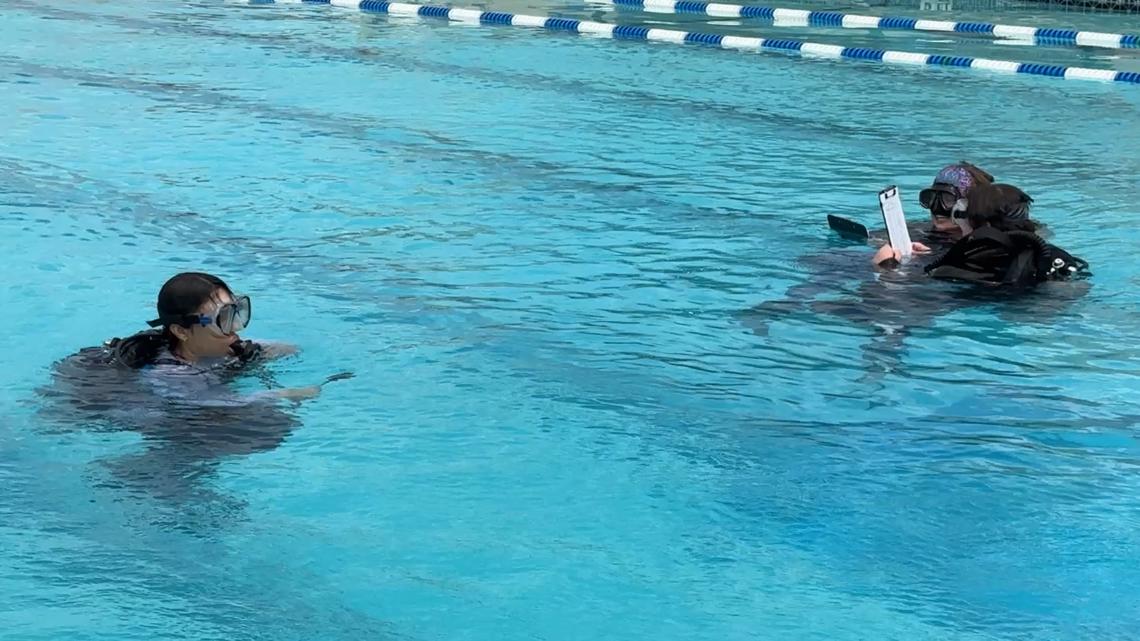
Students at Texas A&M-Corpus Christi are training as scientific divers, preparing for fieldwork while raising awareness of Texas reefs.
CORPUS CHRISTI, Texas — In the University Pool at Texas A&M University–Corpus Christi, students are getting a close-up look at what it takes to study coral reefs — without ever entering the ocean
RELATED: Tiny but dangerous: ‘Blue dragons’ washing up on Texas beaches, Harte Institute warns
The hands-on training is designed to mirror real-world fieldwork, giving marine biology students a chance to practice the same techniques used by National Oceanic and Atmospheric Administration scientists to monitor reef health over time.
“So today what we’re doing is we’re simulating an event in which we can train students of looking at our coral reefs long term,” said Keisha Barr, Chair for Coral Reef and Ocean Health at the Harte Research Institute.
Barr said the goal is to move beyond traditional classroom learning and prepare students for the realities of working underwater.
“These are methods that are used by NOAA to understand how ecosystems change over time and particularly how coral reefs might be changing over time,” she said. “We want to have a controlled environment where the students can learn.”
Most of the students participating are pursuing degrees in marine biology, ranging from undergraduate to graduate levels. The training focuses on building skills needed for scientific diving — a discipline that goes beyond recreational exploration.
“It’s different from regular diving,” Barr said. “You’re not just going and looking at things. You’re actually actively working underwater, and we want to make sure that they’re collecting really sound data and they’re really safe when they’re doing so.”
The program emphasizes hands-on experience, something Barr said is often missing from traditional coursework.
“This is actually putting that knowledge to use and showing them that this is what it would be like if you wanted to get a position or a job in marine biology,” she said. “It helps students understand, ‘Oh, I really like this’ or ‘I don’t really like this,’ so they know that before they go into the field.”
Beyond career preparation, the training also plays a role in environmental stewardship.
“If students understand how we collect data to look at how coral reefs or oyster reefs change over time, they become stewards of the environment,” Barr said. “They understand the importance of doing this research so that they can better take care of these reefs and our marine ecosystems over time.”
The simulation uses life-size maps of the Flower Garden Banks National Marine Sanctuary — a reef system about 100 miles offshore that Barr said many Texans don’t realize exists.
“It is one of the healthiest coral reefs that we have in this side of the world,” she said.
Barr said raising awareness is a key part of the effort, especially as coral reefs face ongoing threats from environmental changes.
“When people think about coral reefs, they think they’re in Hawaii or Florida,” she said. “These are stellar reefs that we have right here off the coast of Texas, and a lot of people don’t know about them. We want to make sure that they’re there for future generations,” Barr said.