
Anna Membrino disassembles illusion in her latest show, Dew, at Erin Cluley Gallery in Dallas. Space never fully settles in her large-scale landscape paintings. The more closely they are observed, the more the images unravel, moving farther from a human perspective.
 Anna Membrino, “Drift,” 2026, acrylic on canvas, 65 x 72 inches
In Drift (2026), stemmed leaves arch across the top of the canvas, their overlapping edges assembling into a continuous curvilinear form — but the internal structures of the leaves diverge along their own paths. Here, the form is both unified and broken, a slight contradiction that builds.
Below, a deep emerald mass rises from the lower left corner — a shore’s edge that extends into the sky. Membrino begins her process by pouring thinned paint down the canvas at odd angles. These washes are visible in the rock forms of the shore, whose boundaries are defined by an opaque field of rippling water. Here, a second tension is established between the fluid, atmospheric landmass and the thick, densely rendered river. A third emerges in the bright pink sky, which flattens the image and pushes itself in front of the leaves.
Through these interactions, Membrino sets up a compositional pressure that pushes the painting past the illusory. She works within a fairly narrow vocabulary — fields of color, long masked passages where she grooms thinned paint into distinct channels, and open areas of layered washes. The paintings share the same four elements — foreground plant, water, rocks, and sky — each created in response to the others.
 Georgia O’Keeffe, “Purple Leaves,” 1922, oil on canvas mounted on board, 9 x 12 x 3/8 inches. Collection of the Dayton Art Institute
Drift recalls Purple Leaves (1922) by Georgia O’Keeffe. In Purple Leaves, we look down at a pile of leaves. A single leaf dominates as it arches across the canvas, but its form is quickly lost in the accumulation. In O’Keeffe’s rendering, we begin to appreciate the nuances of a leaf’s shape. The positive contour of its undulating outline creates a mirror image in the negative. With continued looking, recessive shadows become prominent, turning into leaf shapes themselves. Perspective disorients and the picture plane begins to collapse. The spatial structure breaks down through subtle, overlapping variations in value, and the work settles into a dialogue of shifting space.
Like O’Keeffe, Membrino does not treat observation as passive description. The background imagery comes from photographs the artist takes on walks through nature; the foreground comes from painted plants she photographs in her studio. Through cropping these references and distorting their colors in Photoshop, the images detach from their source and build their own logic once painted. But where O’Keeffe maintains a believable relationship between viewer and subject — a body standing somewhere — Membrino does not. Her images are composited from incompatible sources, creating a world that no longer belongs to embodied vision.
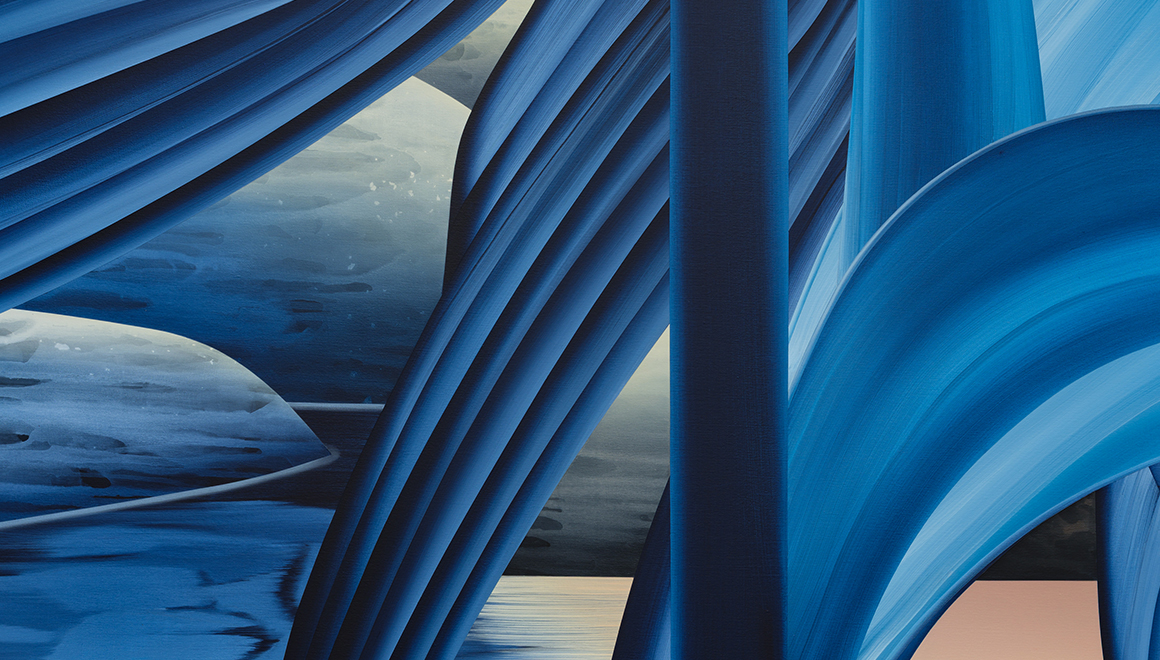
In Drift, the initial impression of looking through a few stemmed leaves gradually unravels. When viewed in segments, Membrino’s ability to redirect the viewer and tie the composition into knots becomes apparent. If we enter the painting head-on, looking through the arch of leaves, we sense its depth. Entered from the upper left, where electric cyan striations fan out into the canvas, the composition becomes completely disorienting, losing its spatial sense until we land on the leaf in the lower right quadrant.
 Anna Membrino, “Dew,” 2026, acrylic on canvas, 65 x 65 inches
A second painting, Dew (2026), shows how Membrino’s established system can be subtly recalibrated. In the foreground, a dark band of stem interrupts the composition, creating an off-center barrier between groupings of cyan and indigo leaves. Both create self-contained illuminated fields that remain untouched by the golden dusk light entering from the right. These leaves amass into nearly unrecognizable forms.
In the background, the shore and partially submerged river rocks are awash in a sienna-gold light. This field is separated from the stems by a deep space articulated through open, atmospheric rendering, creating a believable sense of depth. This space is undercut in the lower right corner, where a flat, rose-tinted shark fin wedges its way into the painting — an open seam that breaks the perspectival order. Even so, Dew sustains a deeper illusion than Drift. And the encompassing scale of both works draws the viewer in, suggesting these might be habitable spaces after all, even if the works ultimately resist.
Membrino paints from experience — these are rivers she has walked along. As these places are revisited in painting, they change. Like memory, they lose fidelity as they are reconstructed, pieced together from fragments. This instability gives the paintings their tension. They reflect the struggle to contain the past and reach resolution only when they push back.
Anna Membrino: Dew is on view through May 9, 2026, at Erin Cluley Gallery in Dallas.