
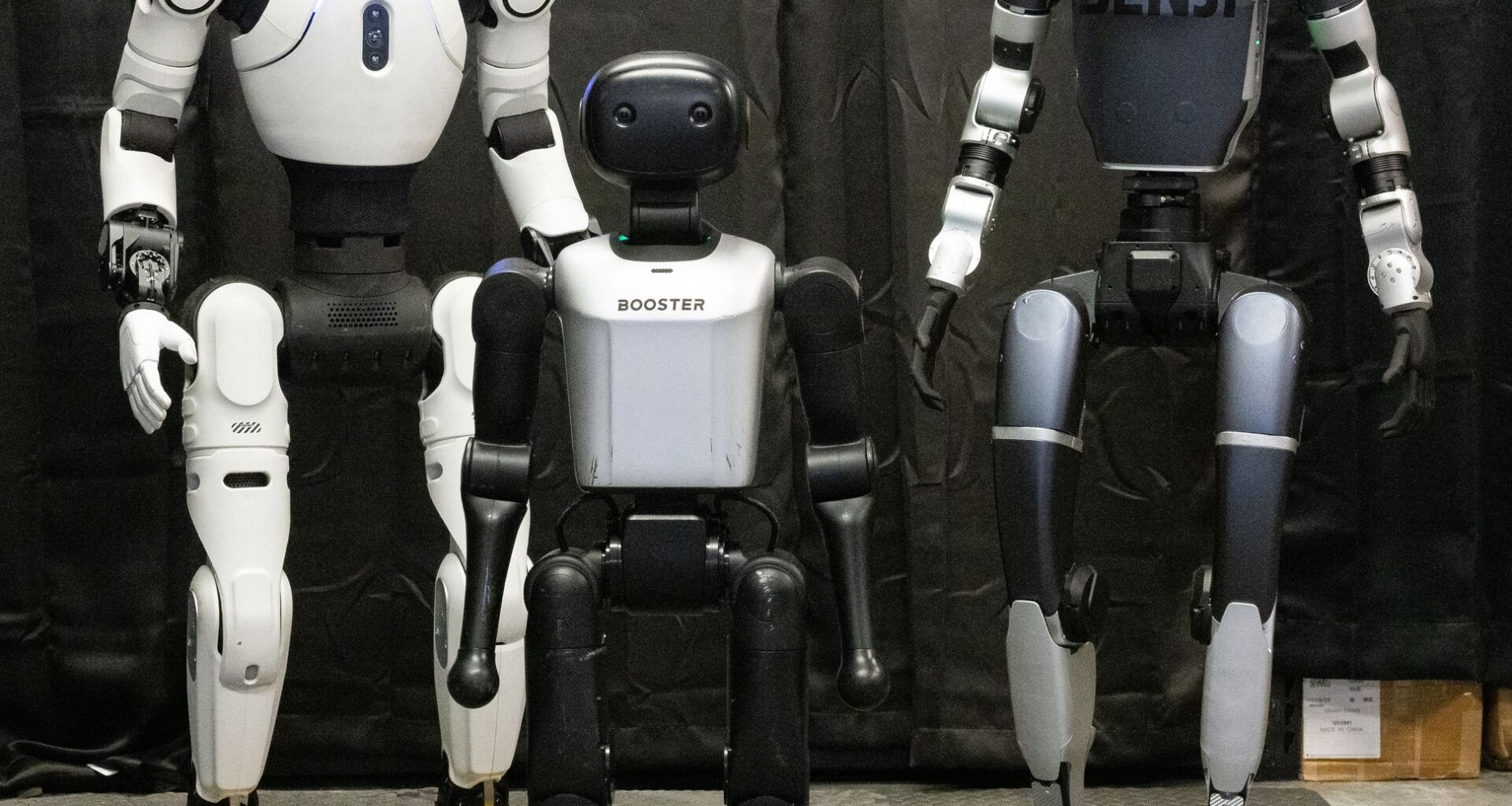
(From left) The AGIBOT X2 Ultra named “Buzz”, a Booster K1 EDU named “Stewie”, and the Unitree G1 named “Benji” at the Robot Studio in Dallas, Friday, April 17, 2026.
Juan Figueroa/The Dallas Morning News
A Booster K1 EDU named “Stewie” dances at the Robot Studio in Dallas, Friday, April 17, 2026. The AGIBOT X2 Ultra named “Buzz” is seen in the background.
Juan Figueroa/The Dallas Morning News
Inside an office in North Dallas, Buzz doesn’t miss a beat. He swings his arms to Zara Larsson’s viral “Lush Life” dance, a routine he has repeated at parties and corporate events across North Texas. But Buzz is no ordinary dancer: He’s a 4-foot-tall humanoid robot, part of The Robot Studio Dallas, a startup betting that robots can be the life of the party.

The company is part of a broader shift in which robots are coming into public view. In recent months, videos of a humanoid robot wearing a cowboy hat and casually walking through downtown Austin have spread online. Closer to home, a video of a robot strolling through DFW International Airport went viral in January — and that robot turned out to be from The Robot Studio’s fleet. Elsewhere, clips from China show robots performing martial arts routines and even running races.
Article continues below this ad
“We don’t have humanoid robots that are doing your housework and working in factories yet,” said Mark Spong, a roboticist at the University of Texas at Dallas, who is not affiliated with The Robot Studio. “There’s a question if they ever will, but the entertainment industry, I think, is perfect for them.”
A Booster K1 EDU named “Stewie” dances at the Robot Studio in Dallas, Friday, April 17, 2026. The AGIBOT X2 Ultra named “Buzz” is seen in the background.
Juan Figueroa/The Dallas Morning News
From scroll to startup
Aaron Mehdizadeh, founder of The Robot Studio, has long been interested in robots. About eight months ago, he got the idea for his company while scrolling on social media and seeing that businesses in China were offering robot rentals.
Article continues below this ad
“I was like, I really want a robot, that sounds like a cool business model,” said Mehdizadeh, 29, who also runs a medical and pharmaceutical supply company. “No one in America has caught on to it yet, because, unfortunately, we’re a little bit behind where [China is] on this front.”
Make Dallas News a preferred source so your search results prioritize writing by actual people, not AI.
Add Preferred Source
In the months since, Mehdizadeh has acquired seven humanoid robots, each costing between $30,000 and $50,000. The tallest — Buzz and Benji — stand a little over four feet and were made by manufacturers Agibot and Unitree, both based in China. (Unitree also made the robot seen wandering Austin in the summer of 2025.) The smallest, named Stewie after the toddler on Family Guy, stands just over three feet. With his Coraline-like button eyes, Stewie is described as the best dancer in the startup’s fleet and was made by Booster Robotics, also based in China.
CTO Pushkar Shinde (left), and founder Aaron Mehdizadeh chat at the Robot Studio in Dallas, Friday, April 17, 2026. (From left) The AGIBOT X2 Ultra named “Buzz” and a Unitree G1 named “Benji” are seen in the foreground.
Juan Figueroa/The Dallas Morning News
Business was initially slow after the company was founded in 2025, Mehdizadeh said, but picked up after the 2026 Consumer Electronics Show, which featured artificial intelligence-powered humanoid robots.
Article continues below this ad
“Suddenly, people are searching, ‘Where can I rent a robot?’ Over the past two or three months, I would say, it’s kind of exploded,” Mehdizadeh said. “We’re renting robots all over the United States.” Recent bookings have included an AI summit in New York City hosted by Morgan Stanley and an event for the Dallas chapter of the Young Presidents’ Organization.
Renting robots for entertainment is a relatively new and niche market, with only a few companies in the United States offering such services. The starting price to rent one of The Robot Studio’s humanoid robots is $1,000 for two hours; larger bookings can run up to $12,000 for multiday, out-of-state events. The robots are made to do whatever the client wants, whether it is to dance or hold short conversations or promote a product. The machines are not fully autonomous; their movements are determined by a mix of programming and someone controlling them in real time.
Pushkar Shinde, chief technology officer at The Robot Studio, studied robotics at New York University. He said it can take several hours to program a robot’s dance. The process typically involves mapping out the choreography and translating it into code the robot can follow, using a coordinated sequence of motors that work together to maintain balance. Through reinforcement learning, the robot is trained to move its arms and legs in sync, allowing it to perform dancelike motions without falling.
CTO Pushkar Shinde prepares to demonstrate the Booster K1 EDU named “Stewie” at the Robot Studio in Dallas, Friday, April 17, 2026.
Juan Figueroa/The Dallas Morning News
When robots meet people
Roboticist Yiwei Lyu, who studies human-robot interactions at Texas A&M University, said ventures like The Robot Studio can help people better understand how robots are engineered and programmed, shaping expectations and building trust — both key to successful human-robot interactions.
Article continues below this ad
“You want to make sure the robots behave in a way that can be understood by humans,” Lyu said. “Basically, the quality of these interactions is going to shape how humans change their expectations. This is very important because if somehow the quality of the interaction is not very good, the human might feel discomfort or unsafe.”
As robotics research expands into public-facing sectors such as education, health care and hospitality, ensuring positive, safe experiences with robots will be critical, Lyu said.

By signing up, you agree to our Terms Of Use and acknowledge that your information will be used as described in our Privacy Policy.
While many clients rent the robots to showcase how tech-forward they are, ensuring positive experiences is a priority for the startup, Mehdizadeh said. He said the company focuses on robots that appear friendly and approachable to help ease concerns about automation among those who interact with the robots.
Article continues below this ad
(From left) Natalie Reese, operations, robot operator Claire Dewine, CTO Pushkar Shinde, and founder Aaron Mehdizadeh, pose with robots: a Booster K1 EDU named “Stewie,” the AGIBOT X2 Ultra named “Buzz” and the Unitree G1 named “Benji” at the Robot Studio in Dallas, Friday, April 17, 2026.
Juan Figueroa/The Dallas Morning News
To that end, the startup plans to add a new cast member to its fleet next month: a bright orange, fox-like humanoid on wheels known as Mirokai, developed by Enchanted Tools, a French company.
“Robotics is definitely going to be mainstream in the future, because a lot of companies are doing it,” said Shinde. “I always try to relate it to the car analogy. Every year, we get a new car, a new design, a new aspect, a new vibe. … Creating a good vibe, creating a wow factor and really getting advanced engineering, that’s what we want to be.”