
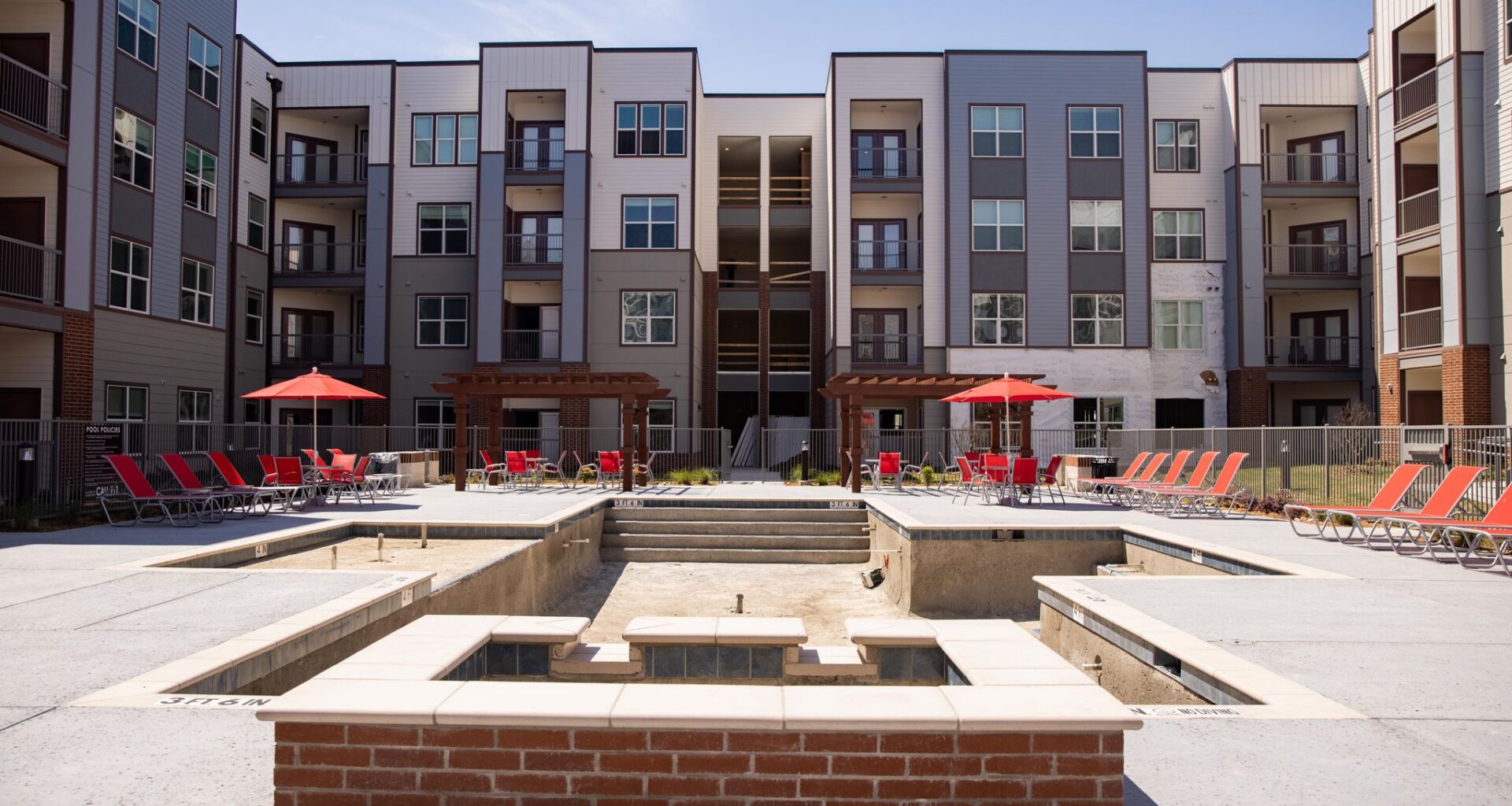
The almost finished swimming pool area of the Palladium RedBird apartments, a project backed by the Dallas Housing Finance Corporation. (Juan Figueroa/The Dallas Morning News)
Juan Figueroa/Staff Photographer
After pushback from developers, housing groups, city council appointees and council members, the city has backed off of a proposed policy that discouraged building more affordable housing in lower-income neighborhoods in Dallas.

A revised proposal, which reversed those measures, is set for a vote at Wednesday’s council meeting.
Article continues below this ad
Civil rights advocates say the reversal represents a potential lost opportunity to begin addressing decades of issues associated with placing one affordable housing project after another in Dallas’ most impoverished neighborhoods.
The earlier proposal, civil rights attorneys say, could have made a dent in the stark divide between whiter and wealthier northern Dallas and southern Dallas, which has proportionately more Black and Hispanic residents with lower income levels.
Opponents of the earlier proposal called it well-intentioned. But, they argued, because it’s hard to finance that type of housing where land is more expensive, the proposal would hinder production of high-quality affordable housing when Dallas needs it more than ever.
Make Dallas News a preferred source so your search results prioritize writing by actual people, not AI.
Add Preferred Source
The new proposal comes after more than a year of back and forth between the city’s housing department and two city-backed nonprofit corporations that help finance low-income housing.
Article continues below this ad
Those who say southern Dallas has enough low-income housing said they weren’t happy with the earlier proposal, but even less so with the latest one.
“It’s gone from bad to worse,” longtime housing activist Darryl Baker said. “We’re back in the same soup we were before.”
Details of the proposal
The revamp of city policy began in late 2024, when two nonprofit corporations the city uses to help create affordable housing began backing more projects, catching council members’ attention. Housing is considered “affordable” when it costs 30% or less than the household’s income, and Dallas, like many cities across the country, is in short supply. Experts say Dallas needs more than 45,000 new units affordable to people making less than half the area’s median income.
Article continues below this ad
Both corporations are overseen by boards of 15 volunteers, each appointed by city council members and the mayor. Corporation staff share office space and are run by the same general manager, but have different missions.
The Dallas Public Facilities Corporation backs housing projects — usually apartment complexes — where at least half of the units are affordable for people at or below 80% of the area median income (around $90,000 a year for a family of four). Partnering with the corporation gives the owner decades-long property tax exemptions — financial relief that allows the landlord to charge lower than typical rents for people who meet the income requirements. The rest of the complex charges the market rate.
Council members Lorie Blair and William Roth listen as Keith Pomykal, president of the Dallas Public Facilities Corporation board, speaks during open mic before the Dallas City Council is briefed on the state of housing at Dallas City Hall in Dallas, Wednesday, April 1, 2026.
Juan Figueroa/The Dallas Morning News
By contrast, the Dallas Housing Finance Corporation backs housing that’s affordable to people making at or below 60% of the area median income. Most DHFC projects are apartment complexes financed through a complex method involving federally issued tax credits, bonds issued by the corporation, and a property tax exemption. Some projects are new construction, others are renovations.
Article continues below this ad
Together, the corporations have helped finance about 11,000 low-income units, including some under construction. In 2024, the two corporations delivered 77% of the affordable units in the city, according to data compiled by the Child Poverty Action Lab, a nonprofit that studies housing trends in Dallas.
Deals backed by both corporations have to be approved by a simple majority of the city council.
City staff proposed new rules for both corporations, as well as for affordable housing financed with tax credits that require city approval but don’t involve the DHFC. Many of the proposed rules were aimed at chipping away at the concentration of poverty that has persisted in the southern portion of the city.
“We have to screen for concentration of poverty and work on deals that can benefit neighborhoods more than we’ve ever had to before,” city housing director Thor Erickson told members of the council’s housing committee in February.
Article continues below this ad
Erickson proposed using the DPFC to build in higher-poverty areas, as a way to bring market-rate units, and more income, into those neighborhoods.
And he proposed using the DHFC to give lower-income families more options in wealthier neighborhoods. The proposal would also have made it harder to put other properties financed by tax credits in areas with high poverty, a lot of other tax credit properties, or that were federally designated as racially and ethnically concentrated. Overriding those criteria for tax-credit properties would have required a two-thirds majority by city council.
Thor Erickson, director of the Office of Housing and Community Empowerment, prepares to brief the Dallas City Council on the state of housing in the city at Dallas City Hall in Dallas, Wednesday, April 1, 2026.
Juan Figueroa/The Dallas Morning News
New tax credit properties in higher poverty areas had to address slum, blight, or other nuisances, or be next to gentrifying areas.
Article continues below this ad
City staff knew following the plan wouldn’t be easy, but said it was important.
“This should be a priority,” Erickson said. “To bring affordable units where they’re hard, market rate units where they are hard, and take advantage of everything that the PFC and HFC have to offer.”
The Baker complaint
In 2021, longtime civil rights attorneys Mike Daniel and Laura Beshara submitted a 35-page complaint to the U.S. Department of Housing and Urban Development about where the city has allowed tax credit properties. Although HUD doesn’t run the tax-credit program, the agency has responsibility for enforcing the act with regard to the city’s role in the program.
Article continues below this ad
With Baker as the complainant, the attorneys cited research documenting the challenges people face when they live in low-income neighborhoods. Concentration of poverty is associated with high crime rates, increased health problems, unemployment and other problems, the attorneys wrote.
The attorneys alleged the city and DHFC have violated the Fair Housing Act by putting most tax credit properties in the southern part of Dallas.
In an interview, Daniel and Beshara said the city’s proposal would have partly addressed the allegations in the complaint to HUD.
“It would have been a step toward addressing those harms,” Beshara said.
Article continues below this ad
The complaint was under investigation by HUD for several years. The attorneys told The Dallas Morning News they withdrew the complaint last fall to consider other litigation strategies against the city.
The News asked city spokespeople whether the earlier proposal to steer tax credit properties into lower poverty census tracts was related to the complaint, but received no response.
Since then, Baker and like-minded neighborhood activists have told city council members they want a moratorium on using the tax-credit program — for both new construction and renovations — in the city’s southern sector.
Baker, who lives in the Red Bird neighborhood southwest of downtown, told The News he wants the city to instead put its efforts into single-family homes and economic development.
Article continues below this ad
“What we need are rich people, high-end jobs,” Baker said. “Salaries, not wages.”
Baker said he views renovating existing tax-credit properties there as problematic, too.
“They are forcing people to stay poor on that side of town,” he said, “as opposed to having opportunities to thrive and to do better.”
Pushback
After the city released its proposal in February, pushback was fierce.
Article continues below this ad
Housing developers voiced opposition at city council meetings. A trade group representing the affordable housing industry sent letters of protest. The Dallas Housing Coalition, a nonprofit that advocates for affordable housing and counts charitable foundations, banks and developers as sponsors, also opposed restrictions tied to poverty rates.
And presidents of the DHFC and DPFC addressed council members, saying that while the proposed policies were well-intentioned, they were also too restrictive.
“I would advocate that we do not mess with success,” DPFC board president Keith Pomykal told city council in April. “Needing a two-thirds council vote approval for exceptions will also be a high bar to meet, and discourage more housing development.”
DHFC president David Ellis told council members he was skeptical that placing tax credit properties in high-poverty areas concentrates poverty. “This is just a theory,” he told council members at the same April meeting. “There have been no studies at all.”
Article continues below this ad
(From left) Anthony Page, Secretary of the Dallas Housing Finance Corporation board, and David Ellis, president of the Dallas Housing Finance Corporation board, listen as the Dallas City Council is briefed on the state of housing at Dallas City Hall in Dallas, Wednesday, April 1, 2026.
Juan Figueroa/The Dallas Morning News
Ellis also told The News in an interview that financing tax credit properties in lower poverty areas is difficult because the land price is often too high to make the deal work. Projects funded with tax credits also offer the chance to put high-quality housing in areas that don’t have much of it. And like Pomykal, Ellis said he was worried that too many restrictions would scare developers from attempting to build affordable properties in the city.
Chad West, who represents north Oak Cliff in District 1, has been the most outspoken council member against the city’s proposal.
“On several occasions over the past year,” he wrote in a March memo, he requested the housing staff “provide evidence to support its assertion that census tract poverty rate restrictions on new development projects are needed to avoid further concentrating poverty.”
Article continues below this ad
He never received any, he wrote.
For several of its provisions, the city had called for further scrutiny when census tract poverty rates were over 20%.
West said setting a demarcation at a 20% poverty rate was a “rudimentary location policy.”
In an interview, West said he thought city staff’s concerns were justifiable, given the city’s history of concentrating low-income housing in parts of the city where minorities are located.
Article continues below this ad
But West said he wanted more information about the impact of putting low-income housing in low-income areas.
“Does that correlate directly with enhancing the poverty level of the area?” West asked. “I’d like to know that, and just saying it does not — in my mind — mean that it is true.”
Council member Chad West speaks during a Dallas City Council briefing on the state of housing in the city at Dallas City Hall in Dallas, Wednesday, April 1, 2026.
Juan Figueroa/The Dallas Morning News
Both West and Ellis, the president of the DHFC, told The News they were unaware of Baker’s complaint. The DHFC is in the process of engaging UT Southwestern professor Tammy Leonard to study the impact of tax-credit properties in Dallas.
Article continues below this ad
Housing director Erickson has said the 20% threshold was in line with previous housing priorities and requirements for a two-thirds vote were intended to invite more scrutiny, not be deal breakers.
“While you could say 40% poverty is where you really need to start paying attention, a lot of our neighborhoods have been at 20%, 30%, 40% poverty for decades,” he told the DHFC’s board of directors in January. “All the investments that have been made in previous projects have not changed that course. So you have to ask, why would this project?”
Erickson also addressed questions about whether tax credit properties further concentrate poverty in already low-income areas at a February meeting of the city council’s housing committee. Even though tax credit properties set rent affordable for incomes as high as 60% of the area’s median income (currently about $70,000 for a family of four), many tenants earn far less, he said. That’s because many people who live in tax credit properties receive housing vouchers to help pay rent they couldn’t otherwise afford.
State data shows that of the 115 active tax credit properties in Dallas, all but a handful reported that they contained households that received government assistance. Not all households reported their income, but of about 18,000 households, 8,670 reported income at or below a level very close to the poverty level.
Article continues below this ad
Up for vote this week
In an April 1 briefing, council members heard from experts about the need to build more affordable housing in Dallas, that many tax-credit properties are aging out of their legal requirements to charge rent affordable to certain income levels, and weighed in on the city’s proposal.
In response, the city backed off on some of the proposal’s strongest provisions, loosened others, and released a new version last week for consideration at Wednesday’s council meeting.
Daniel and Beshara, the civil rights attorneys, see it as part of a pattern in Dallas.
Article continues below this ad
“While they had some ideas, they have now been removed,” Beshara said. “Once again, we’re left with nothing.”
Gone are all requirements for a two-thirds threshold to build in high-poverty areas. That provision would have made it easier to tank deals, something its opponents worried would scare off developers.
And the proposal up for vote this week now contains additional criteria that warrant building tax credit properties, including increasing rent burdens and loss of existing affordable units.
“Thanks to a lot of folks speaking up,” West said in a text message to The News, the proposal has “been loosened to include virtually all the reasons that would justify building tax credit projects in higher poverty areas.”
Article continues below this ad

By signing up, you agree to our Terms Of Use and acknowledge that your information will be used as described in our Privacy Policy.
DHFC board president Ellis echoed that sentiment.
“This language does not prohibit a new project,” he said, “being built in the southern sector. It just has to address certain conditions of that neighborhood.”
The city council is expected to decide Wednesday.