
Join us on a journey to better understand Houston, one question at a time. Sign up to get the Houston Explained newsletter in your inbox every Tuesday and Friday.
Houston is diverse. Houston is accepting.
These are core tenets of our city’s culture and identity, dogma repeated with pride by so many writers (guilty as charged), politicians, suits and even activists that it can be easy to forget that they’re only half true. We hide behind them when confronted with the truth that Houston, as lovely as she is, is often an unjust city where inequality runs so deep it has seeped into the very soil, and even onto our maps.
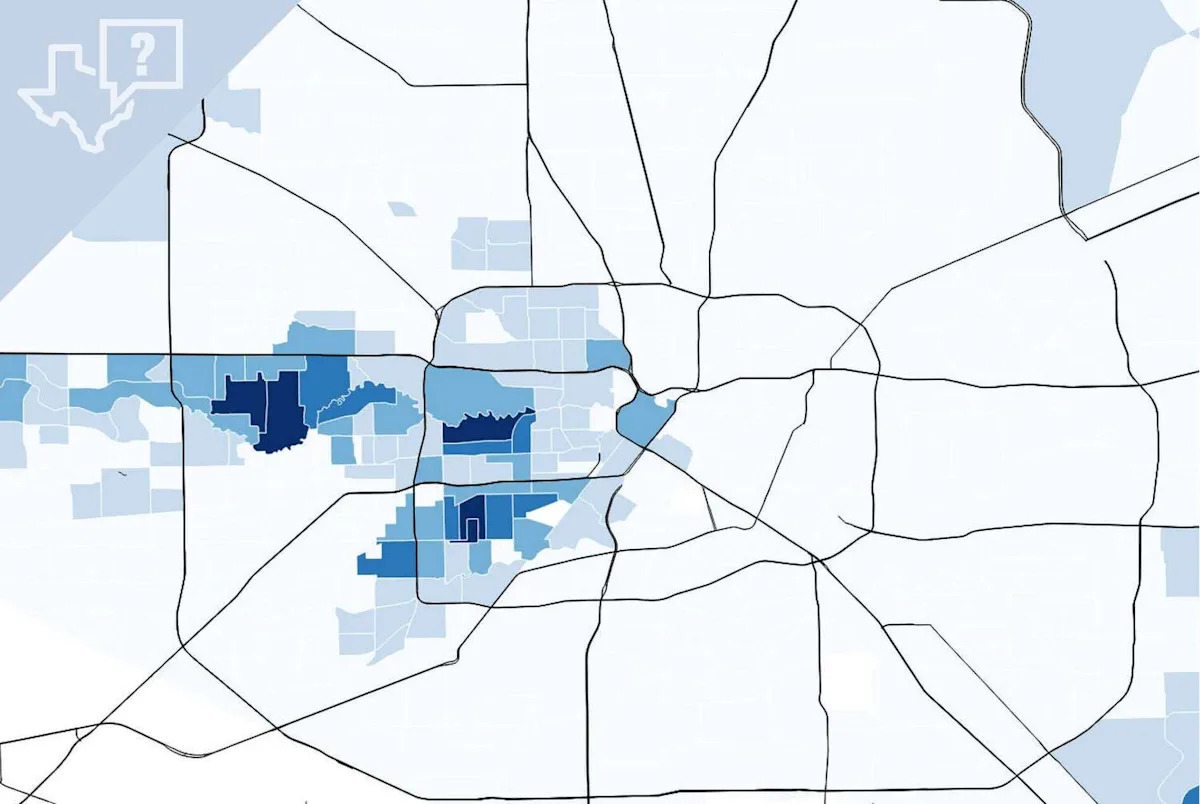
I wish I were making a metaphor. Pull up a map of Houston and plot almost anything across it: wealth disparities, health outcomes, race and ethnicity, flood risk, tree cover. Plot the nice sushi restaurants, the grocery stores, or even the density of Starbucks locations. The same shape appears every single time, and it has a name: the Houston Arrow.
What is the Houston Arrow?
It’s a corridor (guess the shape) that begins out west around the Addicks and Barker reservoirs and points east. Approximately bounded by Interstate 10 to the north and the Westpark Tollway to the south, it narrows into a triangle with downtown as its bull’s-eye.
Inside the Arrow are Houston’s wealthiest (and whitest) neighborhoods: the Heights, River Oaks, Memorial, Rice Village, Montrose, among others.
Map median household income across Houston and the Arrow appears, a corridor of wealth cutting east toward downtown. Map asthma rates and the Arrow reappears, this time showing us that adults and kids inside it are significantly less likely to wheeze through Houston summers than those outside it. Map cancer rates and it shows up again, tracing where people are more likely to get sick.
Or map life expectancy. Or tree canopy coverage. Or the areas where police are most likely to give homeless people tickets for the senseless act of being homeless. Choose any variable, any injustice, and the Arrow materializes again and again, charting the distance between what Houston claims to be – diverse and accepting – and what it actually is: a city segregated and often neglected.
In other words, it’s the shape of our great city’s tragedies and failings.
How Houston’s inequalities got this shape
You can write an entire book on how the Arrow came to be (and some people have!). But the story of River Oaks, the neighborhood at the Arrow’s heart, is enough to make the point: inequality never happens by accident.
In the early 1920s, William and Mike Hogg, the oil-rich sons of a Texas governor and the grandsons of a reckless Confederate general who died of dysentery, got with the attorney Hugh Potter to found River Oaks as a neighborhood specifically for rich white people. Here are some defining features, per some Houston Chronicle clippings of the time: “artistry, natural beauty, picturesqueness, and safety from encroachments.”
Thanks to the founders’ political connections (they also sat on the city’s planning commission), Houston made good on all those promises. On the west side, parks and schools were built, roads paved and property values were protected from the scourge of anyone deemed undesirable.
And when the freeways arrived in the mid-century, neighborhoods like River Oaks were spared. But Black and brown neighborhoods to the east and south were not just cut to pieces but caged in between walls of concrete and exhaust.
The investments compounded on the west side, while neglect (from city leaders, not the people living there) took root everywhere else. The Arrow is just what happens after a hundred years of that.
Why you should love Houston anyway
I might sound resentful, but let me be clear: This ugly history doesn’t make Houston a bad city. It just complicates it, in the way the truth always complicates the things we love.
For as diverse and accepting as we claim to be, the Arrow makes our segregation, our neglect, our injustices impossible to ignore. But this is still a city where working people from all over come to build lives in peace, where families from all over have put down roots for generations, where the beauty of community and belonging are real and abundant and hard-won, especially among the people the Arrow has come to exclude.
So, yeah, I still think that Houston is worth loving, worth making better. And that’s the hardest, but the most necessary, thing to say after all of this.

What is your Houston question?
This article originally published at What is the Houston Arrow? How this shape exposes Houston’s deep divides.