
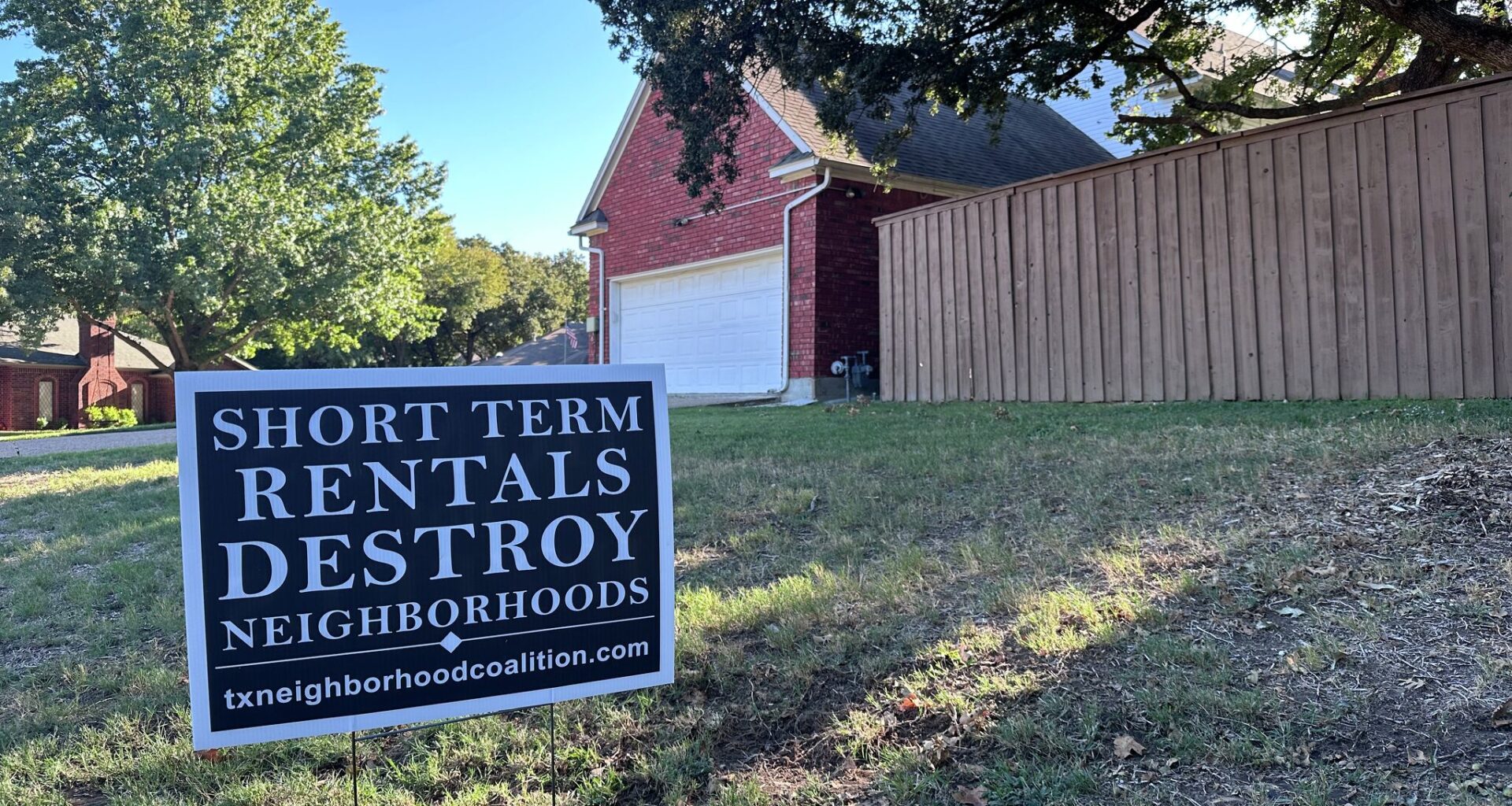
A yard sign posted in the yard of a short term rental in Lewisville expresses a growing sentiment in Texas cities and suburbs.
Susan McFarland/Dallas Morning News
Left to right, former Houston City Council member Jerry Davis, Houston City Council member Julian Ramirez and Airbnb Director of Global Campaigns Laura Spanjian speak during a press conference in Houston, Tuesday, Dec 2, 2025.
Kirk Sides/Houston Chronicle
When Houston’s new short-term rental regulations took effect in January, residents dared to hope that the noisy parties, public indecency, illegal parking, trash and violence plaguing some neighborhood rentals would finally be addressed. Life would grow quieter and safer.
But months later, little has changed.
Under the new rules, short-term rental owners must register their properties with the city annually and pay a $275 fee. They are required to provide a local 24-hour emergency contact and complete human-trafficking awareness training. The city can suspend a registration for repeatedly violating city rules or for certain criminal activity at the rental. Owners can be fined $100 to $500 per offense, with each day counted as a separate violation.
Article continues below this ad
Houston has become a hotbed for short-term rentals with an estimated 10,000 properties. Until recently, it also was one of the few major cities with virtually no rules governing them. Residents have flooded City Hall with complaints for years, while other major cities like New York and San Francisco have adopted some of the nation’s strictest regulations.
SEWING: Houston’s short-term rentals have become a magnet for mayhem. Will new rules stop the violence?
Council Member Julian Ramirez, who chairs the city’s Quality of Life Committee, said that 6,200 active short-term rentals were notified after the council enacted the rules a year ago and more than 5,800 have applied to be registered. So far, 4,400 have been approved.
The ordinance allows the city to go after properties that are not registered. 640 short-term rental properties have been red-tagged by city investigators for not registering, he said.
Article continues below this ad
Still, Ramirez acknowledged it’s too early to tell if the new rules will help reduce violence and nuisances. “This is our first ordinance, so if we need to make adjustments, we certainly can do that,” he said.
That offers little comfort to residents like Roosevelt Gilmore, who lives in the Third Ward area on a block with five short-term rentals, most of which operate respectfully.
But Gilmore called the city’s short-term rental complaint hotline the day a fight broke out at a rental complex on his block and spilled into the street. He called when patrons at another property parked illegally, on an elderly neighbor’s property. And he called again when a nearly naked woman, apparently intoxicated, showed up in his yard.
Police did respond that time. The woman told officers she worked as an escort and had been assaulted, Gilmore said.
“That’s the kind of nefarious activity that goes on in some of these places,” Gilmore said. “They act like hourly motels.”
Article continues below this ad
IN-DEPTH: How many short-term rentals are in your Houston neighborhood? Search our map to find out.
One morning while walking my dogs, I passed one of the properties Gilmore had mentioned and came upon a man and woman in physical altercation, shouting profanity in the street.
Even reporting problems can seem futile. Gilmore discovered the city’s complaint hotline routes to a call center in California, something he only learned after pressing operators directly.
“They don’t give you a reference number or incident number,” he said. “They just say they’ll contact proper authorities, but they don’t tell you who those are. They call you back with a recording that tells you to contact 311 if the problem hasn’t been resolved. So the hotline really doesn’t help you at all.”
Enforcement of city ordinances is never simple, but the stakes are higher when public safety is the issue.
Article continues below this ad
Sebastien Long, president of the Texas Short-Term Rental Association and owner of Lodgeur.com, said the ordinance has no real strength.
“The city isn’t actually interested in solving the problem,” he said. “They just pass the ordinance so they can be seen to be doing something.”
Long said his association offered the city suggestions for stronger measures, such as noise meters that alert guests when things are too loud and language to allow police to intervene more quickly, but were not included in then new rules.
“We’re trying to keep out bad actors too,” he said,
Article continues below this ad
Some of the worst actors are likely not using Airbnb and other mainstream platforms, instead booking through social media channels such as TikTok and Instagram, where oversight is minimal.
Houston set out to regulate short-term rentals. So far, it’s regulating the paperwork, not the problem.