
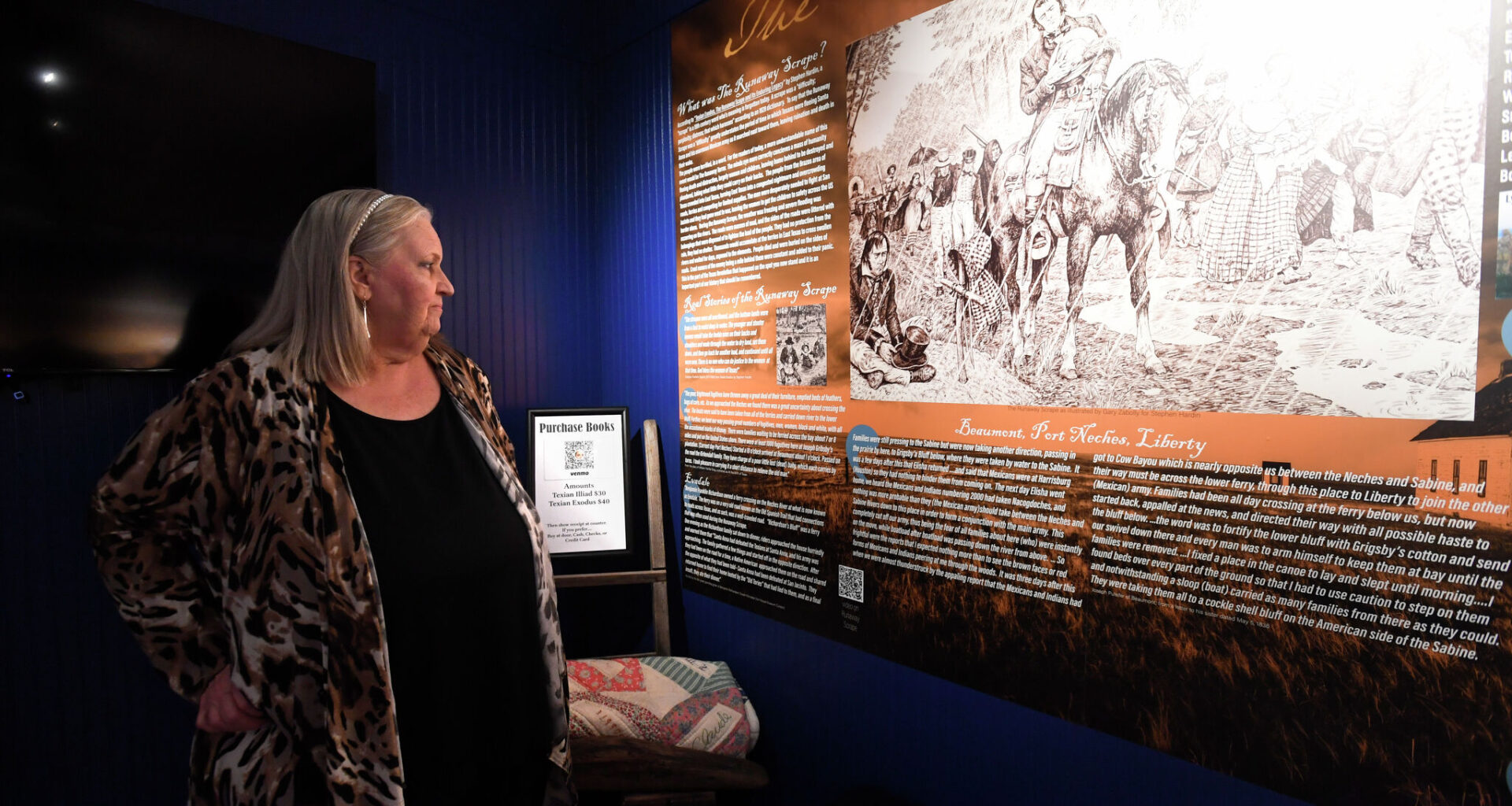
Curator Susan Kilcrease looks over an installation in the new exhibit room dedicated to the Texas Revolution and specifically Southeast Texas’ role in that history, is on display at the Ice House Museum. Photo made Saturday, Feb. 14, 2026 Kim Brent/Beaumont Enterprise staff
Kim Brent
Locally found relics tied to the Texas Revolution are on display in the new exhibit room dedicated to Texas’ fight for independence and the role Southeast Texas played in that history at the Ice House Museum. Photo made Saturday, Feb. 14, 2026 Kim Brent/Beaumont Enterprise staff
Kim Brent
A new exhibit room dedicated to the Texas Revolution and specifically Southeast Texas’ role in that history is on display at the Ice House Museum. Photo made Saturday, Feb. 14, 2026 Kim Brent/Beaumont Enterprise staff
Kim Brent
Curator Susan Kilcrease looks over an interactive station in the new exhibit room dedicated to the Texas Revolution and specifically Southeast Texas’ role in that history, is on display at the Ice House Museum. Photo made Saturday, Feb. 14, 2026 Kim Brent/Beaumont Enterprise staff
Kim Brent
Locally found relics tied to the Texas Revolution are on display in the new exhibit room dedicated to Texas’ fight for independence and the role Southeast Texas played in that history at the Ice House Museum. Photo made Saturday, Feb. 14, 2026 Kim Brent/Beaumont Enterprise staff
Kim Brent
A new exhibit room dedicated to the Texas Revolution and specifically Southeast Texas’ role in that history is on display at the Ice House Museum. Photo made Saturday, Feb. 14, 2026 Kim Brent/Beaumont Enterprise staff
Kim Brent
A new exhibit room dedicated to the Texas Revolution and specifically Southeast Texas’ role in that history is on display at the Ice House Museum. Photo made Saturday, Feb. 14, 2026 Kim Brent/Beaumont Enterprise staff
Kim Brent
Another second floor exhibit room features a variety of materials related to Southeast Texas and Silsbee history at the Ice House Museum. Photo made Saturday, Feb. 14, 2026 Kim Brent/Beaumont Enterprise staff
Kim Brent
Another second floor exhibit room features a variety of materials related to Southeast Texas and Silsbee history at the Ice House Museum. Photo made Saturday, Feb. 14, 2026 Kim Brent/Beaumont Enterprise staff
Kim Brent
Silsbee’s Ice House Museum is bringing the story of the Texas revolution home, with its newest exhibit in place for the 190th anniversary of the Battle of San Jacinto that secured Texas’ freedom from Mexico’s dominion in April of 1836.

The museum’s “Texas Revolution in Southeast Texas” exhibit isn’t just a chronicle of the state’s fight for independence, but one that places the local region squarely at the center of the quest through a story that’s gone largely unnoticed — the “Runaway Scrape.”
Article continues below this ad
Susan Kilcrease’s family history dates back nearly to the founding of Silsbee, including ancestors who ran a ferry across the Neches River near Evadale. Kilcrease grew up hearing stories of the post-Alamo and Goliad Massacre that sent Texian settlers fleeing east with Santa Anna’s 3,000-strong army chomping at their heels.
They left at the behest of revolutionary leaders like Sam Houston, who encouraged their flight for the Louisiana border, where they would find protection from the United States of America.
At least three rivers striated their flight to freedom — the Trinity, Neches and Sabine — and crossing those waterways was a battle all its own. The term “Runaway Scrape” has roots in 19th century parlance, where the word “scrape” was a common slang term referencing a difficult, chaotic and desperate situation.
RELATED: Author brings story of love amid racial turmoil to Silsbee museum audience
Article continues below this ad
Texians’ journey to safety perfectly defined what it meant to be in a “scrape.” Their flight featured Santa Anna’s army at the back end and the unknown response from Native American tribes that lie ahead — not to mention the perils of Mother Nature throwing all manner of wrenches in the works.
Sometimes shoeless, with bare-bone belongings and weapons filling carts and carriages, thousands made their way toward east Texas, traversing muddy riverbanks, alligator-filled riverways and lines for ferry crossings that sometimes took days.
It’s a grassroots story of Texas revolution that’s been largely overshadowed by history’s more grandiose chapters — the Alamo, Goliad, the Battle of San Jacinto. It’s the kind of story that’s right up Kilcrease’s alley.
She’s made a point of highlighting history through exhibitions that delve into some of the region’s lesser known history and artifacts — from the Dog People of Caneyhead to rare river bottom culture to a bona fide dinosaur bone pulled from the banks of the Neches River.
Article continues below this ad
“My goal is to take something big that happened and apply it to what happened here,” Kilcrease said. “People think of Texas independence and they think of the Alamo, but people here were very involved. What’s surprised me most (since the exhibit opened) is that 99% of people coming through have never heard of the Runaway Scrape.”
Celebrating that history and highlighting Southeast Texas’ role in the fight for independence also helped Kilcrease navigate her own personal scrape as a museum curator.
RELATED: Fossil shows Silsbee’s prehistoric past
Reevaluating the museum’s permanent exhibits and what comes next in the Ice House Museum story, Kilcrease was taking a harder look at the second-floor space devoted entirely to the story of Silsbee founding father and timber tycoon John Henry Kirby.
Article continues below this ad
For the past five years, family mementos, furnishings, artwork and more was devoted to the Kirby family story. But Kilcrease realized it was also the story of an elitist and a businessman within the region’s history.
While he may have helped put Silsbee on the map, it was the people who worked, lived and fought to preserve the Big Thicket culture who made it last in a most ubiquitous and impactful way.
“I think there are things as important or more important to this area than his contributions alone,” Kilcrease said. “The Texas Revolution is more a story of the people of Texas at large and the impact of Southeast Texas.”
Kilcrease did her research to bring the story to life in all its richness and detail, seeking out one of the state’s most renowned historians to bolster her exhibit — Stephen Hardin.
Article continues below this ad
He’s authored two books on the Texas Revolution, of which the Runaway Scrape chapter plays a major part — “Texian Iliad” and “Texian Exodus.”
Bringing his expertise into the fold was “part of the process” in establishing a new exhibition, Kilcrease said. After their first meeting, “he blew me away, so I got him real involved.”
RELATED: Canadian history show films segment on Neches River
Excerpts from his works are highlighted in the panel that takes up an entire wall of the second-floor exhibit space. Its size and scope easily matches that of the Alamo photograph filling the opposite wall.
Article continues below this ad
There are quotes from letters describing the harrowing conditions fleeing Texian settlers faced — none more perilous than that faced by those reaching the banks of the Neches River at ferry spots ranging from Port Neches to Beaumont, Evadale and other points north in Tyler County.
Runaways found themselves at the mercy of a recently flooded waterway, its banks and nearby estuaries so thick with mud, even oxen became immobilized.
Stuck on the banks until ferries could safely operate, food became scarce, starvation set in alongside disease and flourishing dysentery that cut through the runaway encampment faster than the floodwaters had moved in weeks prior, according to Hardin’s and other historical documentation.
When settlers got back on their trek as the Neches subsided, many had additional cargo to carry — the bodies of those who’d perished amid that leg of the journey — settlers who’d be ferried to burial in lieu of life in safer U.S. territory.
Article continues below this ad
It was a gruesome time that tested the metal of fleeing settlers, just as it had those who’d already faced the adversity of the Big Thicket when planting their stakes in Southeast Texas territory decades prior.
Museum-goers can now learn all about that and more at the Ice House Museum’s Texas Revolution in Southeast Texas War exhibit, while taking in donated and on-loan artifacts from the era. There’s a Mexican sword recovered from the Battle of San Jacinto, a Kentucky long rifle, spurs, hand-written letters recounting family stories and more.
The 1831 Kentucky long rifle has proven one of the exhibit’s most fascinating artifacts, Kilcrease noted.
RELATED: Texas Revolution started with a bang in Anahuac
Article continues below this ad
The weapon was unearthed from a Neches River adjacent roadway on the east side of the river near Cairo Springs — one that’s been chronicled as part of the Runaway Scrape route through Southeast Texas.
“It was found wrapped in hides and buried deep beneath the mud,” Kilcrease said.
While there’s no way of saying for sure that it was left behind amid the settlers’ flight to safety in the “scrape,” the weapon’s age, location and its weight are strong indicators that it was likely among the items left behind as runaways lightened their loads in the course of the arduous crossing at the Neches.
“People buried silver and all kinds of things,” she said. “They were throwing out all kinds of things they couldn’t carry or get through that thick, horrible mud. They were just so exhausted.”
Article continues below this ad
While the artifacts on display bring the past to life in steel, stone and letters written in signature 19th century flowering ink script, Kilcrease also used AI technology to bring the story to life.
An interactive screen featuring a map offers visitors a self-guided tour through the Texas Independence trail through Southeast Texas and routes used by those in the great “Runaway Scrape.”
The exhibit’s grand opening was held Sept. 27, 2025 — historian and author Stephen Hardin presenting two lectures in advance of the exhibit’s big reveal.
Article continues below this ad
His books remain available for purchase at the museum, located at 818 Earnest Ave. in Silsbee, which is open 10 a.m. to 4 p.m. Thursday and Friday and Saturday from 11 a.m. to 2 p.m.
For questions, to schedule special visits or get news on upcoming events, contact the Ice House Museum at 409-385-2444, email at icehousemuseum@att.net or visit their website at www.icehousemuseum.org.