
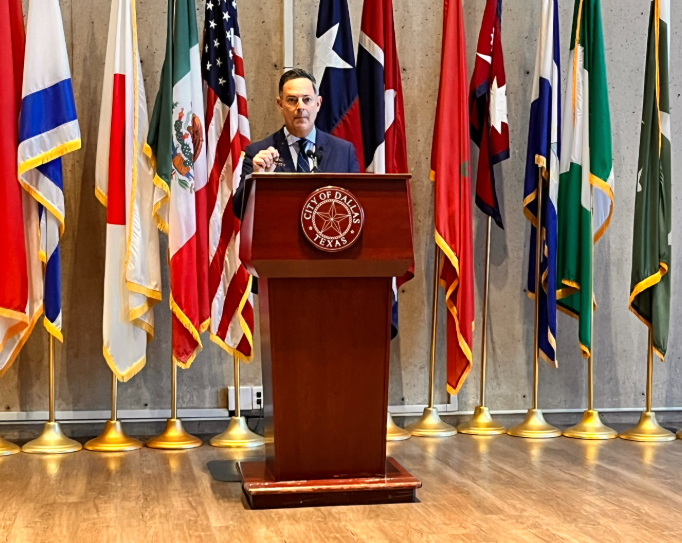
State Rep. Raphael Anchia represents a heavily Latino district in West Dallas.
Austin Wood
Dallas leaders gathered Wednesday morning to push back on Texas Gov. Greg Abbott’s threat to withhold public safety funding over city policies governing police cooperation with federal immigration enforcement.
On April 16, Abbott’s office sent letters to officials in Dallas and Austin saying the cities may not receive millions in state and federal funding if they do not repeal policies governing local police departments’ role in immigration enforcement. Houston received a similar letter earlier in the week, in which Abbott’s office threatened to withhold $110 million in public safety funding if a recent city council-approved ordinance restricting officers’ cooperation with federal immigration agents is not repealed.
Dallas Police Chief Daniel Comeaux has said DPD officers will not conduct immigration investigations and told the Community Police Oversight Board in October that he had refused a $25 million partnership with ICE to detain undocumented Dallasites. City council members affirmed that decision at a contentious November meeting that hosted over 70 public speakers.
One of the press conference’s first speakers, Democratic state Rep. Rafael Anchia, opened his remarks with a message for Abbott.
“First thing I want to say is something directly to Gov. Greg Abbott: stop playing politics with the public safety of the people of Dallas,” Anchia said. “Also, stop threatening to defund our police, and that is really the main message here today.”
The letter to Dallas threatens $32.1 million in state funding and also said the city may “imperil” over $50 million in federal public safety grants for the World Cup this summer if it does not change its policies.
“The governor is characterizing DPD’s local policy as interference with immigration enforcement, but that characterization is false. General Order 315.04 is a commonsense measure that provides clear guidance on stops, detentions and arrests,” Democratic state Rep. Venton Jones said. “It does not violate state law, it does not prohibit cooperation with federal authorities. What it does do is that it protects constitutional rights, it builds community trust and it reduces liability.”
The order states that officers cannot question individuals about their immigration status, prolong detention to investigate status or hold a detainee for federal enforcement officers. Officers are also not required to share information with federal authorities under the order, but may do so at departmental discretion.
Houston’s city council recently passed an ordinance overriding the local police department’s policy requiring officers to wait 30 minutes at a scene for federal agents if they detain someone with an administrative immigration warrant. Houston Mayor John Whitmire said last week that officials extended the deadline to repeal the ordinance, but Texas Attorney General Ken Paxton has since filed a lawsuit against the city for “adopting sanctuary city policies,” according to a release.
While Comeaux turned down the ICE partnership in October, agents can request a local police presence to secure perimeters during arrests and raids. The police chief refused calls from the community oversight board to provide data on DPD’s interactions with ICE in February.
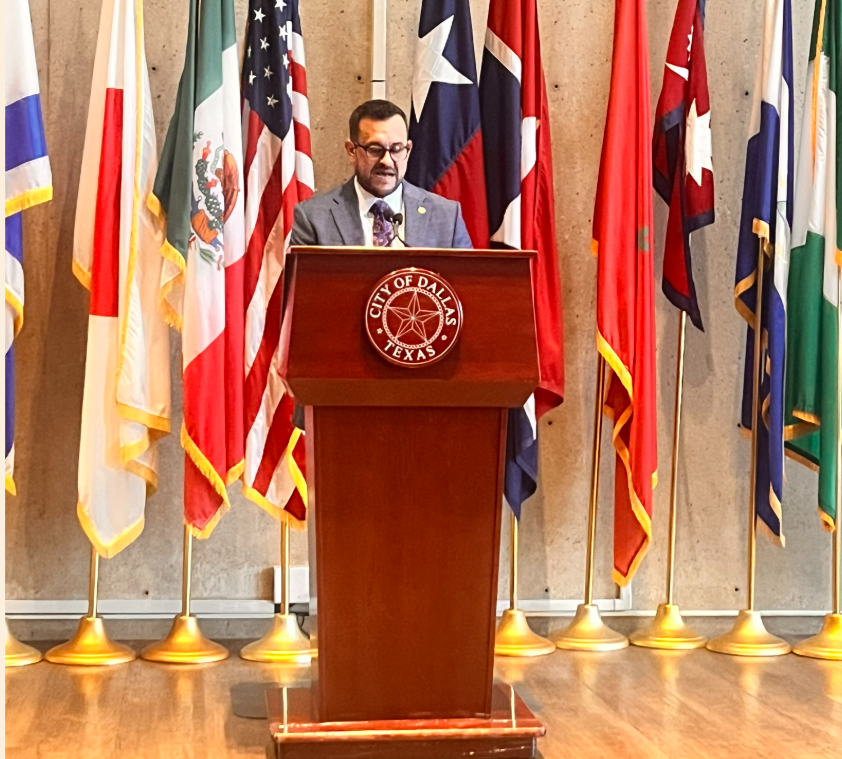 Council member Adam Bazaldua was one of the majority of council members who voted against an ICE partnership in November.
Dallas City Council member Adam Bazaldua, who opposed the ICE partnership in November, said that withholding funding will hurt DPD’s relationships with communities around the city.
“When local law enforcement is perceived as an arm of the federal immigration enforcement, trust erodes, and when trust erodes, public safety suffers,” Bazaldua said. “That is not theoretical. That is real, and it affects every neighborhood in our city. We already comply with all state and federal laws.”
“What we must not do is blur the line between local policing and federal immigration enforcement. Turning our officers into immigration agents undermines the very relationships that we depend on to keep our community safe. If residents are afraid that calling the police could put their families at risk and their own lives at danger, they will not call 911.”
Council member Laura Cadena, who represents West Dallas, said that diverting police priorities toward immigration enforcement will put residents at risk.
“What does this message send to the world? Dallas residents and visitors to Dallas must remain safe,” Cadena said. “Our officers work tirelessly to improve response times to emergency calls for service. And any shift to the priorities that pull officers away from these calls puts our communities at risk.”
According to the latest publicly available data from the department, officers responded to Priority 2 calls (robberies, criminal assaults, major accidents) with an average wait time of approximately 53 minutes in the first four months of 2026.
The Dallas Police Association (DPA) has also voiced opposition to Abbott’s threats to withhold funding. In a statement, DPA President Sean Pease said that withholding funding places further “strain on a department already facing significant staffing challenges.” The department currently has 3,352 sworn officers, according to an update provided to council members earlier this month, falling well short of the department’s Prop. U-mandated goal of 4,000 sworn officers.
Comeaux told the Dallas Morning News last week that city attorneys are reviewing the letter and that he believed the department was already in compliance with the law, but “one or two” changes might be necessary.
Jenny Sanchez, the local organizer for the Texas Civil Rights Project, said the potential loss of federal grants is especially concerning in light of the upcoming World Cup. Organizers have estimated that up to 4 million people could visit North Texas during the tournament’s 39-day run, during which Dallas-Fort Worth will host more games (9) than any other host city.
“Creating confusion and instability around public safety funding right now does not help us prepare for that moment,” Sanchez said. “It puts it at risk. Our communities deserve better than political games with public safety. Taxpayer dollars should be used to keep people safe, not as leverage to force cities into compliance.”