
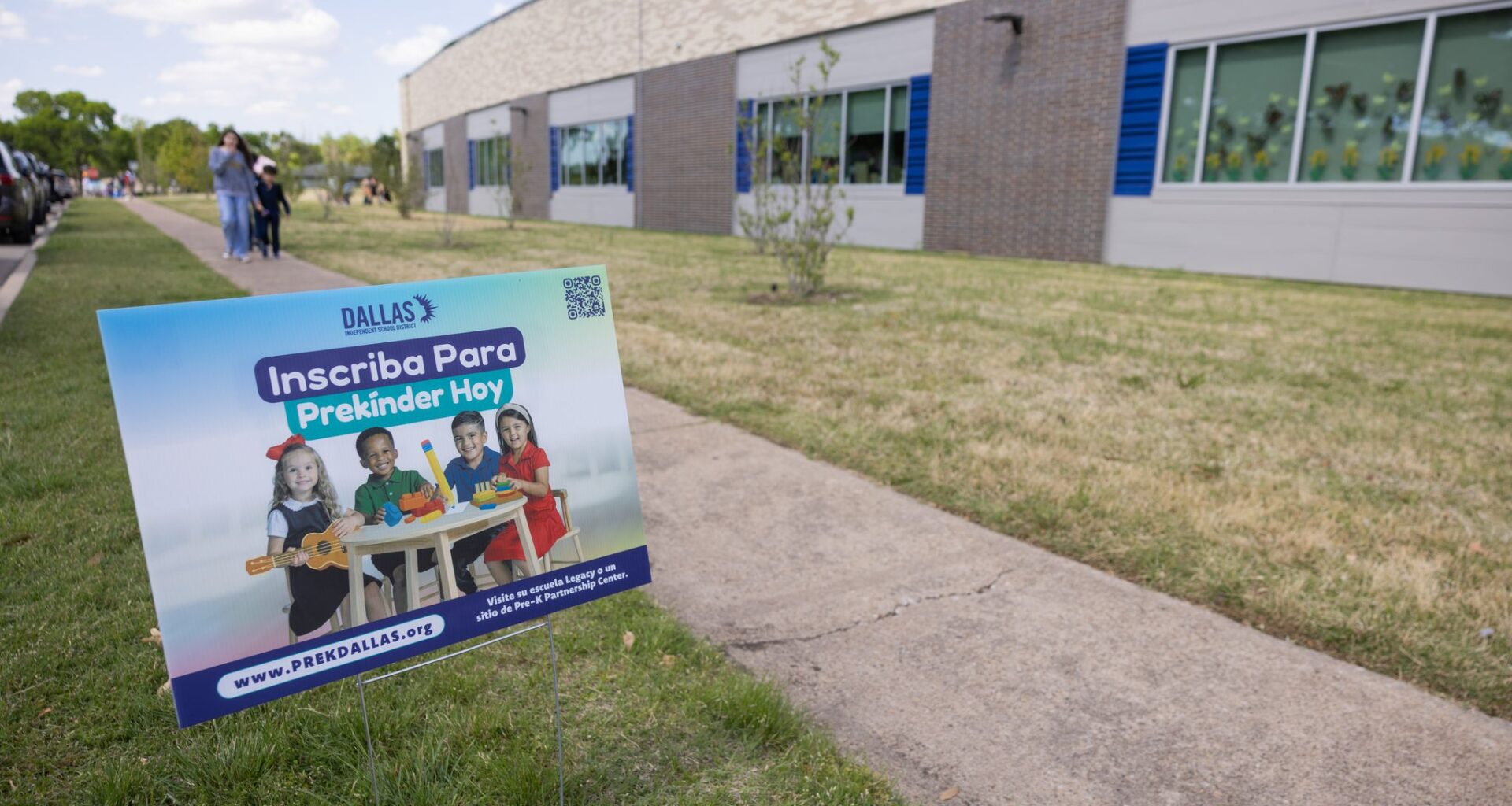
A sign advertises DISD’s pre-K program outside of Martha Turner Reilly Elementary School in Dallas on April 8, 2026.
Juan Figueroa/The Dallas Morning News
Texas’ pre-K system still falls short in many key areas of early childhood education, according to a national report released Wednesday. The report comes after state leaders have taken steps to expand access to prekindergarten programs.

One of the report’s authors said the quality of the early learning programs Texas’ three- and four-year-olds have access to depends largely on where they live.
Article continues below this ad
“If you look at Dallas, Fort Worth, San Antonio, Houston, Austin, the cities are investing their own resources to make up for what the state isn’t doing,” said Steve Barnett, founder and senior director of Rutgers University’s National Institute for Early Education Research.
The institute’s annual report lays out 10 benchmarks that researchers say states need to meet to ensure that students have access to a high-quality pre-K education. Texas met just two: adopting comprehensive state standards for early learning and providing screenings and referrals for vision, hearing and other health issues. Those are the same two benchmarks the state met in last year’s report.
Related: Could Dallas County become the second in Texas to pass a child care tax?
Make Dallas News a preferred source so your search results prioritize writing by actual people, not AI.
Add Preferred Source
The state fell short on teacher training requirements, student-to-teacher ratios and teacher professional development among other areas.
Article continues below this ad
Different standards for public and private pre-K programs
One of the biggest challenges with early learning in Texas is that private pre-K providers aren’t held to the same standards as public schools, Barnett said. For example, in public schools, pre-K teachers are required to have a four-year degree and specialized training in teaching early childhood. Teachers who work for private pre-K providers aren’t required to have either of those things.
There’s reason to be concerned, Barnett said, when education systems begin to rely too heavily on less-regulated private providers for their pre-K offerings. He pointed to lessons learned from a universal child care program launched in Quebec in 1997. Under the program, the province offered heavily subsidized child care through centers or home-based providers. Many of the children in the program got low-quality learning experiences, Barnett said, and research suggests a host of repercussions followed, including a decline in student achievement and a rise in crime rates.
The issues arising from less-regulated private providers are likely to get more acute in Texas as the state’s new education savings account plan comes online, Barnett said. Students going into pre-K represented the largest group of applications for Texas Education Freedom Accounts, according to figures released by the Texas Comptroller’s Office. Unless Texas puts up guardrails around private providers — requiring their teachers to have the same training as their counterparts in public schools, for example — it won’t be able to ensure those students get a high-quality pre-K experience.
Article continues below this ad
Related: Fewer Texas kindergarteners start school ready to succeed
Texas requires school districts to offer free, full-day pre-K to students who fall into any of a number of categories laid out by the state and federal governments, including limited English proficiency, homelessness or having a parent who is active duty military or was injured or killed while serving in the military. Last year, state lawmakers added teachers’ children to the list of students who qualify.
Texas allows districts to charge tuition to pre-K students who don’t fall into those categories. But some districts, including Fort Worth and Arlington ISDs, offer tuition-free pre-K to all students. It’s a group that Dallas ISD will join next year, when a board-approved universal free pre-K program comes online.
Those programs are beneficial for students as far as they go, Barnett said. But they don’t help students outside the school districts that offer them. If a handful of big-city districts offer universal free pre-K and others don’t, it could create more inequality across the state, he said.
Article continues below this ad
“At some point, the legislature has to latch on to this idea that they can’t just have quality early childhood education in the big cities,” he said. “All the kids in Texas need this, and you can’t leave the suburbs and rural areas behind.”
Early childhood education in the Dallas area
Chelsea Jeffery, chief of strategy, insights and talent for the nonprofit Commit Partnership, said Dallas ISD’s adoption of universal free pre-K represents a major piece of progress on early learning at the local level. The program will offer free pre-K to every 3- and 4-year-old in the district, no matter whether they meet any of the qualifications.
Other North Texas districts are doing good things, as well, Jeffery said. Richardson ISD has expanded its pre-K offerings over the past three years, and Lancaster ISD consistently enrolls about 80% of eligible children in pre-K.
Article continues below this ad
State lawmakers have also taken steps to help districts improve and expand pre-K programs, Jeffery said. Last year, lawmakers adjusted the state’s early education allotment, boosting the amount of money it sends to schools for students in pre-K through third grade. Separately, lawmakers passed a bill establishing a task force to deal with governance issues around early childhood education.
Related: More than ABC and 1-2-3: Is my child ready for kindergarten? Here’s what experts look for
Jeffery said it’s unlikely Texas will have much success expanding pre-K programs or improving quality until it deals with those governance issues. As the system is currently structured, the responsibility for handling early childhood education is divided among six agencies. The school districts that provide pre-K classes to students across the state fall under the Texas Education Agency, but Head Start programs fall under Texas Health and Human Services, and child care licensing falls under the Texas Department of Family and Protective Services.

By signing up, you agree to our Terms Of Use and acknowledge that your information will be used as described in our Privacy Policy.
Getting those agencies to coordinate their duties has often been a challenge Jeffery said. She’s hopeful that the task force will come up with recommendations to unify the state’s early childhood education system under a single agency and ultimately give more Texas kids access to high-quality pre-K programs.
Article continues below this ad
The DMN Education Lab deepens the coverage and conversation about urgent education issues critical to the future of North Texas.
The DMN Education Lab is a community-funded journalism initiative, with support from Bobby and Lottye Lyle, Communities Foundation of Texas, The Dallas Foundation, Dallas Regional Chamber, Deedie Rose, Garrett and Cecilia Boone, Judy and Jim Gibbs, The Meadows Foundation, The Murrell Foundation, Ron and Phyllis Steinhart, Solutions Journalism Network, Southern Methodist University, Sydney Smith Hicks, and the University of Texas at Dallas. The Dallas Morning News retains full editorial control of the Education Lab’s journalism.