
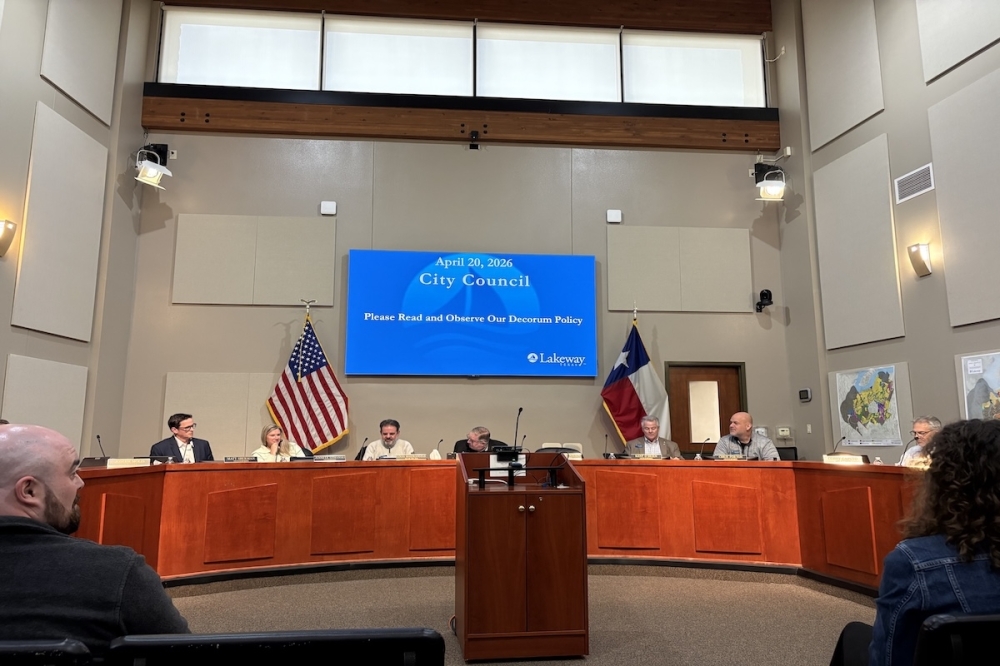
Lakeway City Council moved to provide city staff with guidelines to potentially amend the special use and conditional use permitting process on April 20 in an effort to make the permitting process more practical and consistent with the city’s development needs.
These amendments include removing the duration requirement or giving an automatic duration to permits, changing the permit transfer process and adjusting the list of businesses that are listed as special use or conditional use.
The background
The city’s current special use permit and conditional use permit framework requires discretionary approval for many commercial uses located near residential areas.
Currently, Lakeway’s zoning code for office/retail and commercial/light industrial allows some uses without permitting, but many require additional approval. Often, otherwise compatible commercial uses are required to obtain a special use permit if the business is located within 300 feet of residential or school property. This results in a public hearing process before both the Zoning and Planning Commission and City Council.
“The city of Lakeway is mostly built out,” City Manager Joseph Molis said. “Most people that are buying along these [commercial] corridors are buying existing homes and know the environment to which they are going to … but the code is written as if it is a new development.”
Since 2021, 36 of 38, or 95%, of SUP’s in Lakeway have been approved. The two permits denied were a car wash and a drive-thru oil change service.
The details
Many of the special use permits that have been approved by City Council have a duration of 99 years, Molis said.
“I can’t guarantee we will be able to read the medium this is recorded on, much less enforce that [permit],” Molis said.
The code allows for special use permits to be reviewed and revoked if the operation becomes “detrimental to the public’s health or safety,” making issues like permit duration “redundant,” Molis said.
Additionally, the way the code is written, the special use permit follows the business or applicant rather than the use.
“If a restaurant with a drive-thru were to get an SUP for a drive-thru and they were to sell to another restaurant who wanted a drive-thru, that new restaurant would have to get an SUP,” Molis said. “It sets up the city with potential issues with inconsistency.”
What’s next
City staff will likely present the amendments to City Council at the next meeting with the recommendations council members made. City Council will then decide if the amended process should be presented to the Zoning and Planning Commission in June.