
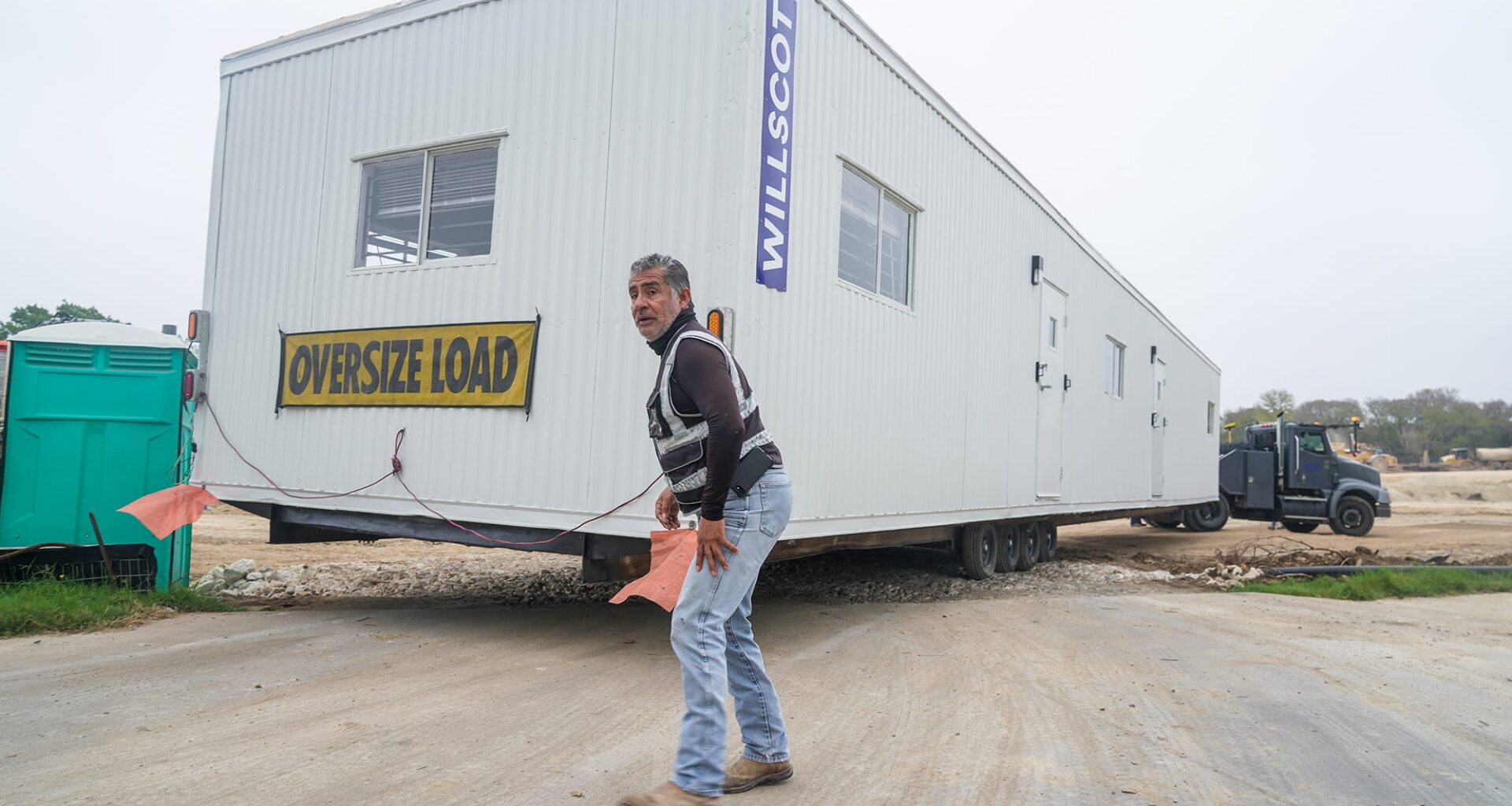
Enrique Guerrero guides the Construction trailer as it arrives at construction site on Thursday, Oct. 12, 2023 for Affordability Unlocked’s foundation. The 2027 budget plan includes an $8 million cut to the Housing Trust Fund, putting affordable housing projects and rental vouchers at risk and potentially displacing up to 350 people.
Ricardo B. Brazziell/American-Statesman
Austinites should brace for deep cuts to city services next year as city leaders work to balance a deficit driven by declining tax revenues and other factors.

That was a key takeaway from a Tuesday presentation to City Council by city budget staff that outlined Austin’s financial outlook over the next five years.
Article continues below this ad
Noe Elias, Acacia Cliffs tenants and tenant organizers, are escorted out of the City Council meeting Thursday, May 8, 2025, at Austin City Hall. Acacia Cliffs apartment residents and affordable housing advocates are in opposition to a pending zoning change and density bonus the property owner is seeking. Tenants say the rezoning would incentivize their displacement and the destruction of Acacia Cliffs’ 290 affordable apartment units if a proposed new development is built there. in opposition to a pending zoning change and density bonus the property owner is seeking. Tenants say the rezoning would incentivize their displacement and the destruction of Acacia Cliffs’ 290 affordable apartment units if a proposed new development is built there.
Mikala Compton/American-Statesman
Homes under construction in fall 2023 in the Mueller neighborhood in East Austin. The latest budget plan includes an $8 million cut to the Housing Trust Fund, putting affordable housing projects and rental vouchers at risk and potentially displacing up to 350 people.
John Jordan/Texas Tribune file photo
Absent significant spending cuts and modest property tax increases, Austin Budget Director Kerri Lang said the city is projected to face a $26 million deficit next year — a gap that could grow to $122 million by 2031. Last year, the city faced a $33.4 million shortfall, which prompted council to ask voters to approve a property tax rate increase.
Proposition Q failed by a wide margin, an outcome that has haunted city leaders as they face another difficult budget cycle.
Preliminary projections show that if City Council adopts a 3.5% property tax increase — the maximum allowed under state law without voter approval — the typical homeowner would pay about $155 more per $100,000 of property value. Under that scenario, the city’s deficit would shrink to about $1.3 million, which Lang said could be closed through a series of spending cuts developed over the past year.
Article continues below this ad
But reaching that lower deficit would come with trade-offs, council member Ryan Alter said.
“There are real pains being felt to get to the $1.3 [million],” Alter said. “I don’t want that to be lost in the conversation.”
Those cuts include $17 million in social service programs, an $8 million reduction to the Housing Trust Fund — which supports affordable housing and rental assistance — and another $8 million cut to funding for maintaining city-owned buildings and infrastructure.
Article continues below this ad
With those cuts, continued annual property tax increases of no more than 3.5% and no spending on new services, Lang said the city could see a $15 million surplus by 2031.
Without those measures, however, the city could face a far more severe financial outlook, including potential layoffs of police officers and firefighters, closures of libraries and community pools, and deeper cuts to social programs.
Council members’ reaction to the forecast was relatively muted compared to last year, when news of a $33.4 million deficit — driven largely by declining property values — sent shockwaves through City Hall.
In the year since, elected officials appear to have adjusted to what budget staff describe as a new financial reality, marked by ongoing cuts and smaller-than-usualtax increases.
Article continues below this ad
City Manager T.C. Broadnax has already proposed $17 million in cuts to social service contracts, along with a controversial plan to consolidate city IT operations. City leaders say the consolidation could save $27 million over five years, but some IT workers warn it could disrupt a range of city services.
Council member Marc Duchen, the only member who voted against last year’s budget, said council should consider all options when deciding what to cut.
“My fear is that we get to a place where we’ve decided some processes are so unpalatable, we can’t talk about them,” Duchen said.
The proposed $8 million cut to the Housing Trust Fund could threaten affordable housing projects and rental assistance, potentially displacing up to 350 people. Both Alter and Council Member Chito Vela said they plan to oppose those cuts.
Article continues below this ad
A major factor behind the city’s budget challenges is a slowdown in new construction. Deputy Budget Director Erik Nelson said higher building costs driven by inflation, along with a surge of new housing over the past decade, have contributed to the decline. Property values in Austin have also dropped about 2.9% compared to last year, according to preliminary figures from the Travis Central Appraisal District.
Together, those trends are reducing property tax revenue.
Sales tax revenue was one of the few bright spots highlighted at Tuesday’s meeting. Collections totaled about $19 million — roughly $1.6 million higher than projected at this time last year — largely due to increased retail spending and inflation.
Still, rising costs — particularly for public safety — continue to strain the budget. City documents show police, fire, EMS and forensic science are expected to account for about 66% of general fund spending, which is primarily supported by property and sales taxes.
Article continues below this ad
Read More: Most of your Austin property taxes go to public safety. Here’s why.
Budget projections also assume civilian city employees will not receive raises next year, though they include 3% annual increases from 2028 through 2031. The forecast also accounts for a 5% annual rise in the city’s health care contributions.
The five-year forecast marks the first major step in Austin’s annual budget process. The next milestone will come in July, when Broadnax is expected to present his proposed spending plan. City Council will debate and adopt a final budget in mid-August ahead of the new fiscal year, which begins in October.
Article continues below this ad
Residents can weigh in on the budget through an online form or at district town halls scheduled for later this summer.