
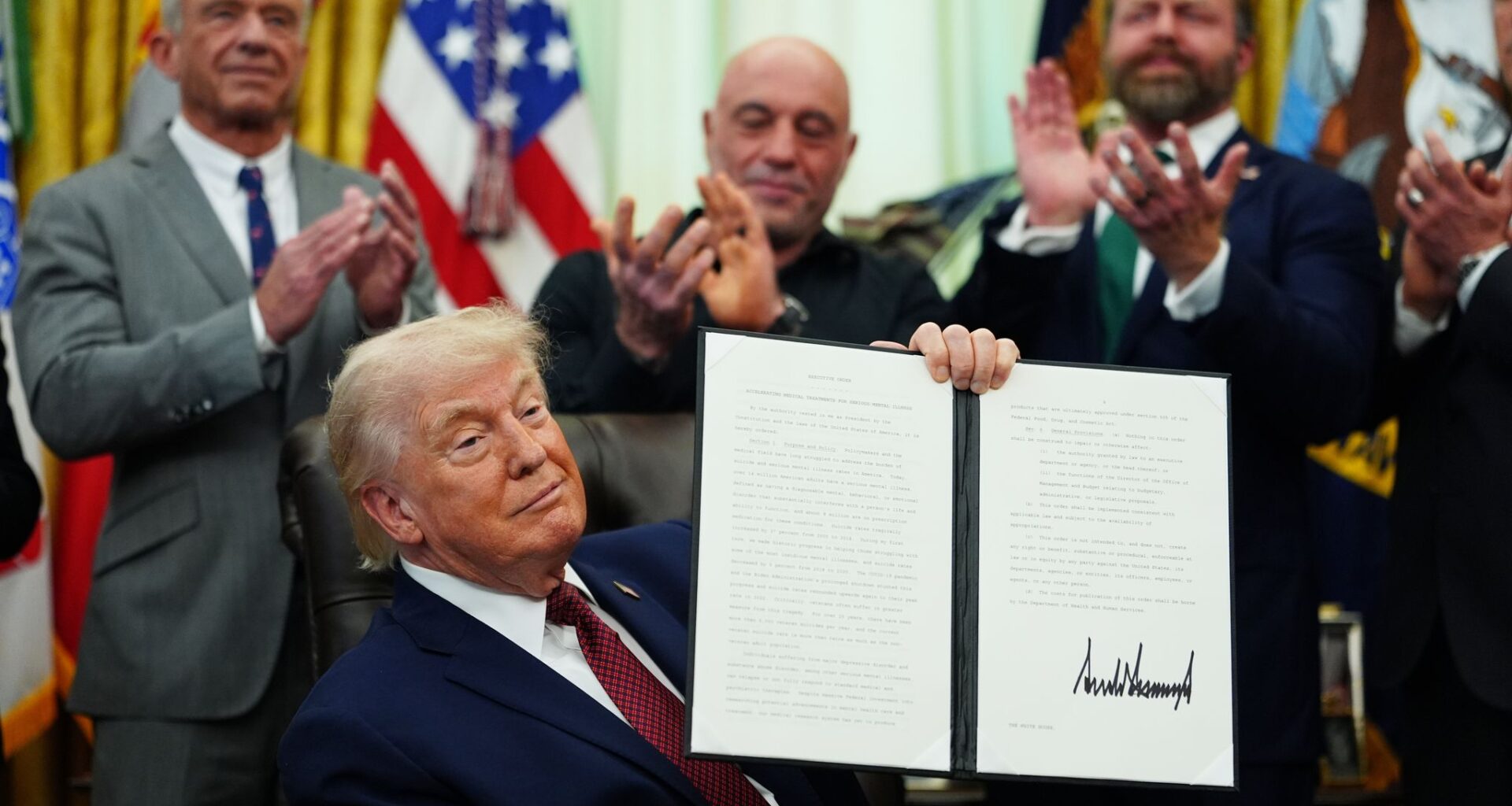
President Donald Trump holds up an executive order giving Ibogaine drug clearance in the Oval Office of the White House, Saturday, April 18, 2026, in Washington. (AP Photo/Julia Demaree Nikhinson)
Julia Demaree Nikhinson/Associated Press
Rep. Dustin Burrows (R-Lubbock) speaks as Gov. Greg Abbott signs legislation that will provide a $50 million state investment to initiate clinical trials for ibogaine, a natural psychedelic extract from an African plant that advocates say can be a safe and effective alternative to opioids for the treatment of PTSD and opioid use disorder, at the Texas Capitol Wednesday, June 11, 2025.
Mikala Compton/American-Statesma/Mikala Compton/American-Statesman
Sen. Tan Parker (R-Flower Mound) speaks as Gov. Greg Abbott signs legislation that will provide a $50 million state investment to initiate clinical trials for ibogaine, a natural psychedelic extract from an African plant that advocates say can be a safe and effective alternative to opioids for the treatment of PTSD and opioid use disorder, at the Texas Capitol Wednesday, June 11, 2025.
Mikala Compton/American-Statesman
Rep. Morgan Luttrell, R-Texas, far right, speaks while, from left seated, President Donald Trump, Joe Rogan, Americans for Ibogaine CEO W. Bryan Hubbard and Marcus Luttrell, a retired U.S. Navy Seal, listen in the Oval Office of the White House, Saturday, April 18, 2026, in Washington. (AP Photo/Julia Demaree Nikhinson)
Julia Demaree Nikhinson/Associated Press
U.S. Secretary of Health and Human Services Robert F. Kennedy Jr., top left, and media personality Joe Rogan, middle, look on as U.S. President Donald Trump, bottom left, shakes hands with W. Bryan Hubbard, CEO of Americans for Ibogaine, during an executive order signing ceremony in the Oval Office of the White House in Washington, D.C., on Saturday, April 18, 2026. (Jim Watson/AFP/Getty Images/TNS)
Jim Watson/AFP/TNS
Texas could become ground zero for turning a West African root with hallucinogenic qualities into an accepted treatment for addiction, post-traumatic stress disorder and other mental health issues, thanks to former Gov. Rick Perry convincing Texas lawmakers and President Donald Trump to commit $100 million to ibogaine research.
One of the world’s foremost ibogaine clinics is moving its headquarters from Cancún, Mexico, to Austin to take advantage, Beond CEO Tom Feegel told me in an interview.
“Texas has signaled seriousness. Texas has signaled scale. Texas has signaled leadership, and Texas appears to be. And tt is, in my opinion, the most forward-leaning state in the United States on ibogaine research and policy,” Feegel said. “Developing and managing alliances and professional relationships at the local or state level is our intention.”
Article continues below this ad
Addiction, PTSD and behavioral problems are among the most persistent, expensive and difficult health care challenges in the world. While many patients benefit from psychiatric drugs, counseling and group therapy, most will suffer from relapses or side effects before they find long-term relief.
In the past 30 years, illicit researchers have found success treating people with hallucinogens, many of which indigenous groups have used in traditional medicines for 7,000 years. The federal government has recently authorized formal research into magic mushrooms and peyote cactus, as well as lab-derived psychedelics such as LSD, MDMA and ketamine.
Last week, Trump authorized $50 million for research into ibogaine, an alkaloid derived from the root bark of an African shrub called iboga, traditionally used for healing rituals. A Stanford University study last summer found that ibogaine, when combined with magnesium to protect the heart, safely and effectively reduces PTSD, anxiety and depression in veterans.
Article continues below this ad
The results were no surprise to Perry, who became an advocate after taking ibogaine for his mental health. He helped convince the Texas Legislature last year to appropriate $50 million for more research.
Feegel said the Stanford study confirms what Beond has documented in 6,000 patients treated at its Cancún clinic. Most say the drug triggers a mind-expanding, transcendent experience with autobiographical visions. Feegel said ibogaine invokes a more introspective experience than other hallucinogens.
The drug can cause severe nausea and vomiting during the experience and depression afterward. Feegel said ibogaine is rarely taken recreationally because the experience is not fun. Yet patients say it changes their perceptions and kick-starts their brains.
Researchers say this increased neuroplasticity helps the brain reorganize, make new connections and break out of ruts. However, the drug can cause fatal heart irregularities; people should only take it in a medical facility under a doctor’s supervision.
“All of our procedures and documentation and notation is very sophisticated, and we have a set of safety protocols and standard operating procedures and dosing protocols. All of our staff are advanced cardio life support certified,” he said.
Article continues below this ad
More importantly, Feegel said the treatment requires talk therapy before, during and after the dosing. While Beond has had success, Feegel welcomes independent research to improve protocols and better understand who can benefit, including those not yet in crisis.
“The focal point right now is for helping people who have not found a solution to these intractable problems,” he said. “If we found out that it prevented dementia rather than treated dementia, would that be something that people would be interested in taking sooner?”
A more practical question is why taxpayers should spend $100 million on ibogaine and not other promising treatments. Perry has said he has no financial interest in ibogaine-related companies, but without him recruiting podcast host Joe Rogan and former political colleagues to ibogaine’s cause, it’s doubtful Trump or Texas lawmakers would have set aside so much cash.
Christian fundamentalists, meanwhile, oppose drugs that alter perceptions of reality.
“We have expressed opposition to the use of psychedelics because of longstanding spiritual, theological and ethical concerns about mind-altering drugs that open individuals up to mystical or transcendent experiences that are not in line with orthodox teaching of scripture,” Tony Perkins, the president of the Family Research Council, said in a statement to the New York Times.
Article continues below this ad
Feegel and other ibogaine proponents argue that $100 million is a small amount to reduce the suffering and health care bills of potentially millions of people. Maybe, but taxpayers should be concerned that politicians allocated millions of dollars based on vibes and connections, not scientific merit.
If Texas does become the nation’s ibogaine hub, though, it could have the added benefit of making Austin weird again.
Award-winning opinion writer Chris Tomlinson writes commentary about money, politics and life in Texas. Sign up for his “Tomlinson’s Take” newsletter at houstonchronicle.com/tomlinsonnewsletter or expressnews.com/tomlinsonnewsletter.