
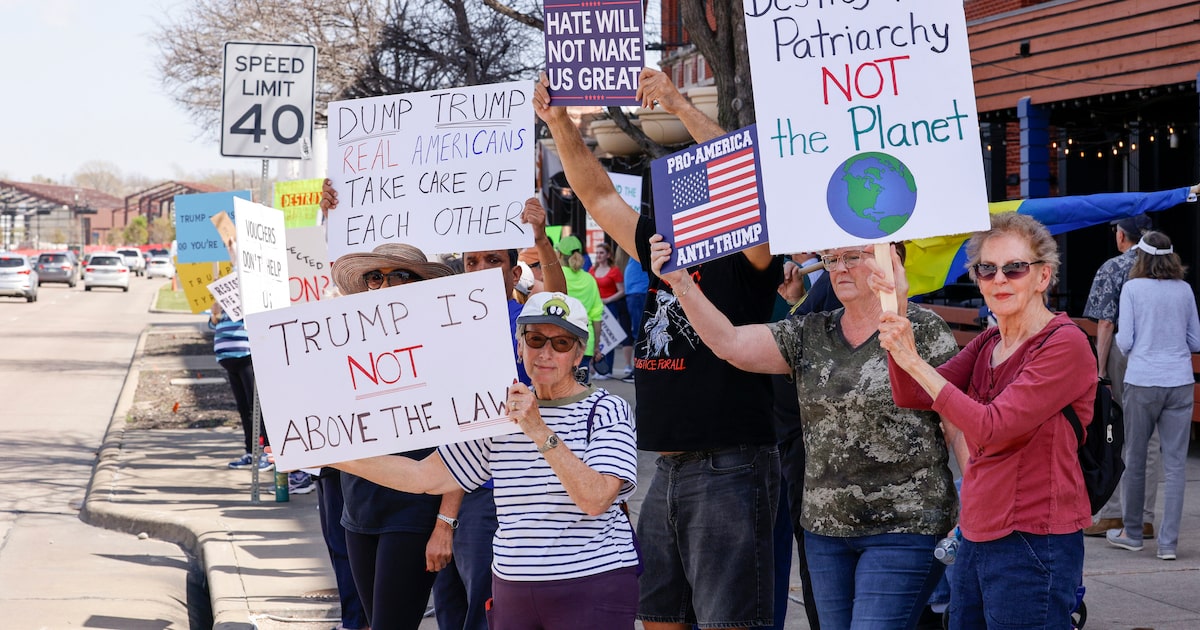
Rekha Shenoy recalls breaking down crying as she stood shoulder-to-shoulder with 3,000 No Kings protesters gathered in Plano on a recent Saturday, one of hundreds demonstrations across the country to protesting President Donald Trump’s governance.
The strong showing bolstered Shenoy’s optimism that broader shifts could be taking place in her county. It was a scene she couldn’t have imagined just a few years back.
Collin County is home to some of the country’s fastest-growing cities, with a population expected to nearly double to more than 2.4 million residents by 2060. As Texas nears a gubernatorial election next year, demographic and economic shifts are turning the Republican stronghold into more of a political battleground.
“There were a lot more people than I ever expected,” said Shenoy, a Democratic Party activist. “So I do feel hopeful.”
She hopes the protests will provide the momentum for stronger turnout among Collin County Democrats and an opportunity to grow a party that has generally had less sway in the county’s partisan elections.
Political Points
Related

In the past two decades, voters in Collin County have gradually begun tilting to the left, even if it remains a Republican stronghold. Rapid development has drawn voters with advanced degrees who have tended to support Democrats in recent years.
The county has also seen an influx of Asian Americans, who lean Democratic and now make up nearly a fifth of the county’s population. In 2020, 72% of English-speaking, single-race, non-Hispanic Asian voters said they voted for Democrat Joe Biden for president, according to Pew Research Center.
Two decades ago, George W. Bush won Collin County with 71% of the vote. In 2024, Donald Trump won the county with 54%. Four years earlier, Trump had a much thinner margin with just 51% voting for him.
And just three years ago, voters in Plano and Allen elected Mihaela Plesa to the Texas House, the first Collin County Democrat to win a seat in Austin in nearly 30 years.
Plesa, whose district includes parts of Plano and Allen, believes voters in her district are focused on traditional Democratic values such as rejecting public school vouchers and protecting reproductive rights.
Former McKinney Mayor George Fuller — a Republican — acknowledges the political shifts, saying the population boom has transformed his city from “a deep red to a less-than-deep-red.” He hopes stewards of governance, regardless of party, will focus on how to make their city better, not on making it more red or more blue.
“Because we are becoming more purple and because we’re having more diverse ideas,” he said, “that will drive both parties to now realize: ‘You know what? I’ve got to start appealing to everybody.’”
For Shenoy and others, there was much on their minds — from gun control to gender identity, and from migrants to health care.
“People cared enough to come out, and it was raining,” she said. “I feel like maybe there’s a little more urgency.”
Roxanne Frietze, a single mom who’s lived in McKinney for eight years, was also astonished at what she saw at the No Kings protest in her community — hundreds of people instead of the usual scant dozens.
Related

In recent years, she said, more progressive voices have shown up on neighborhood social media channels. She said those conversations are no longer as one-sided as they used to be.
“There might have been one brave keyboard warrior before,” Frietze said, “but now a lot of people are speaking out.”
Joshua Blank, research director for the Texas Politics Project at the University of Texas at Austin, said fast-growing areas like Collin County are becoming the most politically competitive in the state.
“Collin County is not made up of conservative voters living on rural stretches of land,” Blank said.
“It’s increasingly made up of a diverse population of college-educated professionals,” he said. “These are the kinds of people that Democrats are generally appealing to more.”
Related

The county is home to some of the state’s most influential Republicans, such as Attorney General Ken Paxton from McKinney and Abraham George, a Parker resident who chairs the state Republican Party.
Still, some Democrats see opportunities.
“It’s less about people shifting to the left as much as it’s about people shifting towards a government that works,” said Kendall Scudder, the chair of the Texas Democratic Party.
Some Republican leaders argue their party has delivered a government that works in Collin County.
Related
“A lot of the people are moving to Collin County … because they like responsible government,” said former county GOP chair Shelby Williams.
“I think most people are chiefly influenced by kitchen table issues. What kind of community are they going to raise their family in? Is it going to be safe? Are there going to be good educational and economic opportunities? That’s what’s driving those people, and that has not changed for … years.”
Collin County Democratic Party Chair Jeremy Sutka, who helped organize the No Kings rally in Plano, hopes local Democrats focus on local policy interests to appeal to a wider net of constituents with local concerns — not national political flashpoints.
Related

“We’re trying to break a little bit from what the Democratic Party nationally was messaging and connect with people where they are here in Collin County, a suburban county with families that want to have public schools that are strong,” Sutka said. “They want to have safe neighborhoods. They want to be able to afford to live in those neighborhoods”
Brandon Rottinghaus, a political science professor at the University of Houston, grew up in Plano in the 1980s and 1990s when parts of the county were just prairies. Residents only put out yard signs for Republicans such as Ronald Reagan, George H.W. Bush and former U.S. Rep. Sam Johnson.
As a college student, he volunteered for congressional campaigns in Collin County in the early 2000s and remembers that Democrats didn’t have much of a presence. Since then, he has noticed that the county’s Democratic party has become more organized, recruiting candidates to run for offices such as county judge and for nonpartisan local positions such as city council.
Related

“They’re investing in getting people to run, even if it’s a long slog for them to win,” Rottinghaus said, “That’s generated a bench that otherwise wasn’t apparent in the prior few decades. Those people then become fixtures on school boards … and can materialize into future candidates.”
Democrat Julie Holmer recently resigned her seat as Plano’s deputy mayor pro tem to launch a bid for a seat on the Collin County Court of Commissioners, which is entirely made up of Republicans.
Holmer is vying for the Precinct 4 post, which is also being sought by Williams, the former county GOP chair.
“I’m a Democrat, but I’m a moderate and I do think people are looking for that,” Holmer said. “They’re looking for balance.”
Early voting for 2025 elections ends Friday: What to know about casting your ballotWhich Dallas restaurants won a Michelin star? All the results from the 2025 Michelin Guide