
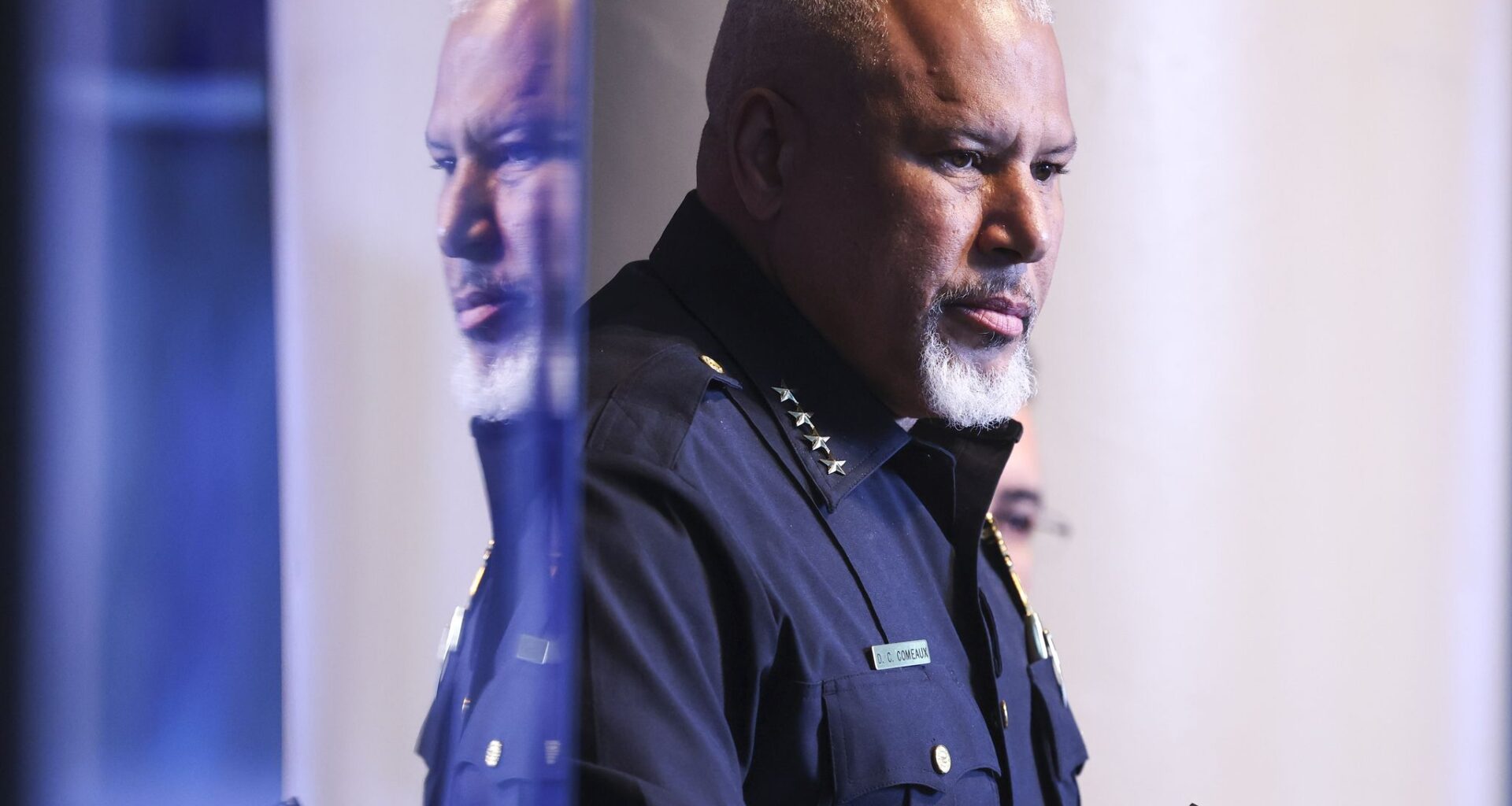
Dallas police Chief Daniel Comeaux has grappled with the department’s most persistent problems and the pressure of politics in his first year on the job.
Voters told the city to hire hundreds more officers. Response times still don’t meet department goals. And his resistance to using city police to enforce federal immigration laws ignited one of the most politically charged issues at City Hall.
The longtime federal drug agent from Houston has pointed to encouraging trends in crime, some of which preceded his arrival. Dallas police said violent crime fell in 2025 for the fifth straight year, and the city recorded its lowest murder count since 2015.
He also acknowledges there is more work to be done, including the department’s efforts to curb random gunfire in the city. He said he is steadily working toward making the Dallas Police Department the “most proactive” in the country.
The chief’s work on three issues — recruiting, response times and immigration — offers an early measure of his performance.
Issue: Months before Comeaux took office, Dallas voters approved Proposition U, a charter amendment requiring the city to maintain at least 4,000 police officers — a mark the department remains short of by hundreds of officers.
Action: Comeaux backed changes meant to widen the applicant pool. City Council approved new, less restrictive standards allowing many applicants ages 21 to 44 to qualify with a high school diploma or GED and 36 months of consecutive full-time work experience, rather than college hours.
Outcome: The department remains roughly 600 officers shy of the 4,000-officer requirement, but recruiting classes have grown. Attorney General Ken Paxton has sued the city, arguing it is not complying with Proposition U’s police funding requirements.
Issue: For years, Dallas police have struggled to meet the department’s response-time goals for all types of calls.
Action: Comeaux said reducing response times remains a priority, beginning with a review of how calls are prioritized and of whether long-standing benchmarks and classifications still make sense. He floated the idea of having drones automatically respond to some lower-priority calls, freeing officers for more urgent incidents.
Outcome: Response times have improved so far this year compared with the same period last year, but the department remains far from its goals. Police aim to respond within 8 minutes to Priority 1 calls, 12 minutes to Priority 2, 30 minutes to Priority 3 and 60 minutes to Priority 4. According to data released Tuesday, the city misses the mark by a few minutes on the most urgent calls and by one to four hours on the others. The department has yet to launch the automated drone program.
Issue: As the Trump administration pressed for greater local cooperation with federal immigration enforcement, the question of how closely Dallas police should work with ICE became one of the most politically charged issues of Comeaux’s first year.
Action: In October, Comeaux said he had turned down what he described as a $25 million offer for Dallas to join ICE’s 287(g) program, which would have authorized some local officers to make arrests on civil immigration warrants. The proposal had not been widely disclosed previously. Facing questions from the City Council, Comeaux said he wanted the department focused on answering 911 calls, responding in a timely manner and keeping people safe in Dallas, rather than taking on immigration enforcement as part of its mission.
Outcome: City Council members ultimately backed Comeaux’s decision. But the broader debate has flared up again. Last week, in a warning similar to those sent to Austin and Houston, Gov. Greg Abbott’s office said Dallas could lose roughly $32 million in state public safety grants due to its internal rules that limit officers’ collaboration with immigration enforcement. Comeaux said the department is reviewing those rules and may make changes, but he maintained that officers would not take on immigration enforcement duties.