
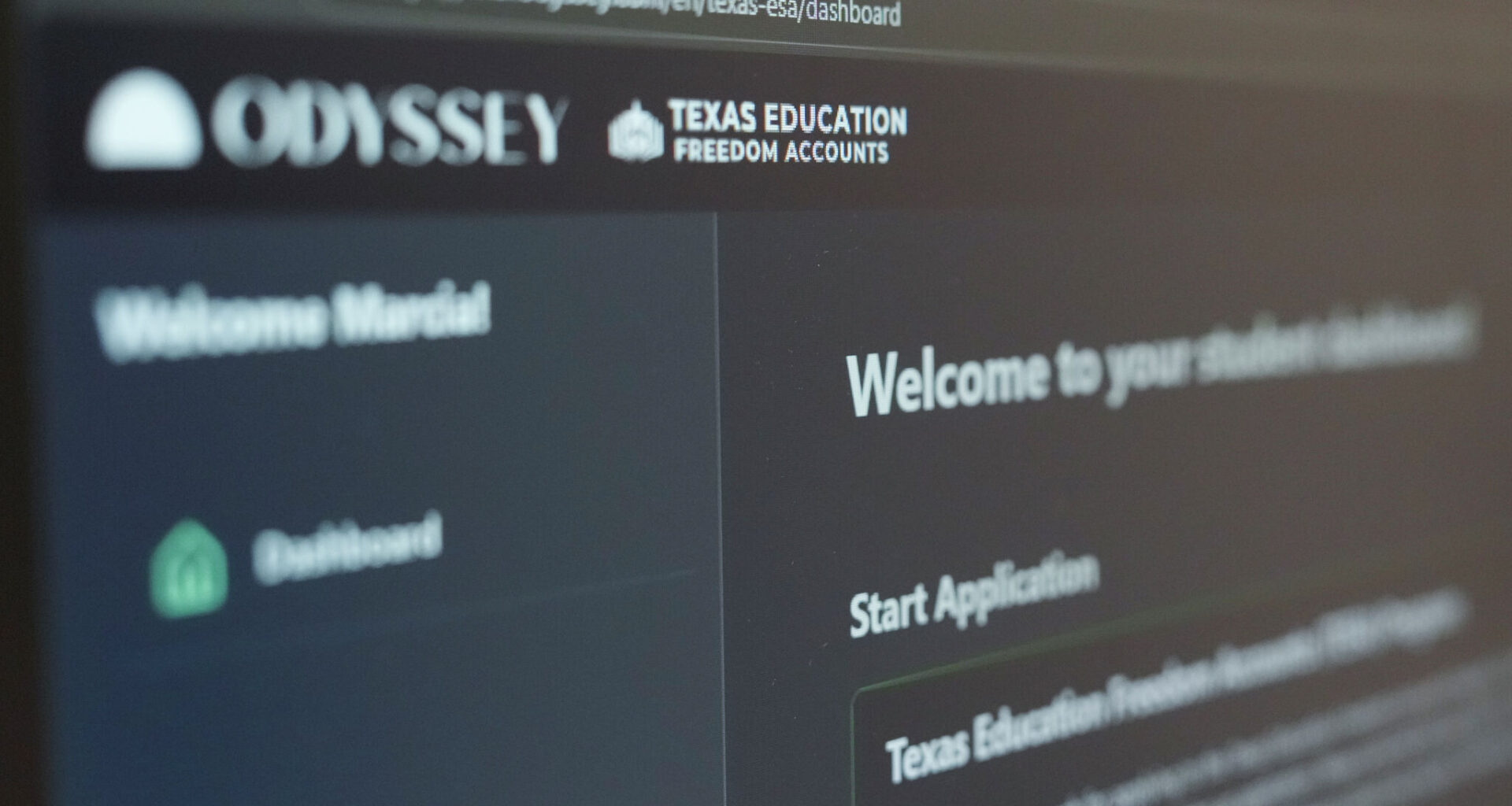
Marcia Pena works to apply for a Texas Education Freedom Account voucher for her daughter’s catholic school next year in Houston, Wednesday, Feb. 4, 2026. Wednesday was the first day that the applications opened for parents to take part in Texas’ new program to utilize tax dollars as part of school choice.
Jason Fochtman/Houston Chronicle
Texas officials began sending out the first notifications to families awarded vouchers on Wednesday, with 42,644 students qualifying in the first round, reserved mostly for those with special needs who were considered the highest priority.
The initial group of awardees will continue to receive notifications through Friday, the comptroller’s office said. They accounted for just over $400 million in awards. Siblings of qualifying special needs children were also included in the first priority tier.
Article continues below this ad
The program offers state funding to help pay for private and homeschool education. Roughly half of the vouchers approved so far went to students who previously attended a public school. The other half of awardees were already in a private school, or homeschooled.
In the initial round, Houston ISD led the state with 1,558 successful applicants living within its boundaries, followed by Dallas ISD with 1,313 and San Antonio’s Northside ISD with 1,139.
The remaining dollars appear likely to cover at least 60,000 other students, putting the $1 billion program on track to support an estimated 100,000 accounts in its first year. The state will run a lottery, scheduled for next week, to determine which other families will be accepted or waitlisted.
Funding for children with special needs featured as a contentious point in the debate over the creation of the voucher program. Supporters including Gov. Greg Abbott promoted the policy as a way to help families escape schools that were not meeting their children’s needs and access higher-quality private options.
Article continues below this ad
Critics, however, warned that vouchers would enable private schools to siphon off other, less resource-intensive student populations, leaving behind those with special needs in a public system that is already severely underfunded and understaffed.
Republicans initially proposed a voucher dedicated to special needs in 2017, but later turned down Democratic attempts to limit the program to the group when approving the program in 2025, with Abbott insisting the money be “universal”, or available to all families.
The program was funded last year with a total of $1 billion in funds, though some of that money was allocated to hire agency staff, pay contractors, and run a marketing campaign.
The comptroller’s office has said it aims to send notice to all other families of acceptance or denial no later than May 1. Acting comptroller Kelly Hancock previously forecast that the funds would run out in the program’s second tier, reserved for families with incomes below 200% of the poverty line. Higher-income families would be put on the waitlist.
The amount of each voucher awarded through this initial round varied. The roughly 11,000 children applying for homeschool funding are set to receive $2,000 each. Private school parents who submitted specific documentation of their children’s special needs, known as an individual education plan, received an average of $15,585, though some were eligible for up to $30,000.
Article continues below this ad
The amount of each special needs voucher was based on two factors: the district in which each family resides and the severity of their children’s needs, correlating to the services each child would otherwise receive in a public school setting.
A smaller group of parents who were unable to submit individual education plans but still qualified for priority status based on doctors’ notes or other documents will receive the base funding amount of $10,474.