
If you need someone to direct a Tom Stoppard classic, look no farther than Main Street’s Rebecca Greene Udden (see that company’s stirring Leopoldstadt). If it’s Beckett you want with all his surreal theater of the absurd intact, hire Jason Nodler from Catastrophic. If you’re mounting an August Wilson drama, there’s no one better to flesh him out than Ensemble’s Artistic Director Eileen J. Morris.
The Alley Theatre has wisely sought her out to put her distinct stamp on Wilson’s magnificent Fences (1985). This production, gloriously realized from top to bottom, is the Alley’s crown jewel of their current season.
Wilson is our American Shakespeare. Celebrated, feted, and awarded for his ten-play “Pittsburgh Cycle,” he chronicles the black experience during each decade of the 20th century, from Gem of the Ocean, set in 1904, through Radio Golf, the ‘90s. Also called the American Century Cycle, the plays are rich and resonant, thick and juicy. While epic in scope, the dramas are intimate and sublimely lyrical. You can quote lines from his plays that are fragrant as the Bard’s, yet are distinctly his own. His dialogue is vernacular, awash in patois and rhythmic like the Blues, but raised to a very high plane. There’s poetry in these mundane lives he describes with such force, understanding, and compassion.
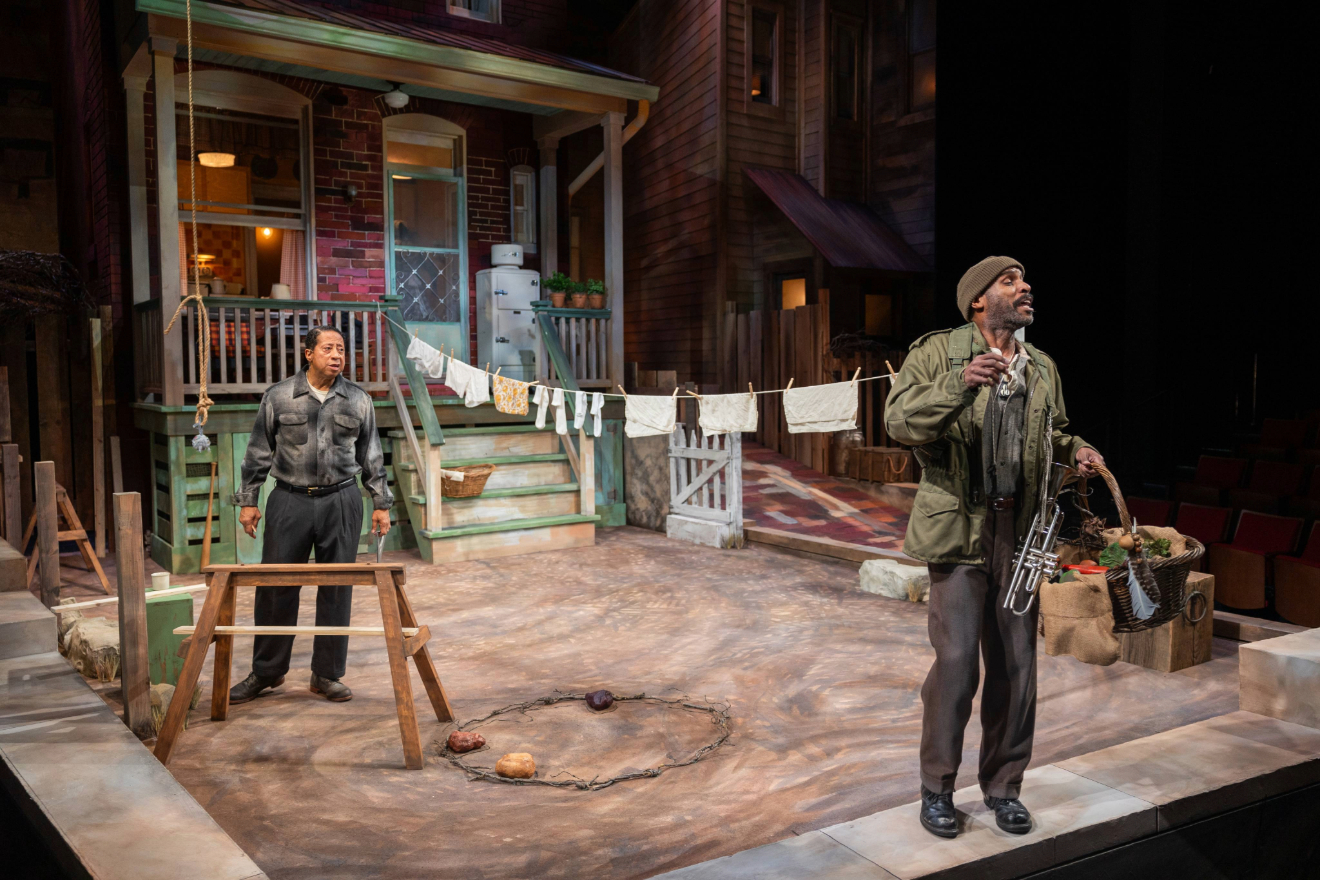
Fences is set in 1957 in his beloved Hill district of Pittsburgh, that city’s black working-class neighborhood. We’re in in the backyard of Troy and Rose Maxson’s shabby brick house. A refrigerator with its electric motor sprouting from the top rests on the back porch. There’s a decorative aluminum screen door to bang shut when someone’s angry. We can see into the kitchen with its worn porcelain oven and metal-edged table. An alley runs down the hill past the yard from the street above. Other nearby houses have lamps in the windows and shades drawn. It’s all so real and habitable thanks to Scott Bradley’s Belasco-esque setting, Alan C. Edwards’ pitch-perfect lighting, Nicole Jescinth Smith’s Sears Catalog-costuming, and Kathy Ruvuna’s subtle yet evocative soundscape of distant street life.
A bit of Arthur Miller, William Inge, and the tragic frayed heroes by O’Neill, Troy (a volcanic David Rainey in the role of a lifetime) is a life force on self-destruct. A once prominent baseball player in the Negro Leagues, he is haunted by his past and stymied by the present. After a stint in a Southern penitentiary serving time for killing a man, Troy was too old (and too damaged) to get into the Major Leagues. He blames his fate on discrimination, but others point out that the color barrier had already been broken by Jackie Robinson a decade before. It wasn’t the white man who kept him down.
He won’t accept any of this, especially at work where he wants to be the first black truck driver. When his best friend and prison buddy, Bono (Alex Morris, charmingly gruff as ever), asks how he can be a driver when he doesn’t know how to drive or even have a license? Troy stubbornly rebuffs him, “All you do is point the truck where you want it to go. Driving ain’t nothing.”
At 57 years old, he’s a garbage man with a steady paycheck each week who provides for his extended family – wife (Michelle Elaine, in a magnificently detailed and dramatic portrait), son Cory (Aramie Payton, all pent-up aggression) and disabled younger brother Gabriel (Timothy Eric in another show-stopping characterization). His other son from a previous marriage, Lyons (Kendrick “KayB” Brown), lives nearby and constantly bums money off him every Friday when pop’s check clears. Lyons is a grifter living off his girlfriend. He’s a wanna-be musician, but never holds a job.
Brusque and no-nonsense, Troy has an easy answer for everything. Life has laid him low and he can’t ever forget that. He’s fenced in, like the symbolic enclosure Rose wants him to build around the backyard. But Troy demands space, he’s been boxed in all his life. He wants someplace where he can “laugh out loud.” He finds it in the arms of a gal from Tallahassee.
When he admits to Rose where he’s been going every Saturday, she momentarily stops breathing in shock, then furiously explodes and attacks him. “Don’t you think I ever wanted other things? Don’t you think I had dreams and hopes? What about my life? What about me…that I wanted someone to make me laugh so I could feel good? You not the only one who’s got wants and needs.” It’s a fearsome scene with Rainey and Elaine at the pinnacle of their game.
Troy has destroyed his marriage, Cory’s done with him, and Bono has lost his respect for his long-time buddy. Gabriel, the Holy Fool, has seen Troy’s name in St. Peter’s book that will grant him entrance into heaven, but his trumpet call fails.
Like Lear, Troy’s pride destroys him. Wilson paints him as indomitable, a blow-hard who clings to a fairy tale past, unchanging in changing times. Rose, like many a female Wilson character, sees his fatal flaw but lives with it – until she can’t. Troy is not a likable character, but we can empathize. A victim of his past, and, yes, of the demeaning ways that segregation and discrimination have poisoned him and torn him down, the small insults and slights, even from his family, overwhelm this man. His demons conquer. But an unlikely peace will come into the House of Maxson. The scars remain, but a healing future has slowly begun.
Wilson’s dysfunctional family saga is epic in theme but has multitudes in its particulars. It is a very American tragedy, and as Miller says in Death of a Salesman, Attention must be paid.
Through Morris’ keen eye and deep-dish understanding of Wilson’s masterful pacing and rhythm, with its superior acting and the ultra-sheen production that only this company is capable of creating, the Alley presents to us, as if a gift, one of the finest of all American plays. A Pulitzer Prize and Tony Award-winner, Fences is a most vivid evening in the theater and one to cherish.
Fences continues through May 10 at 7:30 p.m. Tuesdays through Thursdays; 8 p.m. Fridays and Saturdays; 2 p.m. Saturdays and Sundays; and 7 p.m. Sundays at Alley Theatre, 615 Texas. For more information, call 713-220-5700 or visit alleytheatre.org. $36-$108.
Related