
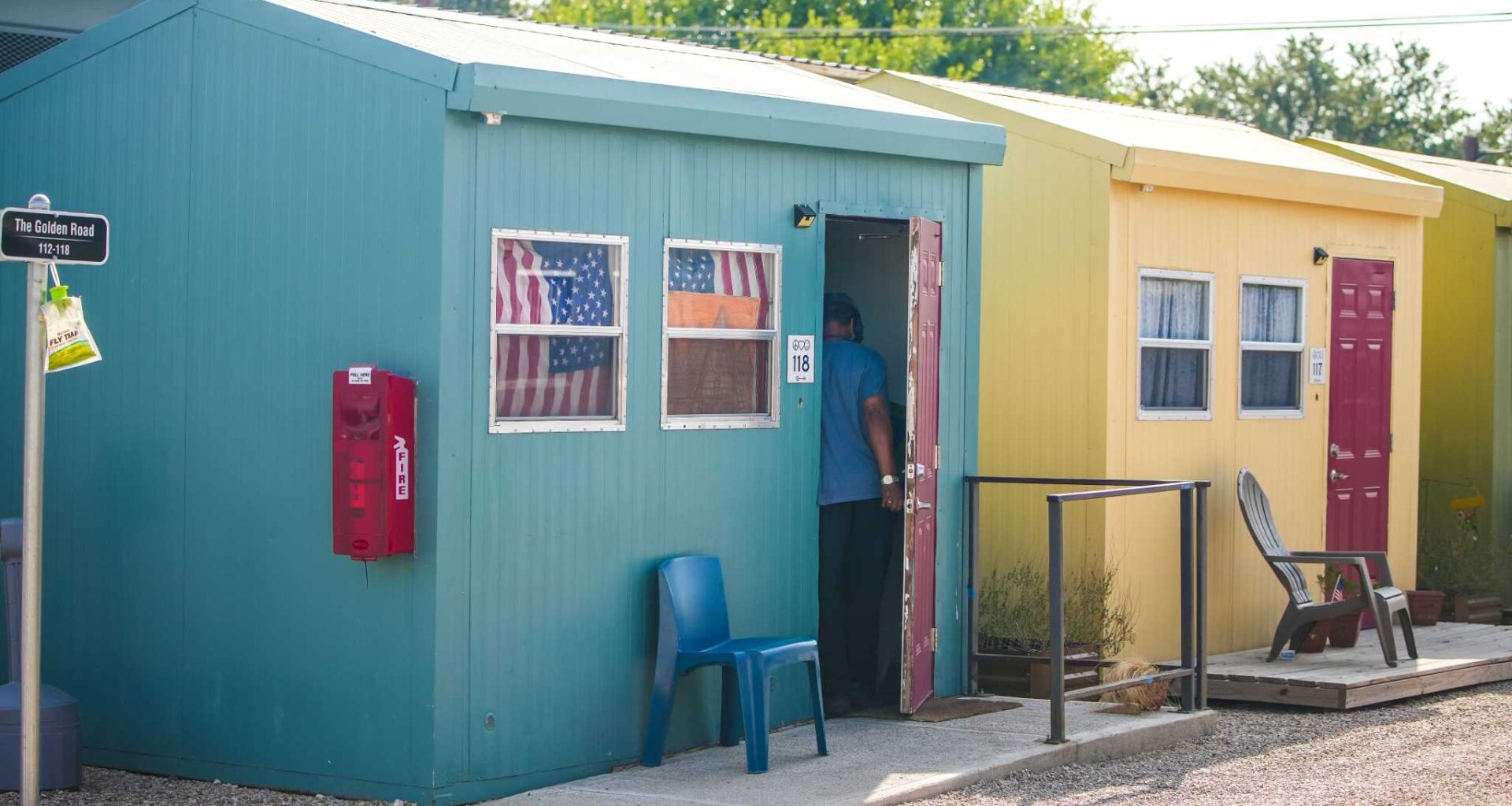
After years of stalled efforts to move people off the streets, Dallas officials are exploring a new concept, a pallet home community they say has growing support at City Hall to move forward.
“There’s finally political will for it,” council member Adam Bazaldua said.
Bazaldua and council members Cara Mendelsohn and Paula Blackmon recently toured a homeless encampment in Austin featuring small, prefabricated homes, and said Dallas could follow a comparable path.
Build a temporary village on Texas Department of Transportation-owned land, paired with mental health and substance use services, before residents move to permanent housing.
Unlike large “congregate-style” shelters, the units are individual, small and meant for short-term stays.
Though discussions remain in early stages, city officials are eyeing a 3.6-acre tract in Bazaldua’s district, covering parts of south and southeast of downtown. They have identified a vendor, Pallet, which has built similar communities in Atlanta, Tampa and Denver.
The proposed 75-unit site would cost about $2.3 million to put up, plus $1.5 million to $2 million annually to operate.
Council members have been searching for interim options for two years to move homeless people from public spaces outside City Hall, parks and thoroughfares.
Among the ideas: tiny homes, manufactured housing and faith-based partnerships to bridge the gap to permanent housing.
The Austin model, called Esperanza, began as a sanctioned encampment with tents and makeshift shelters before transitioning into a cabin-based community with about 200 beds, hygiene facilities and a community center.
The Other Ones Foundation is the nonprofit that runs the community and offers on-site work programs and support services.
“It gives people privacy and security,” said Elizabeth Baker, the nonprofit’s executive director, during a February committee meeting as Dallas council members reviewed strategies from other parts of the country.
Housing Forward, a nonprofit that coordinates homelessness response in Dallas County, said pallet homes could be a “creative solution” to meet the city’s “dire need” for more attainable units.
Dallas’ record with similar projects has been uneven.
Meanwhile, the city did open a new housing facility in North Dallas. It contracted with St. Jude’s, which operates supportive housing sites across Dallas, to manage that facility and another in Oak Cliff at the former Miramar Hotel, which is currently awaiting vouchers from the county to proceed.