
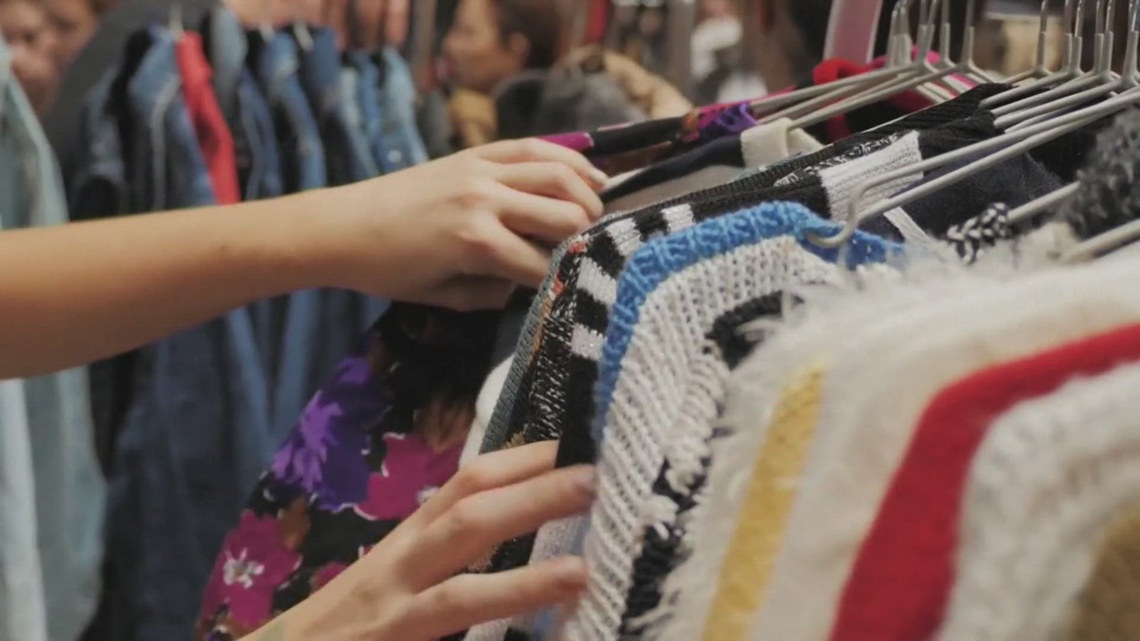
Thrift for Good’s AI system enhances secondhand shopping, easing waste and supporting charities.
DALLAS — Before a donated item ever makes it to the sales floor at Thrift for Good in Hurst, it first moves through a quality control station in the back of the store.
That is where workers inspect donations, photograph them, and use an artificial intelligence-assisted system to help generate prices based on brand, materials and condition.
“Right here we’re checking out the quality of the product,” a worker said during a walkthrough of the distribution center. “We’re gonna look for if it’s a sellable item.”
He said the store’s AI system helps staff move donations through the process faster.
“It’ll generate a price based off the brand, based off the materials of the product, and based off the quality overall,” he said.
That technology sits at the center of a mission that is far less about software than second chances.
Founder Jennifer Cooper said the idea for Thrift for Good came from a simple frustration with waste.
“I started to realize how much waste there was and it didn’t make sense to me in a society where so many people need so much that we have so much excess,” Cooper said.
The environmental problem is significant. The U.S. Environmental Protection Agency says Americans generated 17 million tons of textile municipal solid waste in 2018, and about 11.3 million tons of that ended up in landfills.
Cooper said Thrift for Good was built to keep usable items in circulation while making secondhand shopping feel approachable.
“Since our founding, we have sold over 260,000 items,” Cooper said. “We’ve kept all of those things out of the landfill and we have generated $360,000 for our local charities.”
The store, which has locations in Hurst and Denton, aims to create a more polished shopping experience than some people may expect from thrift retail.
“We make thrifting a lot more like a department store experience where it’s as fun and it’s easy as buying new,” Cooper said.
That pitch appears to be landing at a moment when more shoppers are paying close attention to both price and purpose.
ThredUp’s 2025 resale report said the U.S. secondhand apparel market grew 14% in 2024, its strongest growth since 2021, and projected the market would reach $74 billion by 2029.
For shoppers like Susan King, the appeal is both practical and personal.
“I’ve always loved style, shopping, thrifting,” King said. “I love the hunt.”
King said the rising cost of buying new has made secondhand options even more appealing.
“The prices are so expensive,” she said, adding that consignment and thrift stores can offer clothing “still in really good shape.”
But price is only part of the draw.
As she browsed, King held up a garment in a favorite shade and smiled.
“I’m kind of obsessed with this deep teal color,” she said.
That reaction — part style, part savings, part thrill of discovery — is exactly the kind of moment Cooper said she hoped to create when she launched the business.
Asked what it means to see items find new life instead of ending up in the trash, Cooper called it deeply fulfilling.
“Definitely what I wanted to see when I started this,” she said. “It just seems like it’s a drop in the bucket. Every single time somebody walks out of here with a new outfit, they’re contributing to that change.”
On Earth Day, that change can look small: a shirt, a lamp, a pair of jeans, a new favorite color on a rack.
At Thrift for Good, Cooper sees it adding up one find at a time.
Thrift for Good is also marking Earth Day with its “Thrift for Green” event from 11 a.m. to 8 p.m. April 22 at its Denton store, 1131 E. McKinney St. The free event includes sustainable fashion and home decor, 15% off all day or 20% off for shoppers who bring a reusable bag, plus giveaways, an upcycling vendor, kid-friendly Earth Day temporary tattoos and crafts. And in keeping with the store’s mission, Thrift for Good says 25% of every purchase benefits local charities.