
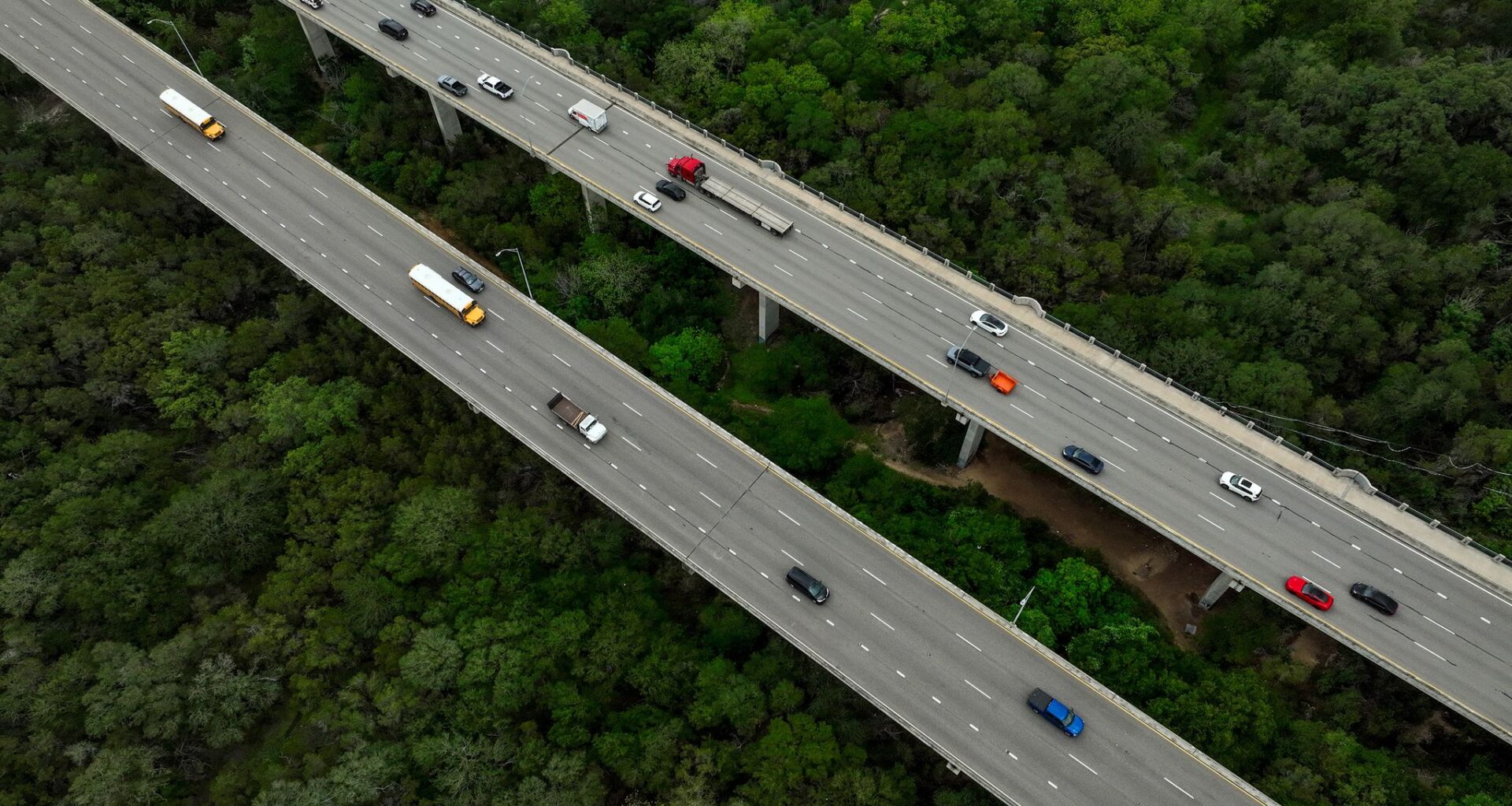
The Austin City Council unanimously passed a resolution Thursday urging the mobility authority to commission a more thorough environmental study on its “MoPac South” proposal. The move came the same week the Travis County Commissioners Court passed a similar resolution and the day after a crowd gathered at Austin High School for an Earth Day town hall to rally opposition to the project.
The project would add multiple lanes in each direction to the highway, including tolled express lanes. The project’s corridor runs alongside Austin High School, Zilker Park and Lady Bird Lake, and it crosses the Barton Springs segment of the Edwards Aquifer recharge zone.
A draft environmental assessment the authority completed in February found the project would not significantly impact the environment. CTRMA, which is leading the effort, has said the expansion would reduce congestion and decrease commute times through the 8-mile corridor. Drivers would save about five minutes during rush hour, or up to 14 minutes if they use the proposed express lanes, the authority estimated.
But organizations like the Save Our Springs Alliance and the Better MoPac Coalition argue the modest time savings don’t outweigh the risks to water quality, endangered species and air quality. They say the environmental study fails to paint a complete picture of the project’s impact.
The assessment is full of “lies about how this won’t harm the environment, how it won’t harm Barton Springs and it will improve our ability to get through town faster,” Travis County Commissioner Brigid Shea said Wednesday at the organizations’ town hall. “None of that is accurate.”
At issue is the type of study that was conducted. Highway projects in Texas require one of two types: an “environmental assessment” or an “environmental impact statement,” the latter of which is much more comprehensive and time intensive. The Texas Department of Transportation decides which type of study is needed, and it directed CTRMA to conduct an environmental assessment for the MoPac South project.
TxDOT also makes the final call on whether the project meets federal environmental rules. Once an environmental assessment is done, the department can clear a project or require a full environmental impact statement. Austin and Travis County are pushing for the latter outcome.
“I-35 had to have a full EIS. Project Connect had to have a full EIS. I just don’t see why the expansion of MoPac would not have to have a full EIS,” Council Member Chito Vela said in support of the city’s resolution during a Thursday meeting.
Jori Liu, a spokeswoman for the mobility authority, emphasized in a statement that nothing is final — including the environmental study.
“The MoPac South Project has not received environmental clearance,” Liu wrote. “We anticipate that decision to be made sometime later this year.”
This is not the first time that Austinites have pushed back on the MoPac expansion. The project’s environmental study was first initiated in 2013, but it was put on pause three years later after some of the same groups filed a lawsuit alleging the same risks to local ecosystems.
The authority is accepting written comments through May 3. Information and a comment form are available online at ph.mopacsouth.com.