
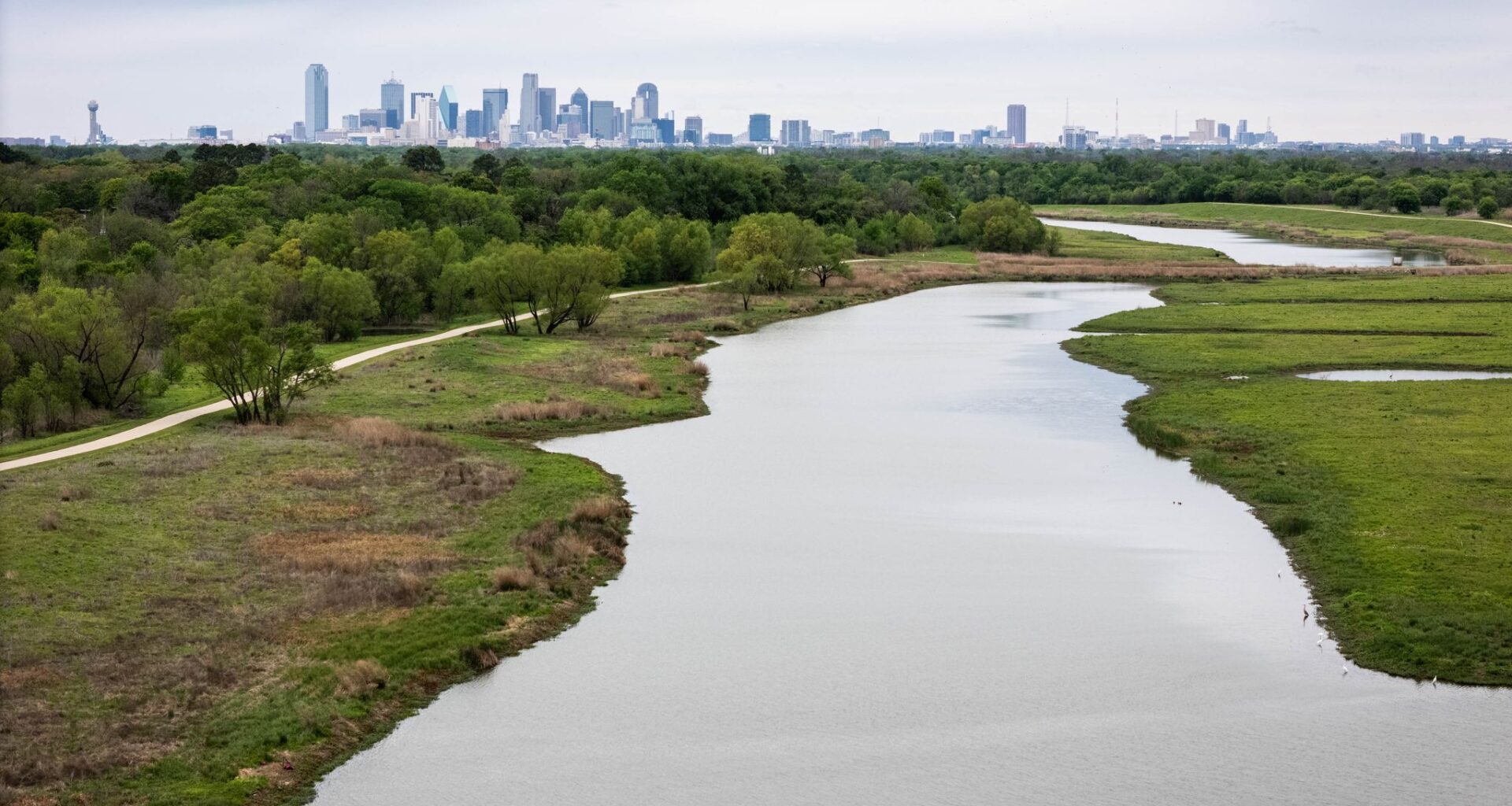
It’s spring and Dallas-Fort Worth feels lush again.

Gardeners plant colorful flowers, runners take laps around White Rock Lake, and boaters and anglers rejoice in warmer days out on the water.
Yet about 400 miles south in Corpus Christi, life looks much different. Residents there are restricting their water use and providers are scrambling to find other groundwater sources amid a historic shortage that looms over the coastal, but parched, city.
Article continues below this ad
The impending emergency grew more urgent recently thanks to a combination of a yearslong drought and delays in developing new reliable water sources needed to welcome new industrial customers.
Related: For more stories and data on the impact of growth in North Texas, visit dallasnews.com/futurentx
Make Dallas News a preferred source so your search results prioritize writing by actual people, not AI.
Add Preferred Source
The stark contrast between what’s happening in Corpus Christi and the lushness in Dallas-Fort Worth suggests the water shortage to the south is more an isolated problem than a harbinger of what’s to come in North Texas.
Article continues below this ad
Or could the escalating water crisis happening there happen here?
The Dallas Morning News posed that question to half a dozen water industry leaders and experts.
The consensus was clear. Right now, North Texas is abundantly hydrated, enough so to accommodate the Lone Star State’s growth story that is rapidly drawing businesses and new residents from around the country.
Article continues below this ad
However, barring appropriate planning and execution, the region could eventually face its own catastrophe – especially while new entrants to the economy put fresh strains on already stretched energy and natural resources.
In separate interviews, the situation was described by two experts as a “canary in a coal mine.”
Andrea Garza and Brandon Oga kiss while sitting on a bench overlooking the new Bachman Lake spillway in Dallas, Monday, April 6, 2026.
Angela Piazza/The Dallas Morning News
“This can happen anywhere for a myriad of reasons,” said Amy Hardberger, professor at Texas Tech School of Law. “No place is safe from a shortage.”
Article continues below this ad
Hardberger said leaders need to make hard decisions.
U.S. cities are considered successful if they’re growing, she said, but there’s a tension between new businesses bringing a higher economy and more people, but also a burden on local resources like water and power.
“If you are city leadership, you have to factor in whether you can meet these businesses’ needs or just the increased demand over time,” Hardberger said.
The other tough conversation communities are facing is the price tag on infrastructure.
Article continues below this ad
Water supply projects, like a desalination plant or reservoir, may be pushed further into the future but the already expensive infrastructure projects have continued to rise in price.
“The cheap water is gone,” she said, “but it isn’t going to get cheaper either.”
‘We have to be aggressive’
Just days after Corpus Christi’s impending water emergency made major headlines in early March, Texas Sen. Charles Perry, R-Lubbock, spoke at Dallas Regional Chamber’s 2026 State of Infrastructure event about the importance of infrastructure planning.
Article continues below this ad
Perry has been a leader in the push for Texas to make investments in its water. He most recently authored the legislation that created the framework for the state to invest a historic $20 billion over two decades into building out water capacity.
He said North Texas is “in good shape” water-wise thanks to local planners, but noted the next version of the state’s blueprint paints a worrying picture.
“If you need water 20 years from now, and you’re not working on it today, you will not meet your water needs … everything in water is long term for lots of reasons,” he said, mentioning Corpus Christi.
State Senator Charles Perry (right) of District 38, delivers the keynote address on water infrastructure for this gathered at the Dallas Regional Chamber’s “State of Infrastructure” luncheon event at the EBJ Union Station in downtown Dallas, March 12, 2026.
Tom Fox/Staff photographer
Perry said some of the biggest challenges around water planning and investment is the narrative around it – including residents who don’t see a problem. They turn on the tap and water pours out.
Article continues below this ad
“Water is the one thing that we do not have a sense of urgency about,” Perry said.
He called the $20 billion historic investment a “drop in the bucket,” because the upcoming 2027 State Water Plan – a draft of which has been published for public comment – will reflect $170 billion or more in water supply and infrastructure needs.
He pointed to opportunities to secure more water. Every area of the state, he believes, has an undeveloped water source. There also is the possibility of purchasing surface water from outside the state.
“We have to be aggressive and get every single drop of water that anybody’s going to sell us on surface level,” he said, also listing water supplies can be obtained from aquifers and repurposing brackish water.
Article continues below this ad
‘We’re seeing it’
Robert Mace, executive director at the Meadows Center for Water and the Environment, said water providers across Texas should be thinking about what they would do if they found themselves in a situation similar to Corpus Christi.
Even proposed solutions – like building out more water supplies – have proven hard-fought and polarizing. For example, the $7 billion Marvin Nichols Reservoir in northeast Texas has been characterized by interregional infighting and local concerns that have delayed the project’s development.
Article continues below this ad
“I tell communities to think about what they would do if their surface water supply dried up,” Mace said. “A lot of communities will probably say that would never happen, but we’re seeing it. I’m not saying build infrastructure when you totally lose your surface water supply but be thinking about what you do, and maybe there’s some things that you could do today to be better prepared for something like that in the future.”
Ways communities can deal with uncertainty include building more robust water supplies, diversifying the sources of their supply, and planning beyond what’s needed to last through a drought of record.
“It’s all risk management and how much risk you’re willing to accept,” Mace said. “There’s probably nothing that is a guaranteed water supply.”
Jeremy Mazur, director of infrastructure and natural resources policy with nonprofit group Texas 2036, said now is the time to revisit the state’s water planning process. He characterized the process as being on “autopilot” for nearly three decades.
Article continues below this ad
Previously, officials used the “drought of record” to plan for worst case scenarios but other elements can’t be ignored. Hotter days last longer, residents and businesses are flocking to Texas in historic numbers and infrastructure is aging.
“We should have water plans because we’re in a drought-prone state,” Mazur said, “but we’re seeing some preliminary evidence suggesting that the state and regional water plans were entirely off the mark with regard to anticipating [Corpus Christi’s] crisis and delivering the infrastructure needed to make the city and the region more resilient to worsening droughts.”
A Ruibal’s Plants of Texas gardener waters flowers in the nursery in downtown Dallas on Thursday, March 19, 2026.
Angela Piazza/Staff Photographer
State and regional water plans in the 2000s and early 2010s, Mazur said, didn’t anticipate a water supply shortage to the scale and magnitude of what’s happening on the coast. It wasn’t until more recent water plans, he said, that officials flagged the need for more water supply infrastructure projects.
Article continues below this ad
“You’re darn right this is a huge lesson learned,” Mazur said. “ … To be clear, we need to have a water plan; it’s no debate. What’s happening raises a lot of questions with regard to the drought assumptions that we’re using, but also, I think we need to be a little more aggressive in terms of talking about how we are identifying and delivering and building these water projects that our regions need for economic growth and drought resilience.”
Some good examples have already been set, Mazur said, mentioning North Texas Municipal Water District’s Bois d’Arc Lake. The Fannin County project was the first major reservoir in Texas in nearly 30 years when it was completed in 2022. It provides up to 82 million gallons of water a day and has been hailed as a feat of “infrastructure ingenuity.”
“We need to have a bigger conversation about water planning and how to make it better,” Mazur said. “I think there’s probably some good lessons learned in what D-FW has done right when it comes to project delivery and development.”
New infrastructure in the works
Local water providers agree that planning is critical for communities across Texas, including in the Dallas-Fort Worth area.
Article continues below this ad
The 2026 Region C Water Plan, which includes North Texas counties, reports many of the water suppliers in the region will have to develop additional supplies before 2080 because some providers are already experiencing shortages. The counties with the largest water needs are Collin, Dallas, Denton and Tarrant.
Jenna Covington, North Texas Municipal Water District’s executive director and general manager, said meeting the needs multiplied by major growth isn’t a new concept for the agency.
That growth is continuing at a rapid rate, she said, citing a statistic forecasting North Texas expected to add a staggering 3.7 million residents by 2050, which is more people than the entire state of California plans to add in the same timeframe.
Maintenance subcontractors Jared Flowers, back, and Rhett Edmondson with Water Tight Inc. and Texas Premiere Coatings use an epoxy to seal a crack between metal and concrete in treatment plant basins at North Texas Municipal Water District on Nov. 13, 2025, in Wylie.
Angela Piazza/Staff Photographer
Multiple supplemental water projects are in the works, including some focused on making use of existing supplies. That includes the Texoma Two Step project, which has two new pipelines allowing more Lake Texoma water to be mixed with water from Lake Lavon and Bois d’Arc.
Article continues below this ad
Expansions are also planned at the agency’s water treatment plants in Leonard and Wylie.
“These types of projects will meet our needs here in the near term,” Covington said. “Beyond the next decade or so, we will need to move forward with some major supply projects to meet the needs of the region and of our organization.”
Planning decades out is important because these massive projects can take a long time to be permitted and constructed. Meanwhile, water supplies, in some cases, are becoming located further away from their service area and the projects are becoming more complex.
“If you’re not looking far into the future, you’re behind,” Covington said. “ … There’s just so many great examples of how folks up this way have been taking steps forward to allow for the growth that we’re experiencing today to be sustained. With that said, we got to keep that up.”
Article continues below this ad
Dan Buhman, general manager of the Tarrant Regional Water District, also serves as chairman of the Texas Water Development Board’s Region C Water Planning Group.
Buhman concluded one of Region C’s most recent meetings with facts he said could serve as a reminder of why the work they’re doing is so important. That includes every dollar invested in water restoration initiatives, which can produce as much as $4 in economic activity.
Spending time, material and emphasis on the foundation of the community “pays dividends forever,” he said.
Article continues below this ad
“It’s often not seen but it’s certainly felt,” he said. “It’s felt by people not having to think about whether their tap will turn on, and that’s good. We want the foundation to be so strong that people can focus on other things, like building their family and building their community.”
Some projects Tarrant Regional Water District has ongoing include a 150-mile long, 108-inch diameter Integrated Pipeline Project with Dallas Water Utilities designed to move water from three East Texas reservoirs into Dallas-Fort Worth, constructing wetlands and testing aquifer storage and recovery.
Both Covington and Buhman said implementing more conservation and reuse strategies and educating the public are integral to meeting the region’s current and future water needs.
Water system manager Kelly Rouse explains, after water is filtered through sand and anthracite, it is pumped through underground pipes at North Texas Municipal Water District into a clear well on Nov. 13, 2025, in Wylie.
Angela Piazza/Staff Photographer
‘Water bankruptcy’
Above all, ensuring Texans have enough water will require buy-in from all levels, including residents, water utilities, developers, lawmakers, and more, said Giovanni Piccinni, director of Texas A&M Agrilife’s Texas Water Resources Institute.
Article continues below this ad
“Something like [Corpus Christi] could happen anywhere,” Piccinni said, “if we don’t start thinking of water as a non-renewable resource.”

By signing up, you agree to our Terms Of Use and acknowledge that your information will be used as described in our Privacy Policy.
A report released by the United Nations earlier this year determined that the world has “moved beyond a water crisis and into a state of global water bankruptcy.” Officials concluded many regions experience persistent shortages with no realistic ability to return to baselines that have prevailed for decades.
“So what are we going to do as a response to that?,” Piccinni asked. “ … We can’t go back and look at the past, but in a city in an urban area, like Dallas that is growing as much as it is, we can make a difference for the future to protect water resources.”
Article continues below this ad
This reporting is part of the Future of North Texas, a community-funded journalism initiative supported by the Commit Partnership, Communities Foundation of Texas, The Dallas Foundation, the Dallas Mavericks, the Dallas Regional Chamber, Deedie Rose, Lisa and Charles Siegel, the McCune-Losinger Family Fund, The Meadows Foundation, the Perot Foundation, the United Way of Metropolitan Dallas and the University of Texas at Dallas. The News retains full editorial control of this coverage.