
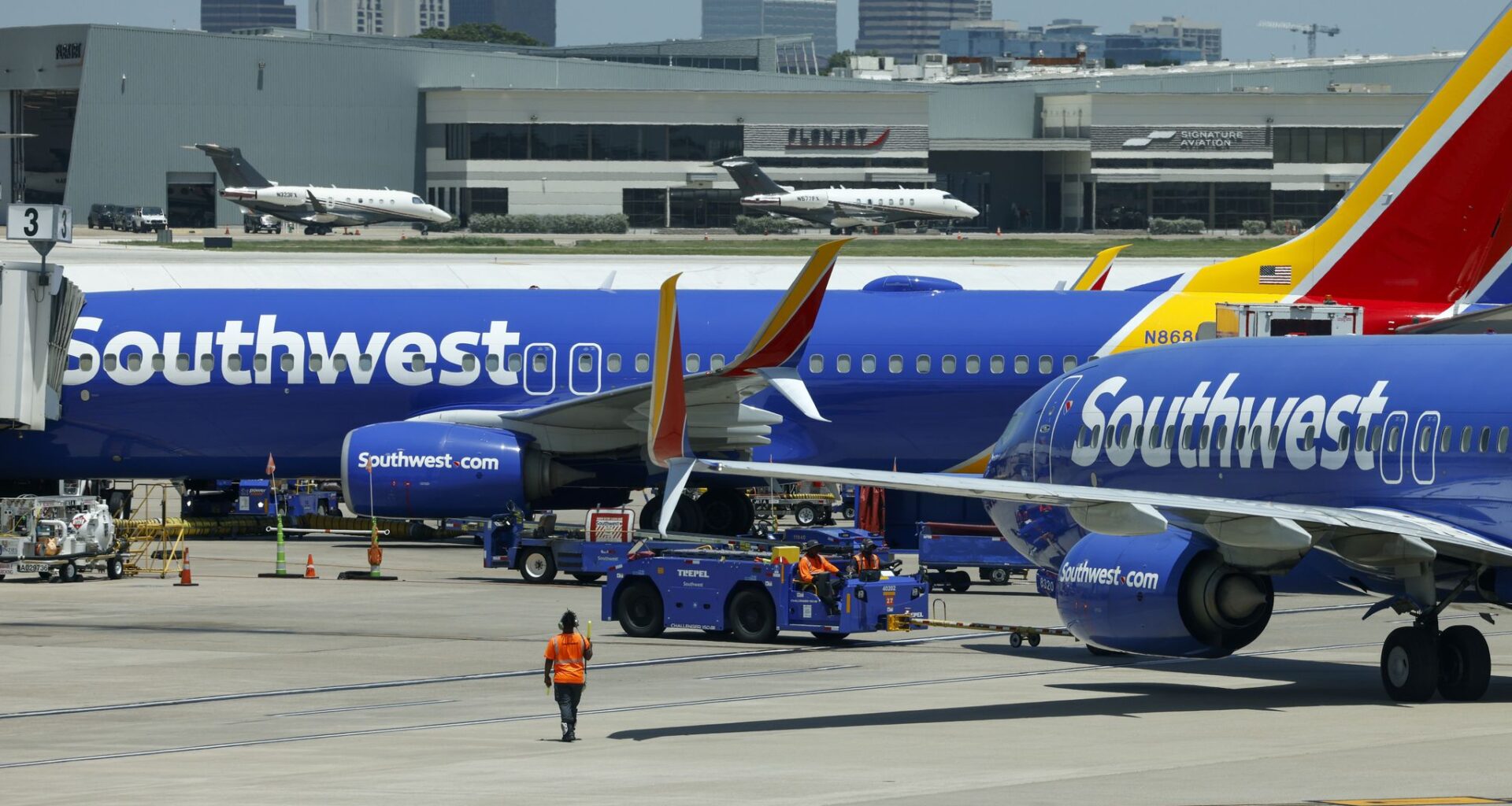
Southwest Airlines reported “meaningful” first-quarter results on Wednesday, setting a Q1 revenue record while containing the fallout from soaring jet fuel prices and the rocky implementation of new boarding policies.
However, the carrier said that costs stemming from the Iran war are expected to spike in the current quarter. Southwest assumes fuel will cost between $4.10 and $4.15 per gallon for the second quarter of 2026, as airlines continue to reel from the impact of the ongoing conflict that has closed the Strait of Hormuz.
The airline, which is the dominant carrier at Dallas Love Field Airport, also forecasted its second-quarter adjusted earnings per share to be between 35 cents and 65 cents per share. However, the current turbulence in the global economy prompted Southwest to demur on a full-year estimate.
“Given the ongoing macroeconomic uncertainty, updating the company’s full-year adjusted [earnings per share] guidance of $4.00 would not be productive at this time,” the airline said in a statement. “Achieving this outcome would require lower fuel prices and/or stronger revenue performance to offset higher fuel expense. The company expects to provide updates to this guidance as appropriate.”
The Dallas-based airline had an action-packed first quarter, highlighted by the launch of assigned seating in late January. The seating change got off to a turbulent start but Southwest quickly began implementing changes to smoothen the process out — resulting in “meaningful margin expansion” despite the initial controversies.
The airline also began service to new markets in St. Thomas (U.S. Virgin Islands) and Knoxville, Tenn., in addition to revealing it is partnering with Elon Musk’s Starlink to upgrade its in-flight Wi-Fi.
And Southwest’s most loyal customers appeared to be pleased with the investments. Enrollments in Rapid Rewards, Southwest’s free loyalty program, were up 37% year-over-year and tier status earners had spiked 62% year-over-year, the airline said.
“Our customers have embraced and value our new products, and that is reflected in our financial performance,” Southwest CEO Bob Jordan said in a statement.
“Demand continues to be strong, and we remain focused on controlling what we can control by managing costs, optimizing revenue initiatives, and directing capacity toward higher‑return opportunities. While the external environment remains uncertain, we are confident in our positioning and the strong momentum we are seeing at Southwest.”
Southwest’s stock fell more than 4% in after-hours trading, after ending Wednesday’s trading session nearly 4% lower at $39.35 on the New York Stock Exchange.