
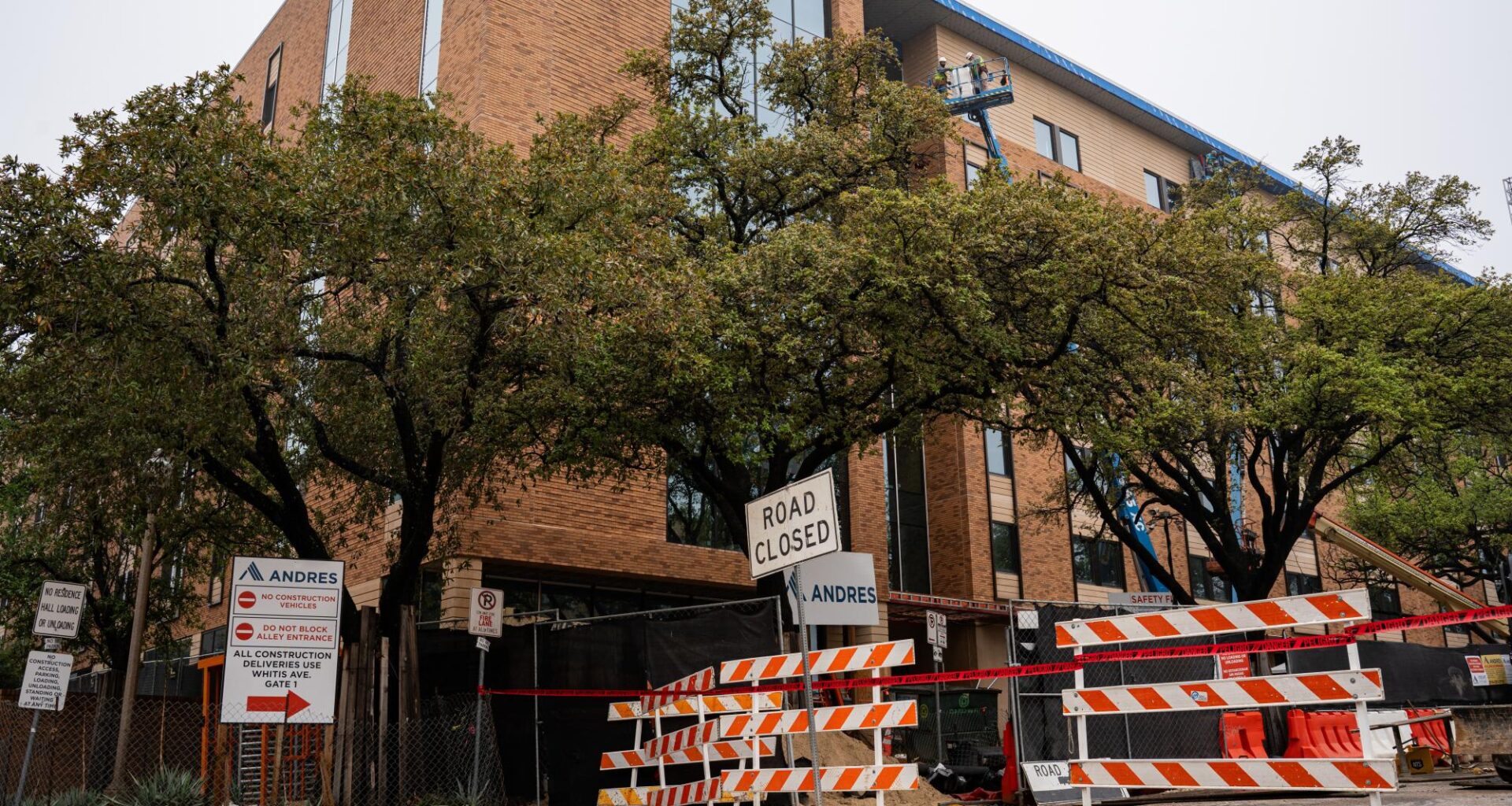
A white banner connected to a lamppost in front of the Tower reads “Our Tower, the next 100 years.” Behind the Dealey Center for New Media, orange and white barricades line the street, shielding the structure of a new residence hall. Where the dark and isolated Chemical and Petroleum Engineering building used to stand, a taller, brighter engineering building will take its place.
As the University continues to grow, so does the construction of new buildings. To ensure new construction is environmentally sustainable, the University looks toward peer institutions and collaborates with various firms, said Matt Stevens, project manager and sustainability planner. UT also works with local chapters of the U.S. Green Building Council, a nonprofit organization dedicated to transforming “the built environment” toward a more sustainable future, Stevens said.
Leadership in Energy and Environmental Design is “the most widely used green building rating system,” according to the USGBC website, and the system UT uses to evaluate its building sustainability. All UT buildings in the design process after March 2025 are required to achieve a LEED Gold certification, Stevens said.
For a project to achieve a LEED certification, it must first meet a set of three minimum program requirements: be in a permanent location on existing land, use reasonable LEED boundaries and comply with project size requirements. Then, the project earns points for meeting criteria in categories such as energy efficiency, water conservation and indoor air quality.
Projects are then reviewed and verified by the Green Business Certification Inc. and awarded points that correspond to a LEED certification level: either Certified (40-49 points), Silver (50-59 points), Gold (60-79 points) or Platinum (80+ points).
The most recent version of LEED, LEED v5, was released in April of 2025, and has an additional focus on decarbonization, ensuring quality of life for occupants and ecological conservation and restoration, according to the USGBC website. Developers cannot register for the old version of LEED after this June, according to Anica Landreneau, the director of sustainable design at HOK, a global design, architecture, engineering and planning firm.
Decarbonization is the process of reducing carbon and other carbon-like greenhouse gases that absorb and radiate heat back onto Earth’s surface, Landreneau said. According to the Global Monitoring Laboratory of the National Oceanic and Atmospheric Administration, “carbon dioxide alone is responsible for about 80% of the total heating influence of all human-produced greenhouse gases since 1990.”
Landreneau, who just ended her three-year tenure as a chair of the USGBC LEED steering committee, said LEED is looking to reduce both embodied and operational carbon throughout the construction process.
Embodied carbon refers to carbon emitted in the beginning of the construction process, from the extraction of raw materials to the installation of those materials in a building, as well as at the end of a building’s life when it is decommissioned or demolished. Operational carbon is the sum of all carbon emitted throughout the lifetime of a building, Landreneau said.
Landreneau said the new version of LEED also requires a carbon assessment, a climate resilience assessment and a human impact assessment as a prerequisite for all projects.
“I think it’s very interesting that our building codes don’t yet require that kind of resilience assessment,” Landreneau said. “But, LEED, as a leadership design standard, is requiring it, and we may see that, just like with other policies and codes, that the regulatory environment catches up as this market demand increases.”
Engineering Discovery Building
The Engineering Discovery Building, originally called the Chemical and Petroleum Engineering building, is projected to finish by this July with a LEED Gold certification, according to Kathleen Hetrick, UT alumna, associate principal at Buro Happold, and part of the team that worked on designing the EDB. The building will feature research labs, integrated teaching labs and classroom labs, and collaborative study areas, according to the University’s Planning, Design, and Construction website.
Landreneau said lab buildings generally use more energy than residence or lecture halls, as they require high ventilation to exhaust out chemicals and have high plug loads to accommodate electrical appliances.
However, the EDB is expected to be 25% more energy efficient than a typical laboratory and save 37% of its indoor water, and its landscape design is expected to save around 50% more water compared to typical landscape designs, according to Hetrick.
The standards set by the American Society of Heating, Refrigerating and Air-Conditioning Engineers are some of the most widely adopted model energy codes, according to the U.S Department of Energy. ASHRAE provides standards and guidelines for indoor air quality, thermal comfort, energy conservation and refrigerants.
The proposed design elements of new projects are entered into a computer model and compared to the ASHRAE baseline. The computer then gives a percentage of how much better or worse the proposed project is compared to the society’s standards. As of March 19, the EDB was projected to be 26.8% more efficient than ASHRAE standards, according to Stevens.
One aspect that sets the EDB apart from other lab buildings is its use of biophilic design, the integration of nature into a building.
“Most people think that sustainable design is only about the environmental impact,” Hetrick said. “But a big part of that is human health in our interaction with nature and bringing people closer to nature, back to nature, especially in learning environments.”
The EDB will feature vegetated patio gardens to mitigate what is called the urban heat island effect, said Stevens. Urban heat islands occur where structures, such as buildings and roads, are concentrated, and greenery is limited, causing the structures to absorb and re-emit the heat. This leads to higher temperatures in urban areas than in surrounding rural areas, according to the United States Environmental Protection Agency.
Biophilic design also includes having windows that allow daylight and seeing the passage of time, as well as incorporating images, colors, organic shapes and materials that are evocative of nature, Hetrick said.
Hetrick, who graduated from UT in 2015 with a degree in architectural engineering, said that as a former student, she recognizes engineering buildings can be “kind of dark” or “not really nice to work in.”
“I’d always go to the Six Pack to study instead, or the Union,” Hetrick said. “So, it’s so awesome to see all these new beautiful, human, student-centered buildings coming up in the engineering quad. It just fills me with a lot of joy to see that.”
Whitis Court Residence Hall
The Whitis Court Residence Hall, originally composed of six two-story buildings connected by a courtyard, is set to finish construction in 2027 as a seven-story residence hall containing 1,000 beds. The project is currently on track for a LEED Gold certification, according to Valerie Neis, the director of organizational communications for UT’s Operational Services and Strategies department.
Whitis Court’s landscape plan includes pollinator gardens, native vegetation and smart irrigation systems, which are anticipated to reduce the building’s landscape water needs by 70%, Nicole Pampe, executive director of strategic communications, wrote in an email.
The University anticipates that potable water will be reduced by at least 30% through energy-efficient washing machines, ice makers, dual-flush toilets and low-plumbing fixtures, Pampe wrote.
Whitis Court will also include “high-performance windows” and a “reflective roof membrane” to minimize heat gain and reduce the cooling load, according to Pampe’s email.
Jim Walker, UT’s director of sustainability, said one of the “coolest things” about Whitis Court is the University’s tree preservation.
The University preserved trees from the original courtyard of the previous residence hall to maintain the ecosystem and sequester CO2 in what will be a highly populated area.
Pampe wrote that the dormitory will also use non-emitting and low-emitting materials like paint and adhesives, along with reusing or repurposing old materials.
Whitis Court will promote circularity by offering “easily accessible recycling collection,” Pampe wrote. Recycling bins will be located in the two trash rooms on every floor, along with smaller bins in each room.
“We’re always trying to do better, right?” Walker said. “We’re always trying to make an energy-efficient building. We’re always trying to have the power plant pursue efficiency. We always try to have water-efficient fixtures in all the buildings, pursue water conservation on a campus level. All scales of our campus need to pursue energy and water conservation.”