
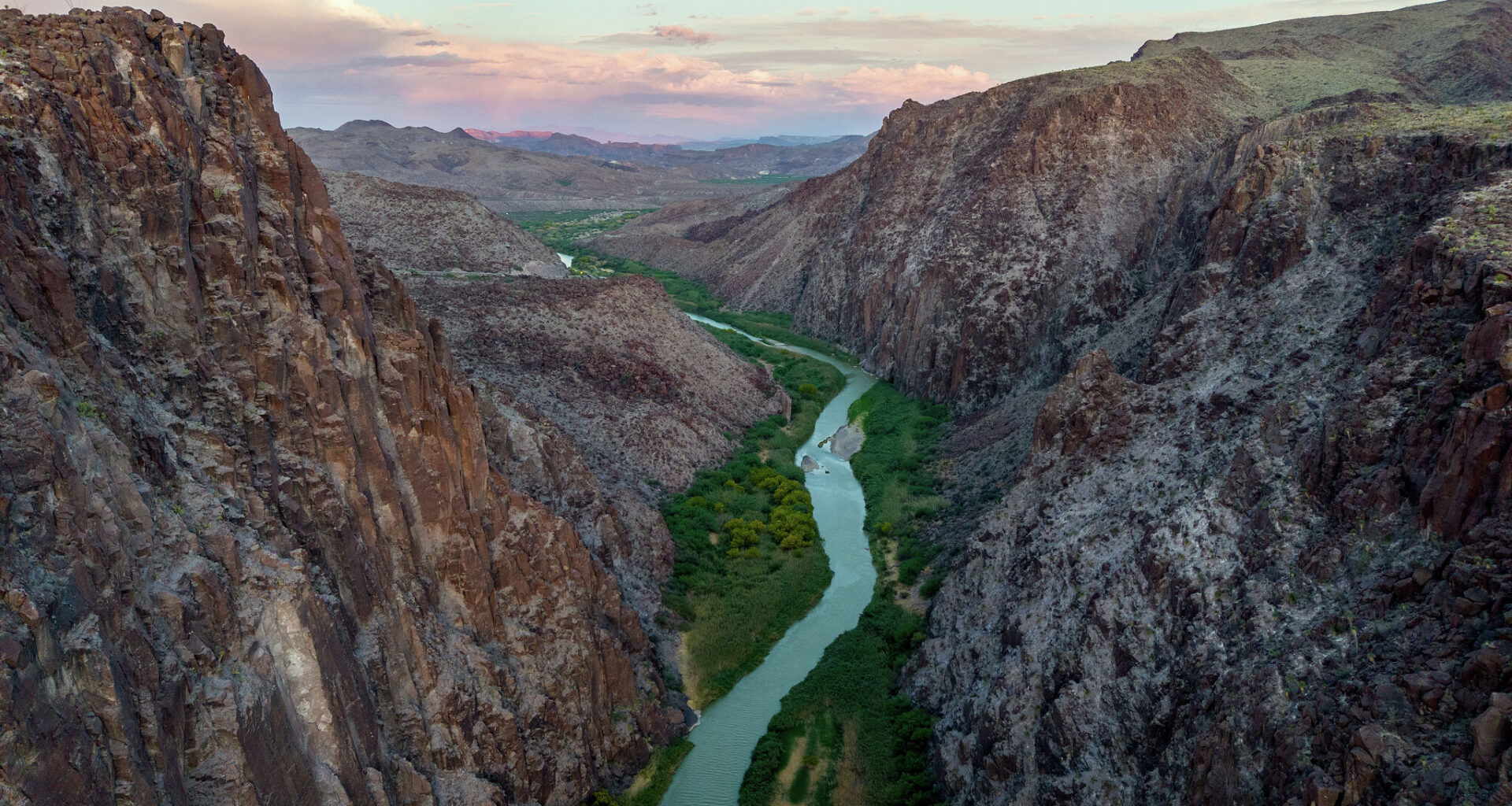
Will a massive steel and concrete border wall cut through the iconic Big Bend National Park, one of the most formidable environments along the United States’ southern border?
Over the last several months, the answer to that question has shifted from yes, to no, to maybe and, now, to who knows? But the possibility that 30-foot-tall concrete and steel bollard fencing could slice through the largest natural wild space left in Texas has united local residents and government leaders alike — regardless of political party affiliation — against the border wall.
That’s the question, but the answer remains unclear. News of U.S. Customs and Border Protection’s plans to build a border wall through even the most rugged and inhospitable portions of Big Bend first broke in early February. At the time, CBP’s so-called “Smart Wall map” — an interactive tool that allowed the public to view what types of security infrastructure the government planned to construct and where — showed that “primary border wall system” would be installed through the national park, according to The Big Bend Sentinel. That meant some 150 miles of 30-foot-tall steel bollard fencing, access roads, and powerful nighttime lighting.
The news sparked fierce public backlash, and, in the weeks that followed, the Smart Wall map was updated to reflect plans for a “virtual wall” instead. The changes continued, with the Smart Wall map at various times alluding to electronic “detection” technology and vehicle barriers. Late Thursday, however, CBP appeared to have removed the Smart Wall map from its website entirely.
The border wall would irreparably change Big Bend. The Center for Biological Diversity, which is suing the federal government in an attempt to stop the wall, has said that a wall would “(gouge) a wound that will never heal into one of America’s most beautiful and wild places.”
The organization further says that a wall would cut the public off from the Rio Grande and isolate wildlife populations, including black bears. Powerful nighttime lighting along the length of the wall would also impact Big Bend’s status as one of the few Dark Sky-certified places in Texas.
CBP’s border wall plans for Big Bend have sparked nearly unanimous bipartisan backlash. On Thursday, the top leaders of all 14 counties along the Texas–Mexico border — both Democrat and Republican — sent a letter to Homeland Security Secretary Markwayne Mullin to dispel uncertainty and be more transparent about the agency’s plans for the region. The 14 border county judges say there’s no one-size-fits-all approach to border security that works along Texas’ 1,300 miles of border.
“In some instances, infrastructure and operational decisions have had unintended impacts, including limitations on access to water sources, (and) challenges related to property access,” the officials wrote.
The county judges invited Mullin to draw on their combined knowledge of the Texas border to work collaboratively on a border security solution that preserves “natural resources, access, and the unique character of the region.”