

Editor’s Note: Join me in welcoming Robin Berghaus, an Austin, Texas based freelance journalist, audio and documentary producer whose work has appeared on NPR at international film festivals, on PBS, and as part of Alfred P. Sloan Foundation’s “Science on Screen.” She’s joining The Microdose to help cover news on Fridays. This is her first post.
On April 18, President Donald Trump signed an executive order to expedite approvals and access to psychedelic-assisted therapies. The order directs psychedelic drug development to be fast-tracked; establishes a pathway for patients with life-threatening illnesses to access psychedelic drugs; allocates at least $50 million in federal funding to support state-funded psychedelic research programs; requires an increase in clinical trial participation and evidence on psychedelic therapies, and directs timely rescheduling of psychedelic drugs that have cleared Phase III clinical trials.
At the White House press conference, podcaster Joe Rogan shared how his recent text exchange with the President prompted the executive order. Rogan said he texted the president that some 80,000 Americans died of drug overdoses in 2024. He then claimed that 80% of people are cured of addiction after one dose of ibogaine, 90% with two doses. “I sent him that information and the text message came back: ‘Sounds great. Do you want FDA approval? Let’s do it,’” Rogan said, recalling the president’s text.
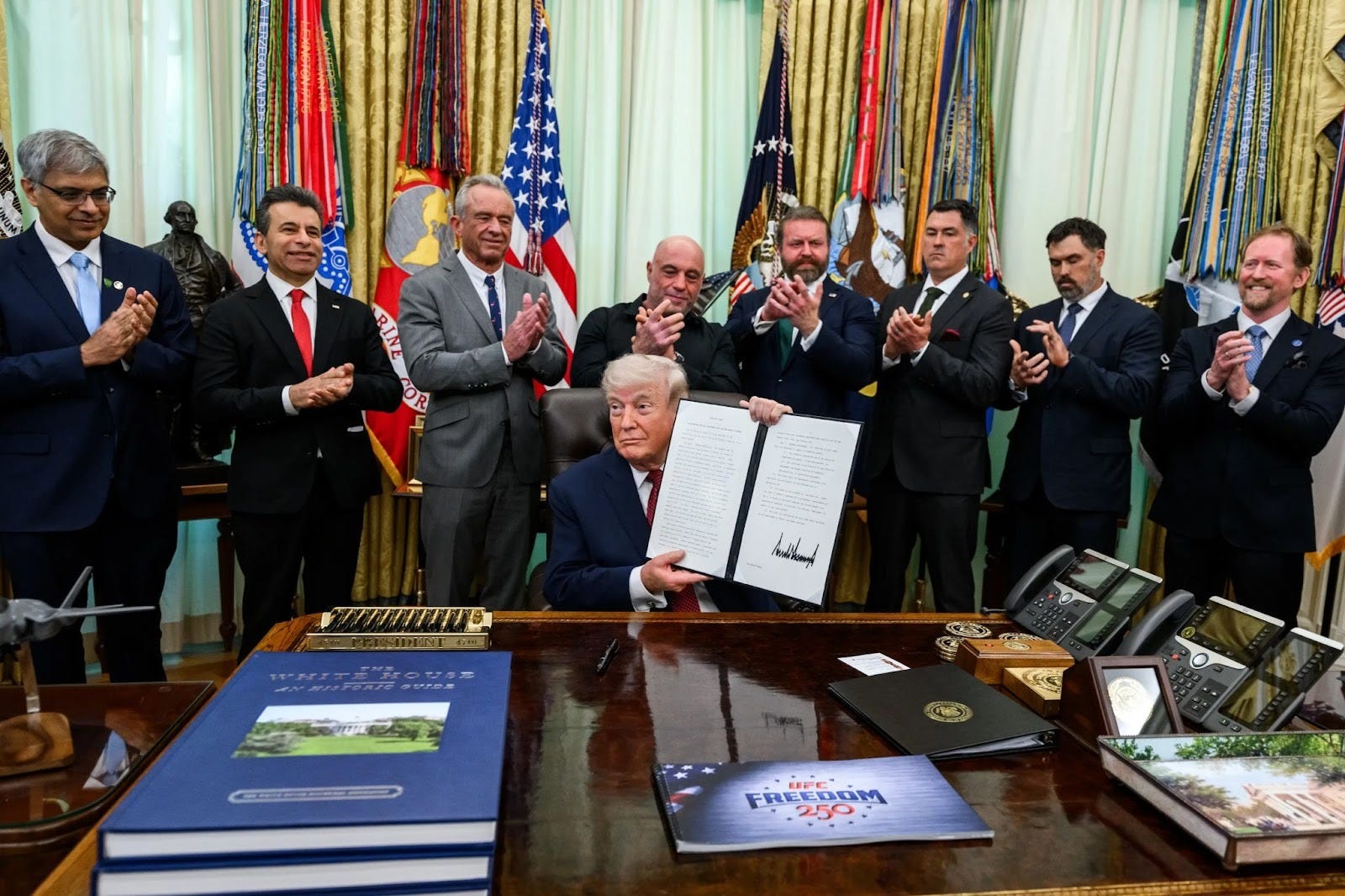 President Donald Trump signed an executive order to accelerate psychedelic treatments in the Oval Office of the White House in Washington, D.C., April 18, 2026. (Photo: White House)
At the signing, President Trump shared findings from an observational study led by the late Nolan Williams and other researchers at Stanford University. The study found that 30 special operations veterans who underwent ibogaine therapy at a clinic in Mexico experienced, on average, an 80 to 90 percent reduction in their symptoms of depression and anxiety within one month. Then President Trump quipped, “Can I have some, please?”
The executive order came together quickly. Three weeks ago, Rogan spoke at length about ibogaine on his podcast with former Texas Governor Rick Perry and Bryan Hubbard, CEO of the non-profit advocacy organization Americans for Ibogaine. This was the second time the pair had gone on the show to talk about ibogaine. “It is the moonshot of our time. And if there’s a humanitarian legacy to be left for the ages by a president who very much wishes to have a legacy that is well reflected upon by posterity, this is one of the most monumental opportunities he has to help folks at scale in a way that no president perhaps has before,” Hubbard told Rogan, who said he’d try to make sure the president got that message. Rogan clearly did that.
That conversation occurred in Rogan’s Austin, Texas podcast studio, one of many ways this executive order was shaped by Texas. Last year, Perry and Hubbard succeeded in getting the Texas Legislature to pass a $100 million bill (SB 2308) to help fund ibogaine clinical trials, which Governor Greg Abbott signed into law in June. Half the funds were to be invested by the Texas government, and half matched by a drug developer. Since then, several states have passed or proposed similar legislation to fund ibogaine research.
Trump’s executive order comes at a crucial time for Texas. In December, UTHealth Houston and The University of Texas Medical Branch at Galveston were awarded $50 million from the state of Texas to lead the ibogaine clinical trials. At the time, a drug developer partner, stipulated in the law (SB 2308), had not been confirmed. On March 31, Texas Lt. Gov. Dan Patrick and Texas House Speaker Dustin Burrows announced that Texas would lead ibogaine clinical trials without a drug developer, and said that they intend to “fully fund this program.”
On that same day, Perry and Hubbard went in to record Rogan’s podcast. In an interview with The Microdose on Tuesday, Hubbard said he and Perry had high hopes for advancing psychedelic reform in Texas and beyond, based on Health and Human Services Secretary Robert F. Kennedy Jr.’s support. But Hubbard felt there were people in President Trump’s administration who opposed psychedelics. He said that a recent Politico article affirmed his gut instincts that “reformers from the inside were going to need political leverage brought from the outside.” That’s where Rogan came in.
Trump’s executive order directs the Secretary of Health and Human Services through the Advanced Research Projects Agency for Health (ARPA-H) to allocate at least $50 million to states that are developing psychedelic research programs. And Texas is likely to get some of that funding. “The $50 million specified in the executive order is what I would describe as an initial down payment to create the unified multistate framework for the execution of a federal-state partnership for a national ibogaine development trial,” Hubbard told The Microdose. Texas would likely be joined by other states that have passed similar ibogaine bills.
Hubbard and other ibogaine advocates have also been working to get tribal nations on board. One week before President Trump signed the executive order, Hubbard met with the leadership of the Cherokee, Chickasaw, Choctaw, Muscogee (Creek), and Seminole Native American tribal governments at the Inter-Tribal Council (ITC) quarterly meeting in Oklahoma, and leadership voted unanimously to support medicalized ibogaine.

So what does the executive order actually do?
It directs the Food and Drug Administration (FDA) Commissioner to provide Commissioner’s National Priority Vouchers to psychedelics that have received Breakthrough Therapy designations for treating mental illnesses, which include formulations of psilocybin, LSD, MDMA, and 5-MeO-DMT. In other words, psychedelic drugs could get fast-tracked approval by the FDA.
At the April 18 press conference, FDA Commissioner Martin Makary said that three national priority vouchers for psychedelics would be issued. The compounds, but not the companies receiving the vouchers, were announced by the FDA on Friday. They are psilocybin for treatment-resistant depression, psilocybin for major depressive disorder, and methylone, a drug similar to MDMA, for post-traumatic stress disorder. Makary told NBC News that the FDA could potentially approve the first psychedelic drug by the end of summer.
It establishes a way for patients with life-threatening and terminal conditions to access Schedule I psychedelic drugs under the Right to Try Act. Under the Right to Try Act, patients with life-threatening conditions who have exhausted approved treatment options can access experimental medications that have passed Phase I testing but are not yet FDA-approved. In order for a patient to get a psychedelic drug in this way, there would need to be a willing prescriber and a government-approved manufacturer.
It allocates at least $50 million in federal funding to match investments made by state governments to advance research into psychedelic therapies for populations with serious mental health conditions.
It requires Health and Human Services (HHS) and FDA to work with the Department of Veterans Affairs and the private sector to increase clinical trial participation and obtain evidence about psychedelic therapies.
It directs the U.S. Attorney General to initiate reviews of psychedelic compounds that have completed Phase III clinical trials so they can be rescheduled soon after FDA approval.
Currently, ibogaine, MDMA, psilocybin, LSD and DMT are all Schedule I drugs, meaning the federal government considers them to be substances with a high potential for abuse and no currently accepted medical use. Rescheduling substances into a less restrictive class makes it easier for medical providers and researchers to access them.
Now that the executive order has been signed, Hubbard says the work begins to ensure the order is enforced by “five massive bureaucracies:” the Health and Human Services (HHS), Food and Drug Administration (FDA), Veterans Affairs (VA), Department of Justice (DOJ), and Drug Enforcement Administration (DEA). “It ain’t worth the paper it’s written on, unless the government follows its instructions, and government has the propensity to not follow its own rules,” Hubbard said.

If you want to dive even deeper into the Texas psychedelics story, last year I reported and produced a three-part podcast with Texas Public Radio called Psychedelics and the Texas Trip.
On April 15, the Louisiana Senate unanimously passed a bill (SB43) to create a psychedelic-assisted therapy program to fund ibogaine and psilocybin clinical studies for opioid and substance use disorders, and treatment-resistant mental health conditions. If passed by the Louisiana House and signed by the governor, the bill would authorize the state’s Department of Health to seek funding from the federal government, opioid settlement funds, and other grants and gifts.
Pharmaceutical company DemeRx announced the FDA has accepted its Investigational New Drug (IND) application for DMX-1001, an oral noribogaine, which is the primary active metabolite of ibogaine, for treating alcohol use disorder. The company anticipates initiating its Phase II clinical trial of DMX-1001 in 2027.
The federal Advanced Research Projects Agency for Health (ARPA-H), an agency within Health and Human Services, announced the first research teams for a $139 million initiative that aims to validate the effectiveness and safe use of rapid-acting therapies for behavioral and mental health and to definitively understand and accelerate approvals of effective therapies. Multiple awardees on the list are working with psychedelics.
The ibogaine treatment provider Beond, which has been offering ibogaine to clients in Cancún, Mexico, will establish its U.S. headquarters in Austin, Texas this year. For now, the Austin location will offer pre-treatment preparation and post-treatment integration for U.S. clients who receive ibogaine at the Mexico clinic, but the company also seems to be positioning itself in Texas in advance of the possibility of FDA approval of ibogaine.
Thomas Delaney, a 39-year-old educator who lives in Glasgow, told the Guardian he was “peeing blood constantly” due to a years-long ketamine addiction before going to a rehabilitation clinic.
Canadian drug manufacturer Optimi Health launched an Ibogaine Initiative, to manufacture and supply ibogaine. Optimi Health supplies pharmaceutical-grade MDMA and psilocybin to clinical trials and special access programs globally.
Journalist Mattha Busby reported for The Guardian about the changing U.S. drug landscape and its shift away from cocaine toward ketamine, psychedelics, and GHB.

You’re all caught up! We’ll be back in your inbox on Monday with a new issue of 5 Questions.
If you know anyone who might like the latest on psychedelics in their inbox, feel free to forward this to them, or click below.
Got tips? Email us at themicrodose@berkeley.edu.