
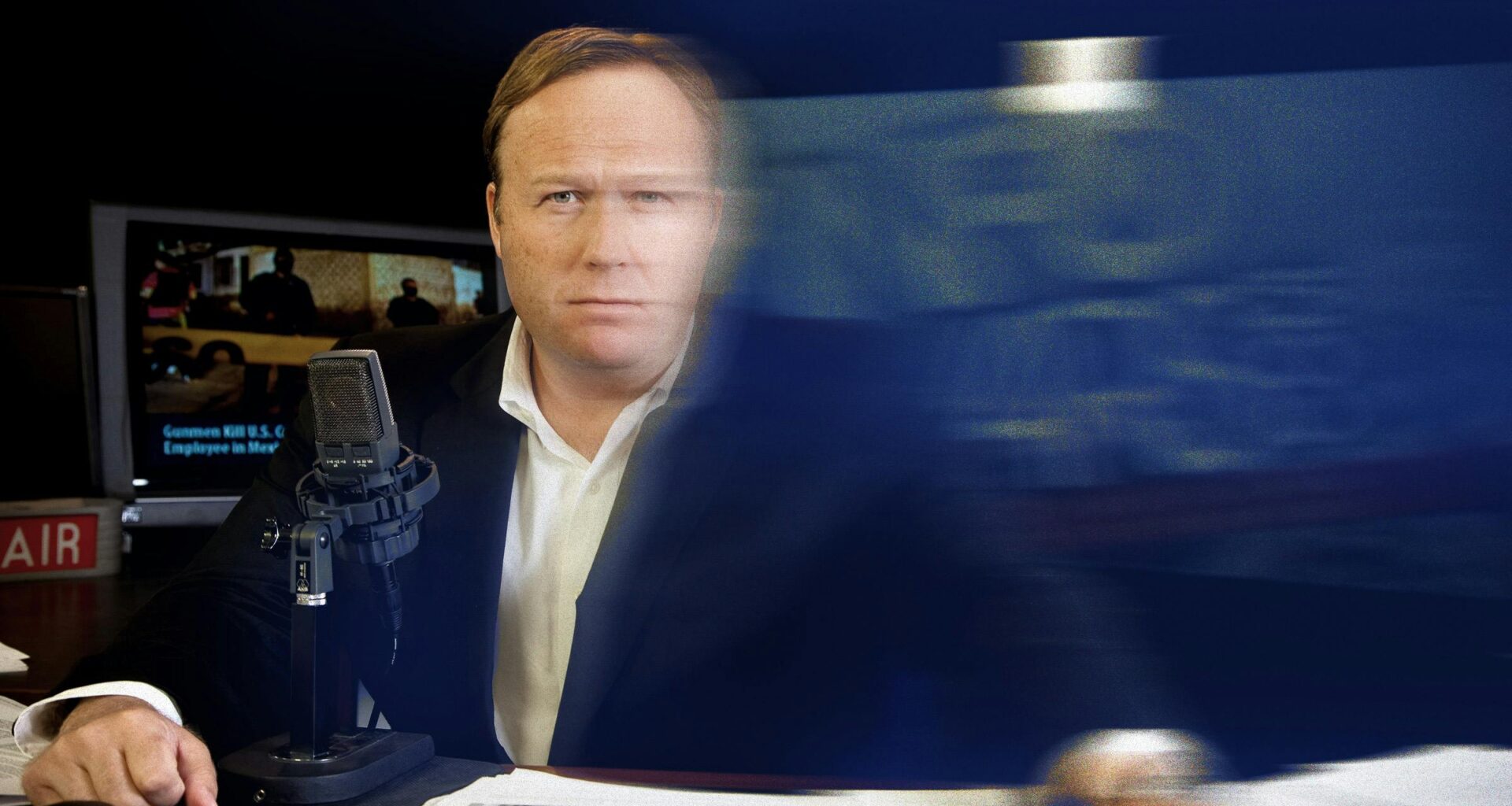
Infowars’ time as the mouthpiece of Austin far-right conspiracy theorist Alex Jones is, pending a final review in the same courtroom in which he lost his first defamation lawsuit, coming to an end. It’s the culmination of a journey toward oblivion that began more than a decade ago, when Jones insisted on the air that the Sandy Hook school shooting in which 26 people, mostly small children, were murdered was a hoax.
The shooting did occur, of course. Twenty of the victims were kindergarteners, whose parents arrived at the school the day of the massacre unsure if their kids were among those slaughtered; they waited in a staging area as other parents were told where they could claim their children until they learned there were no more surviving children to reunite with their families. Those parents were, instead, given the opportunity to identify their six- or seven-year-olds, holding their bullet-riddled bodies one last time. Jones claimed on his show in 2017 that those parents were actors, and that the children who were murdered had never lived at all.
That broadcast proved fateful for Jones and Infowars. He had made similar claims in the past, but revisiting the topic five years after the shooting restarted the clock on the statute of limitations for a lawsuit among parents whose feelings had evolved from shock to outrage. Neil Heslin, a father who spoke of cradling the body of his son Jesse, and his ex-wife, Scarlett Lewis, hired Houston attorney Mark Bankston to sue Jones and Infowars in an Austin court. Later other Sandy Hook parents filed their own joint suit in their home state of Connecticut. Jones lost both cases and was found liable for a total of $1.4 billion in damages, far more than Jones or his assets were worth.
Still, Jones was successful in delaying the most visible consequence of the verdict: Filing for bankruptcy protection in a Houston court left many of his assets in limbo—chief among them the Infowars web domain and intellectual property. (His watch collection, alas, was not granted the same deferral.) The families to whom he is ten figures in debt wanted Infowars put up for auction, and the bid was won by the satirical newspaper The Onion for $1.75 million in cash, along with other incentives. When Jones complained that the property could have fetched more than it did, the judge canceled the transaction and Jones maintained control of the site, on which he’s expected to cease broadcasting and publishing in a few weeks’ time. Now, however, after more than eighteen months of legal wrangling, The Onion is finally poised to gain control of the Infowars internet domain and intellectual property, where it will be run as a parody of its former self, overseen by comedian Tim Heidecker.
And thus ends an era—one in which a local Austin crank began his career as a ruddy-faced crackpot in a city known for keeping it weird and rose, largely by accident, to a position of unlikely political influence. What comes next—for Jones, and for the post-truth world he helped pioneer—remains a question.
Alex Jones’s career as a broadcaster began in the mid-nineties on Austin Public, his home city’s public access cable network, which allowed anyone with an idea and the willingness to sign up for an obscure time slot in the network’s studio the opportunity to go live in front of an audience of other up-late weirdos.
Back then, such an ability was uncommon; it would be decades before YouTube or smartphones were invented, and actually reaching any sort of audience required outside help. Austin’s Channel 10 was an incubator of sorts for some of the city’s most vibrant and singular talents—Bill Hicks, Richard Linklater, and Robert Rodriguez all participated—and featured oddball shows like The Ol’ Bitty Show, Clown Time, and Sail Hatan (a call-in karaoke show). It attracted those who wanted to connect or alienate, perform or curate. Musicians touring through Austin might pop into the studio to perform on CapZeyeZ or Raw Time; if you turned on Channel 10 at the right time of night, you might have gotten to see an early performance from Gwen Stefani and No Doubt. Or you might have seen Alex Jones developing a nascent version of what would become Infowars. Speaking to The Austin Chronicle in 1999, Jones gushed about what Austin Public meant to the community. “I just think access is so damn important,” he said. “If someone watching doesn’t like what they see, wait a minute and it will be something completely different, or they can come down and get a show.”
In those early days, Jones’s act, which was also syndicated on radio stations, was full of conspiracy theories, but such things were mostly a novelty. His show was an entertaining mix of skits and rants about black helicopters—not much different from, say, Art Bell’s Coast to Coast AM. He caught the attention of producer Kevin Booth, whose Sacred Cow Productions had helped famed comedian Bill Hicks become an international cult figure before his death from cancer at age 32; Booth saw in Jones another funny, shouty absurdist whose willingness to go to extremes in positing nonsensical conspiracies was harmless fun. He told me the first time we talked about Jones, back in 2017, that he’d assumed if people liked Bill Hicks, they’d love Alex Jones. Sacred Cow released compilations like 2000’s The Best of Alex Jones and produced Jones’s 2005 documentary, Martial Law 9/11: Rise of the Police State.
In those years, Jones was mostly harmless, a keep-it-weird fixture of an Austin that was still defined more by Slacker than Joe Rogan or Elon Musk. You might walk by a construction site and the crew would be listening to Jones’s radio show on a boombox as Jones bragged about how many followers he had on MySpace in between insisting that George Soros had Slobodan Milošević killed. He could be funny, even about his own public persona, as his career took off in the post-9/11 years; he parodied himself in a prescreening video for the Alamo Drafthouse in which he urged patrons not to talk during the movie. “We’re going to find out who these talkers are, we’re going to find out where their funding comes from, and we’re going to shut them down!” he intoned. He was the sort of conspiracist crank you might see a version of in a show like The X Files or a movie like Enemy of the State—or see directly in Linklater’s A Scanner Darkly and Waking Life, both of which featured Jones playing a character inspired by his own persona.
That persona took on a darker edge during the Obama years. Conspiracy theories about our forty-fourth president were part of the mainstream on the right, from lies about his birth certificate to claims that the federal government was preparing to invade Texas. Jones’s position that the government was constantly on the verge of sending jackbooted thugs onto the street found purchase among militia types and so-called “patriot groups.” By the time Jones started insisting that Sandy Hook was, as he would say in 2015, “completely fake, with actors,” part of a plot by the Obama administration to seize Americans’ guns, his audience wasn’t laughing with him anymore. The move made him rich, as his business model pivoted from selling DVDs by mail and collecting syndication fees to selling dubious “health” supplements to the paranoiacs who made up his new audience.
In whatever part of the multiverse where John McCain won the 2008 election, Jones is probably still Austin’s lovable local crank, making $150,000 a year via syndication and talking about how President Martin O’Malley is secretly a robot. But the political history of the past decade has been full of unlikely outcomes, and as the Obama years gave way to the first Trump administration, Jones—who interviewed President Trump during his first campaign—was no longer an outsider. “Alex used to be anti–Fox News, anti-Republican, anti-establishment in general,” Booth told me back in 2017. “The hardest thing to wrap my head around in all of this is that Alex is the establishment now.”
Jones’s time in the mainstream has been fraught. In addition to the Sandy Hook lawsuits, he’s been investigated for his role in the events of January 6, though those concerns subsided upon Trump’s reelection. His relationship with the president evolved too. He has alternated between boosterism and criticism over the years, always with a history of falling back in line. Their most recent breakup may be more meaningful, though. In April, after Jones called for the cabinet to invoke the Twenty-fifth Amendment in response to Trump’s war in Iran, the president publicly attacked him, calling Jones a loser who “says some of the dumbest things.” Jones responded by blaming Trump’s behavior on Israel and demonic possession.
Alex Jones accusing the president of the United States of being possessed by a demon might well have been part of his act back when he was taking phone calls while carving a pumpkin on Channel 10; that he did so as a direct response to a personal attack from a president who once told him his reputation was “amazing,” however, would have been hard to imagine.
There’s an irony to all of this. Jones began his career saying outlandish things he may or may not have believed, on a network where he had to sign up for airtime for no pay, to an audience of stoners and insomniacs who thought his demonstrative approach to peddling nonsense was a hoot. Without changing his act much, Jones became influential first among right-wing fringe players, who then successfully got another conspiracy theorist elected president, and with whom Jones struck an alliance that made him rich; he went from selling DVDs to hawking supplements. (A forensic economist hired by the Sandy Hook plaintiffs testified that, as a business, Infowars could probably most accurately be characterized as a health food store, though the medical and nutritional benefits of “Brain Force Plus” and “Super Male Vitality” were dubious.) All of this gave him a platform larger than he could have ever dreamed and an ability to shape domestic politics that left even some of his oldest friends downright baffled. It also cost him everything: his personal assets liquidated, his alliance with Trump in tatters, his closest collaborators gone, and now Infowars itself in the hands of a company that intends to use it to mock him. One suspects Jones would probably be happier if he’d never gone beyond ranting about the illuminati and how the moon landing was staged.
If there are tears to be shed, though, don’t spend them on Jones. The rest of us are living in a world he helped usher in and reshape in his own image. Jones’s true gift, according to those who knew him even in his earliest days, and which I witnessed in courtrooms during his 2017 trial over the custody of his children and again during the 2022 Sandy Hook trial, is his ability to believe anything he says while he’s saying it. It’s not that Jones was ever necessarily lying about even the most ridiculous, demonstrably false things he said—it’s that he had no interest in discerning the truth and was most delighted to believe things that sounded outrageous or that made him feel powerful to say.
We live in a world now where truth is less shared than ever and everyone feels entitled to their own set of facts, where even the most powerful among us are comfortable starting with a conclusion and then finding evidence, however shaky, to support that belief. This was true when the Sandy Hook verdict was rendered, and it’s only grown in the years since, as voters are asked to treat their own financial struggles as an “affordability hoax” and generative AI floods the internet with garbage from Shrimp Jesus to fake videos of ICE raids.
Jones may be done broadcasting, or he may not. Who knows? (If you miss him, his son Rex now has his own podcast with dozens of listeners.) But more importantly, who cares? The end of Infowars means little for the future; the damage is already done. It was an impossibly stupid thing that was tolerable—perhaps even a little bit funny—when he was performing for an audience that was mostly blazed out of its mind. It went on to become so powerfully corrosive that it will continue to make all of our lives, and the lives of generations to come, worse forever.
In our polarized times, many seem to believe that the death of one’s political opponents is a blow for justice. A surprising number of Americans lost their jobs for making light of the death of right-wing activist Charlie Kirk; the president of the United States posted missives to the nation on his Truth Social website celebrating the deaths of former FBI director Robert Mueller and of filmmaker Rob Reiner. But the random death of a foe is a poor substitute for justice, as this final ending comes for us all, just and unjust alike.
But here’s something that does not come for all of us: A $1.4 billion court judgment against a business, levied as a direct response to the harm caused by that business’s owner. The death of a person—any person—is tragic on some level; if nothing else, it robs those who were harmed by their actions of an opportunity to receive something resembling actual justice. The end of Infowars, on the other hand, is a consequence of choices made by Jones and his employees. The only tragedy is that it came far too late.
Read Next