
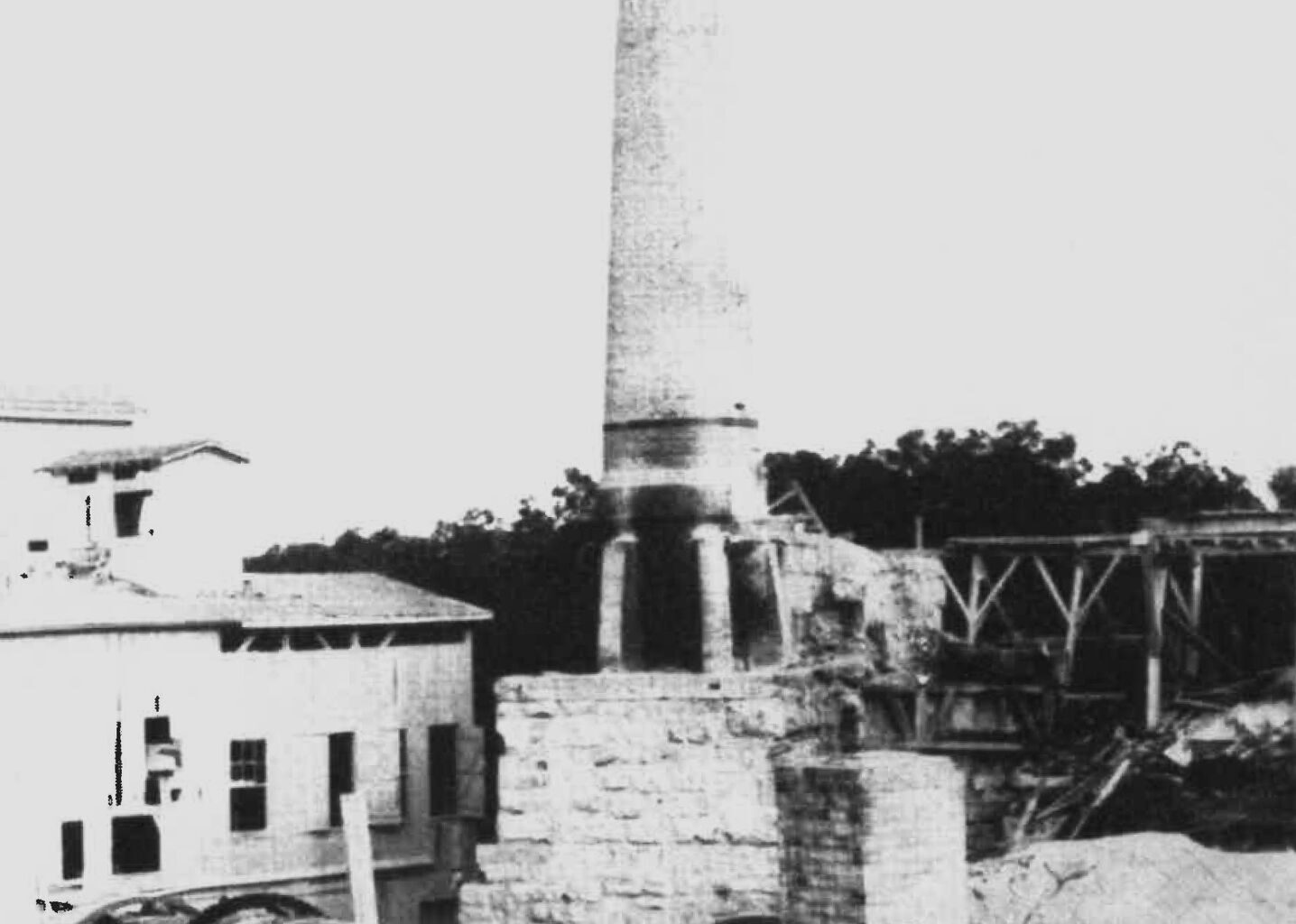
The original site of the San Antonio Portland Cement Co., makers of Alamo Cement, is seen here in 1892 adjacent to the city quarry. When the company left in 1908 for its Alamo Heights-area location, the land was given to Brackenridge Park.
UTSA Special Collections
The Cementville Band poses in front of Municipal Auditorium in 1930. Founded just three years earlier, the band was made up of cement-plant employees with company supervisors as its business manager and conductor. With weekly rehearsals, the band was able to play many classical and popular tunes.
UTSA Special Collections
A water tower was one of the last structures left in Cementville after the cement plant moved 14 miles north of the Alamo Heights site in 1980.
UTSA Special Collections
Workers at San Antonio Portland Cement gather for this undated photo (probably 1920s). Many were recent immigrants from Mexico.
UTSA Special Collections
An aerial view taken in 1976 shows how extensive the buildings and grounds of the San Antonio Portland Cement Co. off U.S. Highway 281 were before the plant moved out to Loop 1604 and Green Mountain Road.
UTSA Special Collections
Streets in Cementville were named after families with long history in the community.
UTSA Special Collections
A 1950s photograph shows how many factory buildings and facilities were added since the San Antonio Portland Cement Co. moved to a once-remote site in 1908. A company town, Cementville, was added in 1914.
UTSA Special Collections
Shown here circa 1950, small wooden houses were home to families of workers at the old cement plant. The community wasn’t served with indoor plumbing until after city annexation in 1956.
UTSA Special Collections
I have been working on ancestry research for some time now, and just found out recently that my great-uncle worked and lived with his family at Cementville somewhere between 1934 to 1945. His name was Abraham or Abram Lopez. His wife’s name was Adela Lopez.

Do you know if by any chance there are any records listing names of people who used to work there during that time period?
Article continues below this ad
One of the long-gone neighborhood’s chief landmarks was a tall water tower painted with “Cementville Texas,” as if it supplied an actual town.
It didn’t. Cementville was a company town (covered here March 20, 2011, and Sept. 10, 1995), built in an unincorporated area north of the San Antonio city limits. It was where the Lincoln Heights subdivision and Quarry Market shopping and dining complex are today.
The San Antonio Portland Cement Co., whose marquee product was Alamo Cement, was founded in 1880 on land leased from the city near the former quarry that is now Sunken Garden in Brackenridge Park.
Article continues below this ad
The company made cement from limestone quarried on site, pulverized into a dust that could be reconstituted for concrete and mortar. As the latter, it was used in the building of the pink-granite Texas Capitol in Austin, completed in 1888, according to “The Businesses That Built San Antonio,” by Marianne Odom and Gaylon Finklea Young.
In 1908, the company – later known as Alamo Cement, after its marquee product – moved to an unincorporated area north of the city limits, which afforded room for growth without regulation. The property, including offices, factory buildings, worker houses and gathering places eventually filled nearly 500 acres.
At the original location, workers lived off-premises. The new site, however, was miles from the nearest streetcar stop at Broadway and Patterson Avenue. Few people owned personal automobiles at that time, and those who did tended to be affluent.
To make it possible to work in this isolated setting, the company built about 70 small wooden houses or “cottages” on gridded streets within walking distance from the factory. Workers, many of whom were immigrants from Mexico, weren’t required to live on site, but most did. Their addresses on forms or when reported in the newspapers were given only as “Cementville,” although company streets later were named after families long associated with the community.
Article continues below this ad
RELATED: Lost town of Alamo Heights
San Antonio Portland Cement employees rented their homes from the company for up to $20 a month and bought their groceries from a company store. While layoffs were rare, during the Great Depression, married men could be cut back to one work day per week, and single men to a half-day. A typical wage during the 1930s was 25 cents an hour.
By the mid-1920s, there was a four-room elementary school, known as Bluebonnet School, with teachers from Alamo Heights Independent School District. Originally through fifth grade only, it was extended through seventh grade in 1929.
Other amenities included a community hall and a baseball diamond for the Cementville Tigers or Cats, who played mostly home games in a local amateur league (covered here Nov. 4, 2017). There was a 35-piece Cementville Band from the late 1920s that led parades and sometimes performed off-campus.
Article continues below this ad
Electricity came to the compound in the late 1910s or early ’20s, but sewage lines weren’t fully installed until after annexation by the city in 1956.
RELATED: Repurposed quarries
In the mid-1920s, St. Anthony’s Shrine (discussed here March 20, 2011) was founded by Father Peter Baque as a mission church to minister to the spiritual needs of the community. An affiliated religious order, the Missionary Servants of Christ the Master, started a parochial school and a day nursery.
Some other enhancements were imported into the community. The San Antonio Public Library sent a bookmobile, and the federally sponsored Public Affairs Forum sent lecturers – mostly public officials, clergy and businessmen – to speak on improving topics at the Cementville auditorium. Charities brought holiday treats and toys and supported Cementville’s annual Christmas pageant.
Article continues below this ad
A swimming pool was built only a few years before the company was sold in 1979 to a Swiss concern. Families began moving out of their Cementville homes soon after, and all the cottages and streets were bulldozed by the summer of 1986. A few buildings considered historic sites were preserved.
I asked staff of several libraries, archives and genealogical organizations if they knew of a repository for Cementville employment records. None did.
Buzzi Unicem USA Inc., current owners of the Alamo Cement plant at 6055 W. Green Mountain Road, did not reply to this column’s request.
“I wish I had been able to locate any such information,” said Char Miller, a former Trinity University history professor who worked with students on a short documentary film, “Resurrecting Cementville,” released in 2003 that can be viewed on the website of the Texas Archive of the Moving Image.
Article continues below this ad
At that time, Miller “looked all over hoping to find any sense of who did what work (and) where they might have lived” to no avail.
Anyone who knows of a source of records from the old cement company may contact this column.
Thanks to Debbie Countess of the Texana/Genealogy Department of the San Antonio Public Library and Beth Standifird of the San Antonio Conservation Society Foundation library for sharing research materials.
Article continues below this ad
historycolumn@yahoo.com | X: @sahistorycolumn | Facebook: SanAntoniohistorycolumn