
FORT WORTH — Are orchestra concerts too visually boring for our hyper-stimulated age? Some say so, and some orchestras have essayed various visual additions to performances. Whether they’re enhancements or distractions can be argued.
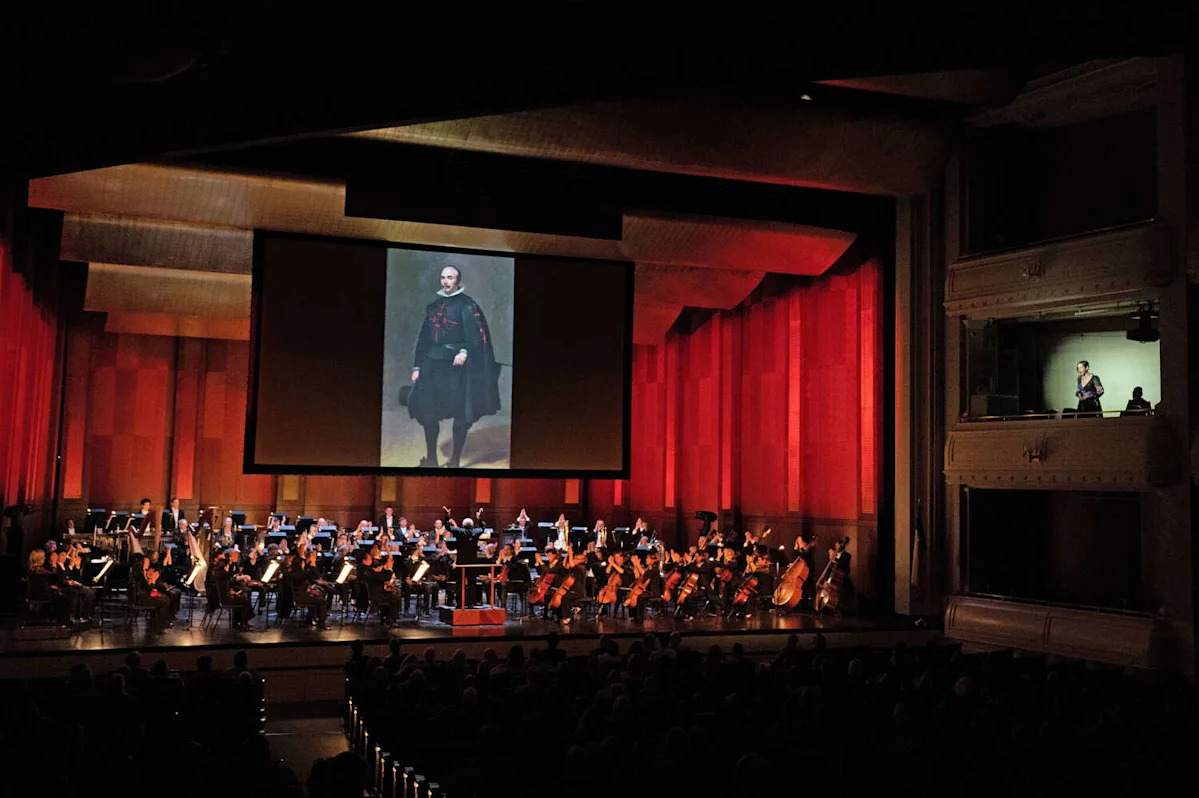
The Fort Worth Symphony has added costumed actors and dancers to some concerts and presented semi-staged operas — even Wagner’s complete Flying Dutchman. Friday night’s concert at Bass Performance Hall, billed as “Spanish Masters: An Evening of Music and Art,” included a performance of Manuel de Falla’s Three Cornered Hat (El sombrero de tres picos) with over-the-stage projections of Spanish paintings from the Kimbell Art Museum.
That was the only wholly Spanish item on the program, which opened with the Rapsodie espagnole of French composer Maurice Ravel. Neruda Songs, by American composer Peter Lieberson (1946-2011), set love poems — in Spanish — by the Chilean writer Pablo Neruda.
Lieberson’s cycle was a five-part love song to his wife, mezzo-soprano Lorraine Hunt Lieberson, who in a too-short career developed almost a cult following. Already being treated for cancer, she died only a year after premiering the cycle in 2005.
The poems range from the symbolist imagery of the opening “If your eyes were not the color of the moon” to clear-eyed contemplations of mortality. The orchestra writing represents latter-day impressionism, adding extra tang and ambiguity to passing harmonies, with brighter sonic splashes here and there.
Kelley O’Connor has been a frequent performer of the cycle, and her experience told in vividly personalized and projected singing, with just enough metal to her mezzo.
As in the Ravel and Falla, the orchestra played splendidly for music director Robert Spano. The Falla had a particularly huge dynamic range, appropriately so, with bright flashes of color, but both it and the Ravel evinced great care with nuances of rhythm, volume and color.
For the Falla, the orchestra played from stand lights, with lighting effects projected on the stage shell by Krista Billings. O’Connor also sang a couple of brief items from a box on the side of the stage. Alas, shifting, panning images projected by designer Jamie Milligan on that huge screen over the stage — ranging from a medieval altarpiece to paintings by Velázquez, El Greco, Ribera, Murillo, Picasso and Miró — had nothing to do with the music.
The score was prepared, after all, for a 1919 ballet about a miller, his wife and a lecherous magistrate, with sets and costumes by Picasso. The projected paintings’ religious figures and dour and scowling faces were often utterly at odds with the musical goings-on.
That projections can dramatically enhance an orchestra concert was demonstrated last November in a St. Louis Symphony performance of Stravinsky’s Firebird. With illustrations from the original Ballets Russes production, the projections supplied play-by-play accounts of the ballet’s action — who was doing what and when — occasionally pointing out details in the orchestrations. The FWSO’s presentation showed no comparable thought.
Details
Repeats at 7:30 p.m. Saturday and 2 p.m. Sunday at Bass Performance Hall, Fourth and Commerce streets, Fort Worth. $30 to $106. 871-665-6000, fwsymphony.org