
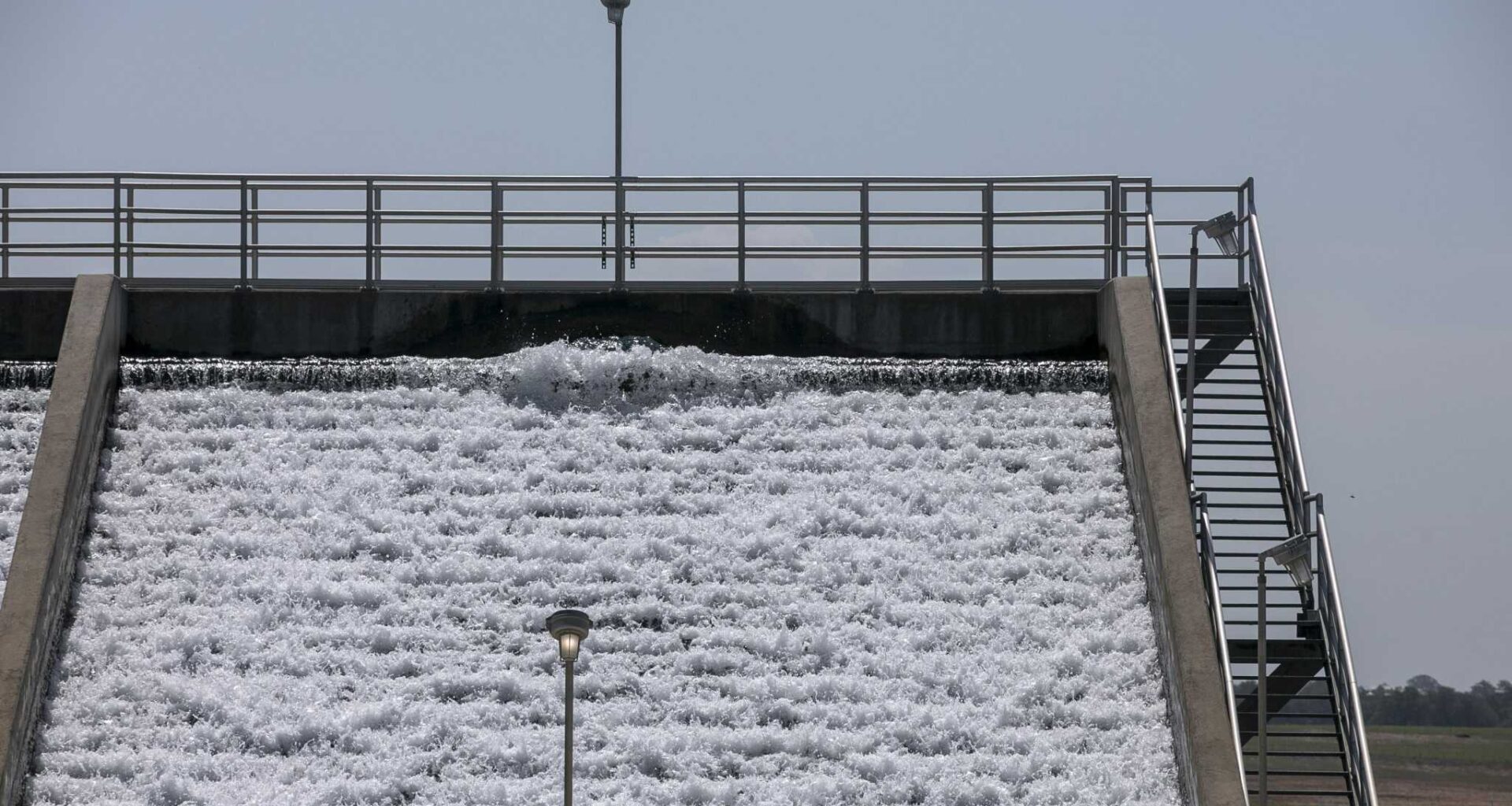
Water is aerated at the San Antonio Water System’s H2Oaks Center in August 2022. SAWS has said San Antonio is water-secure, particularly as the Vista Ridge pipeline brings thousands of gallons a day here, but the Texas Water Development Board’s draft 2027 State Water Plan suggests that no community in the state can afford to get complacent as the population continues to increase.
Josie Norris, San Antonio Express-News / Staff photographer
Water passes through a cooling tower at the San Antonio Water System’s central cooling plant in San Antonio. San Antonio City Council members have expressed concern about water for cooling data centers as the region becomes a magnet for such development.
Josie Norris/San Antonio Express-News
The Texas Water Development Board’s recently released draft 2027 State Water Plan is an alarming document.

Article continues below this ad
It will cost an estimated $174 billion — in 2023 dollars — to design, build and implement more than 3,000 water projects that are recommended statewide by 2080.
Failing to implement the plan’s recommendations over the next 50 years will result in roughly a fourth of Texas’ population in 2080 having less than half the municipal water supplies needed during a drought of record.
And failing to implement those strategies and projects would result in $91 billion in economic damages during a severe drought in 2030 and $177 billion in 2080.
The plan’s sticker shock is significantly more, well, shocking than that of the 2022 plan, which estimated a cost of $81 billion to do projects recommended by 2070. And it calls into question whether last year’s voter-approved statewide proposition that calls for depositing $20 billion over 20 years in the newly established Texas Water Fund goes far enough.
RELATED: Cost to meet Texas’ future water demand just skyrocketed to $174B
The draft 2027 water plan comes while we may be watching previews of future bleak scenarios playing out in Corpus Christi and some of its smaller neighboring communities.
Article continues below this ad
That city is scrambling to complete new groundwater wells in the wake of scrapping a yearslong plan to build a desalination plant after it became clear cost estimates had been deceptively low. A 10 million-gallon-per-day plant that seemed doable for $140 million in 2019 morphed into a 30 million-gallon-per-day plant that was out of reach at $1.2 billion before the City Council killed the proposal in September.
Meanwhile, the city of Three Rivers — with a little more than 1,000 residents, and roughly halfway between Corpus Christi and San Antonio — recently issued a drought-related disaster declaration while blaming Corpus for its water woes.
Three Rivers officials complained that due to its bigger neighbor’s “inaccurate water projections,” Corpus notified them it would release more water from the Choke Canyon Reservoir to Lake Corpus Christi, leaving Three Rivers potentially high and dry.
It could be easy to dismiss those troubles as local mismanagement, but they reflect the pressures to serve industrial growth while meeting residential need.
Article continues below this ad
And while recent heavy rains offer some relief, they don’t alter Texas’ growth trajectory or end our prolonged drought. The draft water plan notes that the state’s population is expected to increase 53%, from 34.2 million to 52.3 million, from 2030 to 2080. And those additional 18.1 million people will need water to live.
So it’s crucial the 2027 water plan is as thorough and accurate as possible, and that state leaders get serious about implementing its recommendations.
Perhaps the most daunting — or discouraging — aspect of the draft 2027 plan is its acknowledgment that Texas has a growing backlog of projects. The Water Development Board closed on roughly $12.4 billion in financial assistance for 68 projects the 2022 State Water Plan recommended.
There’s another aspect of the draft 2027 plan that is troubling: Nowhere in the 93-page document does the term “data center” appear.
Article continues below this ad
Given the well-documented explosion in applications from data center developers eager to build here, the idea that Texas could issue a statewide water planning document that bears any resemblance to reality without including the future demands for water among data centers is incomplete at best. It is negligent at worst.
Some suggest the plan’s failure to adequately account for such demand is inherent in how it’s crafted. On one hand, the plan relies on historical data generated before today’s surge in artificial intelligence, which is driving the data center boom.
Meanwhile, and perhaps more frustratingly, the state lacks accurate insight into data centers’ water demand. As reported by Texas Scorecard, the Water Development Board said that only 18 of roughly 70 data centers responded to a survey that asked how much groundwater and surface water they used each month, and who was supplying it. While data centers are statutorily required to respond to the board’s surveys, the maximum fine for not complying is $500.
RELATED: San Antonio City Council has opinions on steering local data center boom
Article continues below this ad
Trusting optimists might say the omission of data centers in the draft 2027 water plan is not a problem because future ones will be insignificant water uses as technology develops. Data center developers say that modern centers use closed-loop cooling systems, in which a cooling fluid, such as water, circulates in a sealed piping network, absorbing heat from electric equipment.
The rub is that somewhere in that circuit, energy is needed to remove heat from that liquid before it’s sent back to cool equipment. So, data centers can be water-conscious or energy-conscious, but it’s unlikely they can be both. And it’s reasonable to consider the possibility that many will lean toward energy efficiency with evaporative cooling that uses significant amounts of water.
Either way, to not even acknowledge data centers in the 2027 plan strains public confidence. Public Utility Commission Chairman Thomas Gleeson told a state House committee on April 9 that the commission is surveying data centers “to better understand their water usage” and plans to provide that information to the Texas Legislature and the Water Development Board.
We’ll see whether his organization has more success and whether it can obtain that data in time to be considered in the final water plan.
Article continues below this ad
In the meantime, the Water Development Board is taking public comments online regarding the draft plan until 5 p.m. May 29, and it will hear “relevant comments” about it during a public hearing set for 1 p.m. on May 27 in the Stephen F. Austin Building in Austin, as well as via a virtual meeting link. Go to the 2027 State Water Plan webpage for how to participate online.
As details matter, we hope the public will examine the plan and participate in the comment period. Most of all, we hope state and local leaders will up their urgency to implement the plan’s recommendations.
Growth is coming, and water is not optional.