
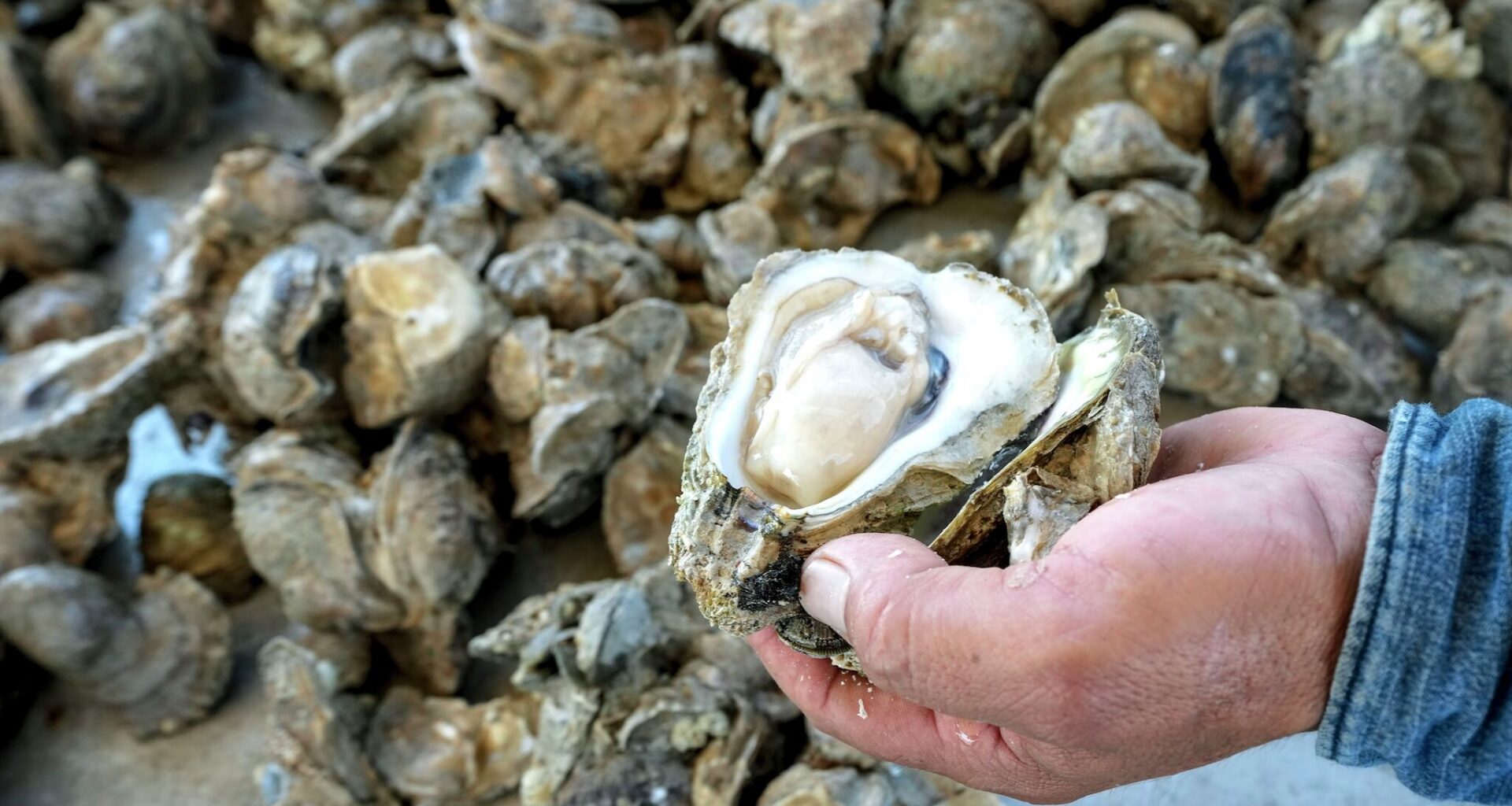
An oyster harvester inspects his catch after heavy rains in June 2024 killed a large number of the shellfish in Galveston Bay.
Brett Coomer/Houston Chronicle/Getty Images
For oyster harvesters along the Texas coast this season, keeping track of which public areas are open and which have closed early has resembled a game of musical chairs.

The Texas Parks and Wildlife Department closes an area when sampling reveals the amount of market-size oysters has dropped below a certain threshold. In the Matagorda Bay area, the department closed TX-19 in January and reopened TX-14 two months later. Galveston Bay’s three public areas remained open until mid-February, when officials closed TX-5 in the central bay. Both remaining areas stayed open until earlier this month; the last, TX-1, closed on April 21.
Article continues below this ad
The season will end on April 30 with five harvesting areas open out of a total of 34, unless more close between now and then.
Although Galveston Bay’s reefs have struggled to fully recover from Hurricane Ike and subsequent weather events, TPWD regional director of coastal fisheries Kelley Kowal challenged the notion that the early closures signaled a subpar season. For the most recent activity, TX-1 in the southern bay closed because harvest pressure had shifted onto the area after the previous week’s closure of TX-7 (to the east), Kowal told Chron.
Shells for a Galveston Bay Foundation restoration project in 2024
Galveston Bay Foundation
“From a management perspective, this season provided a good balance of opportunity for the oyster industry while still protecting the resource,” Kowal said. “Harvest areas were available across much of the coast, and areas with low numbers of market-size oysters remained closed to support sustainability.”
Article continues below this ad
Having three areas in Galveston Bay open to public harvesting when the season opened last November is still more than in previous years, Kowal added.
“Throughout the season, every major bay system that typically supports oyster harvest had open harvest area, with the exception of San Antonio Bay,” Kowal said. “Galveston Bay supported the majority of harvest pressure this season and continued to do so for most of the harvest period.”
Beyond Texas, though, a pair of recent studies is giving conservationists hope that new insight into designing more efficient and better constructed artificial reefs may be just over the horizon.
Article continues below this ad
Texas Parks and Wildlife game wardens visit an oyster boat in 2018
Texas Parks and Wildlife
Publishing their findings in the journal Nature, researchers in Australia created 16 types of concrete ’tiles’ to match the way reefs resemble what one called “finely tuned 3D systems.” After carefully studying the geometry of three reefs near Sydney and placing their own tiles nearby, they concluded that the tiles that best sheltered oyster larvae, also known as spat, were those that closely mimicked the reefs’ natural construction.
“While total surface area is important, juvenile oysters are very small and highly susceptible to predators like fish and crabs and to overheating and drying out,” Macquarie University’s Dr. Juan Esquivel-Muelbert said, according to the website SciTech Daily. “That’s ultimately what you need to form a reef. There’s no point in having lots of oyster larvae turning up if they don’t survive.”
A team from the University of North Carolina-Chapel Hill studying reefs in the state’s Outer Banks region, meanwhile, found that taller, denser reefs removed more nitrogen from the water (and faster) than shorter reefs that remained fully submerged. Their research is of particular interest to John Eads, chairman of the new Texas nonprofit Coastal Preservation and Restoration.
Article continues below this ad
Oysters very early in the restoration process
Galveston Bay Foundation
“Of course in Texas, we care a lot about that because we get fertilizer and other types of things in our water, and so the more nitrogen that we can sequester [the better], hopefully some phosphorus as well,” Eads told Chron. “These little oysters, the more you dig into it and look really hard, they’re pretty remarkable organisms.”
And back in Galveston Bay, scientists from Texas A&M-Galveston’s Agrilife Extension Service paid an encouraging visit earlier this month to Rett Reef, a non-harvestable 10-acre reef near San Leon constructed through a joint effort by the wholesalers Prestige Oysters, The Nature Conservancy, Pier 6 seafood restaurant, and the San Leon Oyster Festival, among other organizations. Her team found “a ton” of oyster spat, Brandi Keller, Galveston County’s coastal and marine resources agent, wrote on Facebook.
Article continues below this ad
Encountering that much spat, she reported, “is a sign of a healthy, reproducing ecosystem.”