
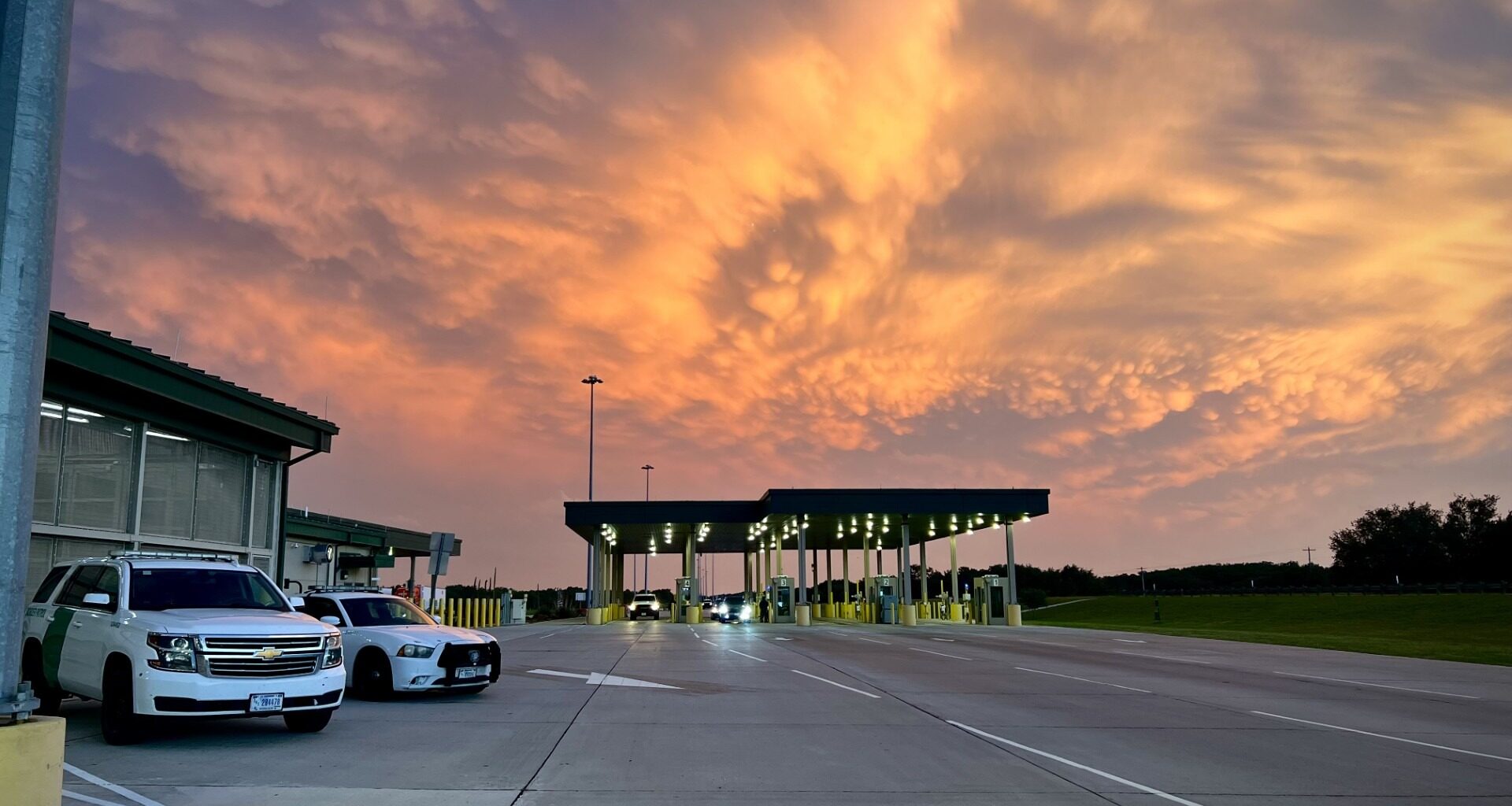
The U.S. Border Patrol’s Falfurrias checkpoint is seen at sunset in this undated photograph.
Courtesy U.S. Border Patrol via Facebook
If you’ve ever road-tripped to the Texas borderlands, you might’ve encountered something strange on the drive back: a massive checkpoint where all traffic — whether passenger or commercial — is required to stop.

But just what are these checkpoints, who runs them, and what are they for? Read on to learn more about the roadside inspection stations that the U.S. Department of Homeland Security characterizes as “critical” in keeping the United States safe from terrorists, weapons traffickers, and drug and human smugglers.
Article continues below this ad
What are the Border Patrol checkpoints?
The checkpoints are operated by the U.S. Border Patrol and are located along major highways leading into the interior of the United States. The majority are located along the southern border, including several in deep South Texas. According to the U.S. Government Accountability Office (GAO), there are more than 110 checkpoints around the country.
The U.S. Border Patrol’s Laredo checkpoint is seen in this undated aerial photograph.
U.S Border Patrol
Where are Border Patrol checkpoints in South Texas located?
By design, the checkpoints are typically located a few dozen miles from the border in what is commonly referred to as the “100-mile border zone.”
Article continues below this ad
“The site should be far enough from the border to avoid interfering with traffic in populated areas near the border,” reads a 2003 Border Patrol directive outlining checkpoint operations and guidelines.
Checkpoints can be permanent installations with brick-and-mortar buildings, office space, and designated traffic control lanes with booths or more mobile — what Border Patrol refers to as “tactical” checkpoints.
There are two permanent checkpoints located north of the Rio Grande Valley. The most heavily traveled one is located on U.S. 281 about 50 miles north of Edinburg and 13 miles south of Falfurrias in Brooks County. The second is located along U.S. 77 about 37 miles north of Raymondville and just outside Sarita in rural Kenedy County. A tactical Border Patrol checkpoint that was located along Texas 4 just outside Starbase was quietly decommissioned last summer. Additional checkpoints are located outside Laredo, Eagle Pass, Uvalde, Zapata, Freer and Hebbronville.
Article continues below this ad
A U.S. Border Patrol agent asks a motorist their citizenship status at the Border Patrol checkpoint located along U.S. 281 south of Falfurrias on Monday, April 20, 2026.
Dina Arévalo
Who must stop at a Border Patrol checkpoint?
Everyone traveling into the interior of the country by vehicle must stop. That includes roadtrippers, people traveling for work, commercial truck drivers and bus passengers.
“No person or vehicle is exempt from inspection procedures at Border Patrol checkpoints. The only exceptions shall be in cases where health, safety or exigent circumstances exist,” reads the 2003 Border Patrol directive.
Article continues below this ad
Why can the Border Patrol stop you at a highway checkpoint?
Border Patrol is “responsible for securing the U.S. border.” As part of that responsibility, the U.S. Supreme Court has affirmed the agency’s authority to operate the highway checkpoints to determine travelers’ citizenship status “and make quick observations of what is in plain view in the interior of the vehicle,” CBP officials said in February.
Cameras and other so-called “non-intrusive” inspection technology is seen on Monday, April 20, 2026, at the U.S. Border Patrol’s Falfurrias checkpoint located on the northbound lanes of U.S. 281.
Dina Arévalo
What will you be asked at a Border Patrol checkpoint?
Border Patrol agents will ask both drivers and passengers if they are U.S. citizens. For citizens, a simple “yes” is typically all that’s needed before you can continue on your way. But legal permanent residents and international travelers may be asked to show documentation — such as a green card, passport or visa — that proves they are allowed to venture further into the country. Commercial drivers may be required to answer questions about the cargo they are hauling.
Article continues below this ad
Occasionally, agents will ask drivers to pull into a so-called “secondary” inspection station — one of several drive-up stalls located just past the regular inspection booths. If you are sent to secondary, agents will ask you more in-depth questions about your identity and travel plans. They could also conduct more invasive inspections of your vehicle and belongings, including X-ray examinations, physical inspections of the vehicle’s interior, luggage, and even electronic devices.
While the federal government asserts that it has expanded powers within the 100-mile border zone, the American Civil Liberties Union reminds travelers that, under the Fourth Amendment, Border Patrol agents still need probable cause to conduct a search of electronic devices, such as cellphones, laptops or cameras. An agent may ask for consent to search, but travelers can still say no and maintain their right to remain silent.
A U.S. Border Patrol agent and his canine inspect a vehicle at the Border Patrol checkpoint located along U.S. 281 south of Falfurrias on Monday, April 20, 2026.
Dina Arévalo
What are the Border Patrol checkpoints like?
Permanent checkpoints look a lot like toll plazas you’ll find in major metropolitan areas. They have expansive canopies with what look like toll booths and secondary inspection stalls off to the side. There’s also a lot of high-tech inspection equipment, including multiple cameras and X-ray and gamma-ray imaging systems. Uniformed agents, including K-9 officers, are located within each inspection lane. The stations operate 24 hours per day, year-round.