
Nine years before he shot and killed Lee Harvey Oswald, Jack Ruby booked Nat King Cole to perform at the Longhorn Ballroom in Dallas.
It was Sept. 30, 1954, and Dallas operated under strict Jim Crow laws that enforced segregated schools, public facilities and housing. But the Longhorn Ballroom, a 2,000-seat honky-tonk located less than a mile from downtown Dallas, was in Cedars, a largely industrial district where the Dallas police had no jurisdiction. The Longhorn was a room with a stage and a bar where anything could happen.
For over five decades, the concert hall hosted music’s biggest stars across genres, including Roy Orbison, Patsy Cline, Ray Charles, The Ramones and Patti Smith. But after it was sold in the mid-1990s, the 23,000-square-foot space, used for private events and an occasional concert, fell into disrepair. By the early days of the pandemic, the Longhorn was abandoned.
An unprotected building with no historical status, the Longhorn sat on land with views of downtown Dallas. Developers were interested. Talk of demolition and apartment construction was rampant. Then, Edwin Cabaniss, a wealthy, fifth-generation Texan, stepped in to save the iconic music venue.
Six years later, he has turned the Longhorn Ballroom into a six-acre creative campus, complete with a brand-new amphitheater, that is welcoming back Longhorn stalwarts and attracting a new generation of music lovers.
If Only Its Walls Could Talk
Nat King Cole’s performance came four years after the Texas millionaire O. L. Nelms built the Longhorn Ballroom, then called Bob Wills’ Ranch House, for country music legend Bob Wills and his Texas Playboys. When the honky-tonk opened on Nov. 15, 1950, it was the largest dance hall in Texas.
A few years later Jack Ruby was booking Black artists to play for integrated audiences. A photo taken on the night of Cole’s 1954 performance captures Black patrons seated directly in front of the stage. The white guests stand behind them in a roped-off area. Ruby is in the center of that crowd, smirking at the camera.
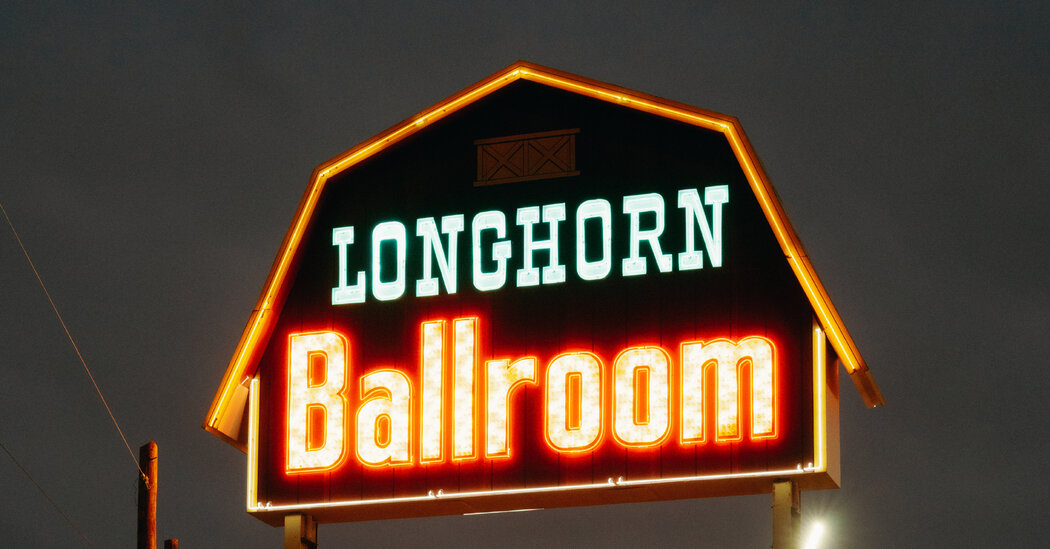
Douglas “Dewey” Groom, who bought the Ranch from Mr. Nelms in 1967, added the building’s Old West outpost front facade and the iconic “Longhorn Ballroom” neon sign at its entrance. A 40-foot-tall marquee advertised upcoming Country and Western acts, as well as blues, jazz and R&B artists.
During the 1970s, the venue secured its status as the center of music counterculture. Mick Jagger and Jerry Hall visited the Longhorn, and the Sex Pistols bassist Sid Vicious famously played at the venue, covered in his own blood. “He was writing on his chest with his blood. It was gross,” said Jeff Liles, who sneaked in to see the show when he was 16.
A decade later Ira Zack, the owner at the time, hired Mr. Liles to book rock, punk and metal acts. He recalls taking Anthony Kiedis and Flea to his mother’s house so the rock stars could do their laundry.
“The Longhorn’s niche is finding the stuff that’s not mainstream,” said Mr. Liles. “It might be part of the mainstream, but it’s still the periphery. When the Chili Peppers played here in the ’80s, or when the Butthole Surfers, the Sex Pistols, The Ramones and Patti Smith played here, they all recognized the counterculture aspect of it.”
But the Longhorn’s heyday was already nearing its end. In 1996, Raul Ramirez bought the venue and booked Tejano acts like Selena and La Mafia. He put the property up for sale just five years later for $3.95 million. It sat on the market for 16 years, as Mr. Ramirez sought a buyer who wouldn’t tear down the building. The Longhorn was mainly used for private events, and the concert hall slowly slipped off Dallas’ radar.
In 2017, Jay LaFrance, a Dallas entrepreneur, bought the building with plans to revitalize it as a music venue. But in 2019, those plans ended in bankruptcy and lawsuits.
The venue soon resembled a ghost town. A storm had knocked down the Longhorn’s landmark sign, and other signage was locked up behind a fence.
By that time, the Cedars neighborhood was within the Dallas jurisdiction and was slowly being gentrified. Nestled along the banks of the original Trinity River, the Longhorn was on one of the last big pieces of land running alongside the perimeter of downtown Dallas. Bankruptcy trustees received bids from multiple real estate developers, and Preservation Dallas declared the Longhorn Ballroom one of the city’s most endangered buildings.
A ‘High-Tech Redneck’ Steps In
Mr. Cabaniss, 56, tried to buy the Longhorn in 2015, but after several months of negotiations, Mr. Ramirez rejected his offer.
Years earlier, Mr. Cabaniss’s company, Kessler Presents, bought and restored a movie theater in Dallas’ Oak Cliff neighborhood. Built in 1941, the Art Deco building was once owned by the singing cowboy, Gene Autry. It had been vacant for 17 years before Mr. Cabaniss turned it into the Kessler Theater, a 577-seat concert hall in 2010. He convinced Mr. Liles, 63, to return to Dallas to be the venue’s artistic director. At the time, Mr. Liles was living in Los Angeles and managing Sunset Strip’s Roxy Theatre.
Initially, preserving old buildings was a side job for Mr. Cabaniss, who built his wealth working for various finance behemoths, including Merrill Lynch and Salomon Smith Barney. After amassing a small fortune, he decided he needed a “lifestyle change” before he turned 40. “I wanted to do something creative,” he said. “I didn’t know what my muse was going to be, but I wanted to be hyperlocal about it.”
A self-described “high-tech redneck who loves music,” Mr. Cabaniss saw the Longhorn as a space where artists who played at the Kessler Theater could perform to larger audiences. “I love music because it’s nonpartisan,” he said. “It is not conservative. It is not progressive. It’s for all people.”
When developer interest in the Longhorn waned because of the pandemic, Mr. Cabaniss got a second shot at owning it. He bought the venue in 2021 for an estimated $4 million. “The pandemic drove the competition out because I was looking at this as a building and they were looking at it as dirt,” he said.
In 2022, with $4 million in city subsidies, Mr. Cabaniss spearheaded a three-phase restoration of the historic concert hall and its property. The total cost was just over $20 million.
In 2023, the restored Longhorn Ballroom opened its doors with the Western swing band Asleep at the Wheel as the first headliner. The new venue featured a revamped stage, updated bars and restrooms and a curated museum showcasing the Longhorn’s musical legacy. Mr. Cabaniss also repaired the original Longhorn Ballroom neon sign, which had been stored in a warehouse for over a decade, and reinstalled it above the venue’s entrance.
An unopened safe that Ruby left behind sits outside a V.I.P. area.
“We know that there are some contents in there,” said Mr. Cabaniss. “We’ve done a little X-ray. We are going to open that and have our Geraldo Rivero moment if things get dicey, but in the three years we haven’t been slow enough to need to.”
Back and Bigger Than Ever
In March, La Mafia, Grammy Award winners who began their career playing at the Longhorn Ballroom, kicked off the inaugural concert season of the Longhorn Backyard Amphitheater.
Directly behind the Longhorn Ballroom, the new 6,500-capacity outdoor stage is the latest in Mr. Cabaniss’s three-part revival of the property. By the end of the year, the third and final phase will take shape: Three restaurants will open inside a 20,000-square-foot old motel that once housed touring bands and has already been partially converted into live-work spaces for artists and co-working spaces for creative professionals.
“In the same way Edwin wanted to revitalize the Longhorn, he wants to revitalize people’s connection to this space,” Mr. Liles said.
Armando Lichtenberger Jr., La Mafia founding member and keyboardist, said the return to the Longhorn was like being in a time capsule. “Same place, but brand-new and amazing,” he said, “So many memories came back to me, including playing a New Year’s Eve show here in 1985.”
Memories are what the Longhorn, now a federally protected heritage site, is all about.
“Most people don’t remember what they had for dinner three nights ago, but people remember a really incredible live music show they went to 20, 30, 40 years ago,” Mr. Liles said. “That’s what this is all about. Providing experiences for people that last a lifetime.”
That, Mr. Cabaniss said, “is the most rewarding part of all of this.”