
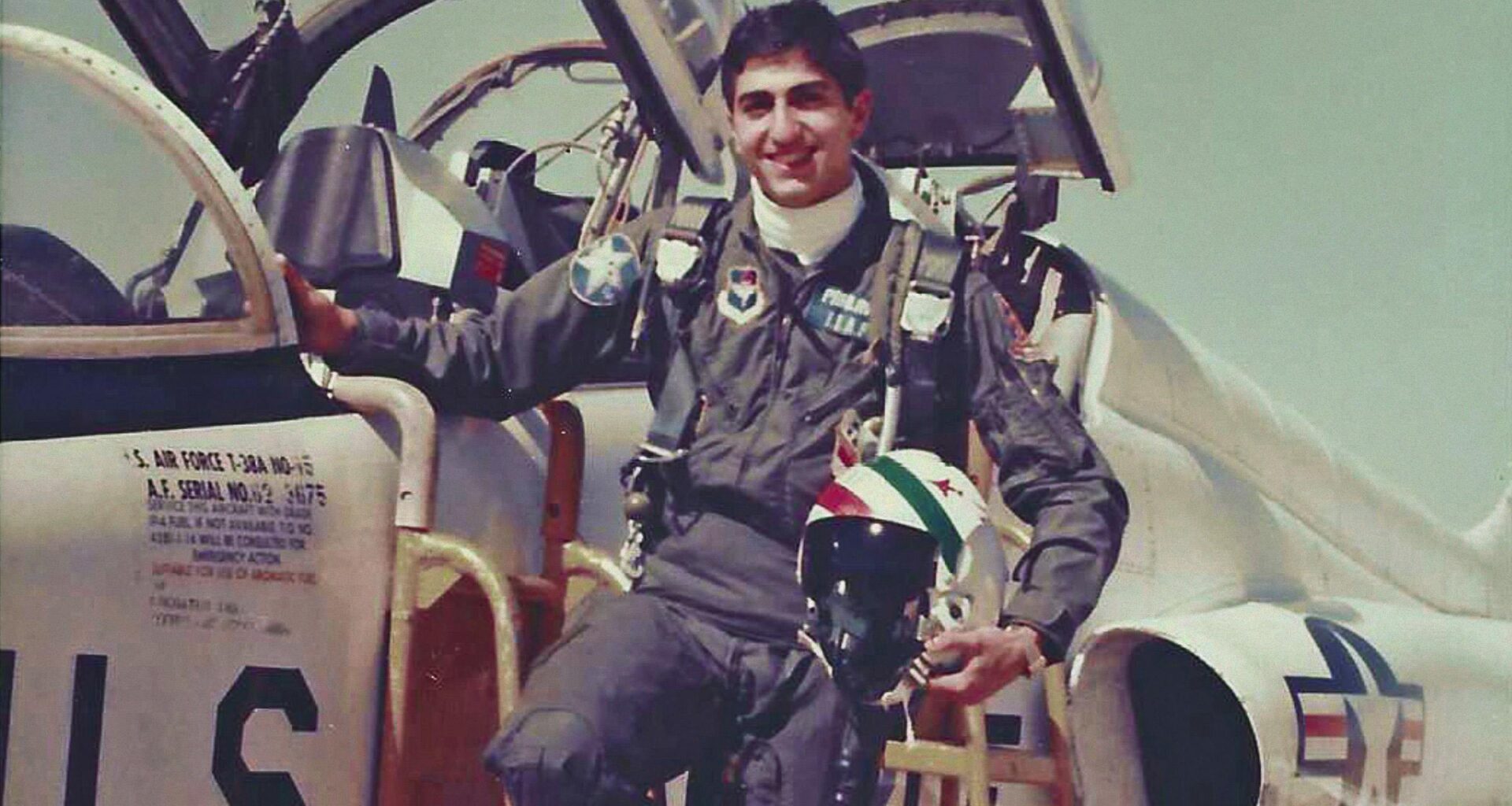
When Reza Pahlavi arrived at the United States Air Force Academy, in Colorado Springs, in June 1978, two weeks before starting a year-long jet-pilot training program at Reese Air Force Base, in Lubbock, John Thompson, his flight instructor, was waiting for him. He looked on with a measure of astonishment as the seventeen-year-old—son of the shah of Iran and heir to the throne—taxied down the airstrip in an Imperial Iranian Air Force tanker, his arm dangling out of the window. He’d flown in all the way from Tehran.
Pahlavi sat in the commander’s seat—unusual for someone his age, but then again, he was no ordinary teenager. As the shah’s son, he was the beneficiary of extraordinary privilege. He’d been flying fighter jets since he was thirteen and had soloed an F-5 just a few years later.
His father, Mohammad Reza Pahlavi, who maintained a close strategic relationship with the United States Air Force, wanted his son, fresh out of high school, to attend a military program in the United States. “Lubbock was considered the safest of the bases that were available for pilot training at the time,” Thompson told me.
Unlike many of his fellow flight instructors, Thompson had real tactical experience—credentials that at least partly explain why at just 28, he was tapped to train Pahlavi. Alongside his wing commander, Thompson traveled to Iran in April 1978. Their visit was considered highly sensitive, he said. They toured air bases across the country and received briefings from generals, though no one knew exactly why he and his commander were there. At the end of his visit, Thompson was brought to the opulent Niavaran Palace to meet the young Pahlavi and walk him through what to expect from pilot training. Thompson had assembled a book—photographs of the base, its people, and its living quarters—and outlined the flying curriculum. “We had instant chemistry,” he said. “Everybody was happy to see that.”
In Colorado Springs, Thompson wasn’t the only one waiting for Pahlavi: Local officials, military brass, politicians—the full array of dignitaries—had turned out for the occasion.
Beside Thompson stood Ardeshir Zahedi, the Iranian ambassador to the United States. He turned to Thompson: “Let me tell you something,” Thompson recalled the man saying. “The crown prince isn’t just here to learn how to fly jets. He’s here to learn how the United States became the strongest country in the world in only two hundred years.”
As part of his broader education, Thompson told me, Pahlavi took part in a series of specially arranged excursions on weekends when he wasn’t in training: a visit to NASA, where he flew a space shuttle simulator alongside astronaut John Young, and a trip to Houston to observe open-heart surgery by the renowned surgeon Denton Cooley.
Whatever he took from his time in the United States, he would not have the chance to apply it back home. Within months, the monarchy that had sent him would collapse, forcing the royal family into exile. Pahlavi never returned to Iran.
Now, nearly five decades later, amid recent geopolitical upheaval and a weeks-long U.S.-and-Israeli-led war against Iran, Pahlavi has emerged as a more visible figure, urging Iranians to protest the current regime and casting himself as a leader of a democratic transition—an idea that remains divisive among Iranians.
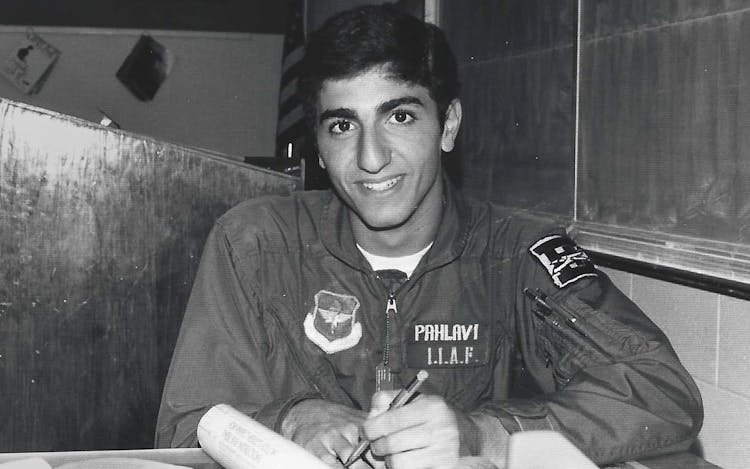 Pahlavi in class. After his father, the shah, was deposed, his pilot-training course was compressed into eight months. Courtesy of John Thompson
 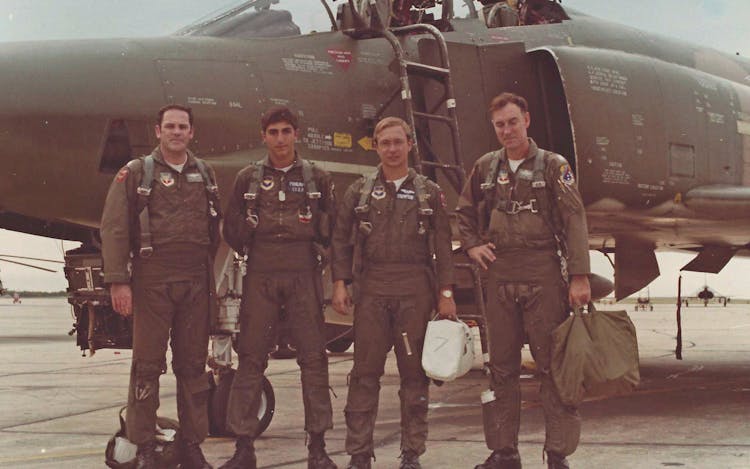 Pahlavi and classmates after a formation flight in the F-4E Phantom supersonic fighter jet. Courtesy of John Thompson
Meanwhile, in Lubbock, many still remember the months leading up to the Iranian Revolution when Pahlavi lived in their town on the Texas plains. For residents of a place about which Mac Davis famously sang “I thought happiness was Lubbock, Texas, in my rearview mirror,” the arrival of international royalty was a momentous occasion, chronicled in dozens of local news stories—and one they would not soon forget.
Pahlavi had grown up in palatial opulence in Iran—the sort of extravagance that would ultimately help fuel public anger toward the monarchy. In Lubbock, he lived in a different kind of luxury: a four-bedroom, three-bath ranch-style house with a pool, fitted with bulletproof glass and steel doors and valued at $256,000—roughly $1.3 million today. The Iranian government covered both the purchase of the home and his $182,000 tuition.
During the week, he lived in the Air Force barracks alongside the other trainees, rising at dawn and shining his own shoes. On weekends he retreated to his home, cruising around town in a gold Lincoln Continental or a maroon Jaguar, Newsweek reported at the time.
Residents still recall him as a rare celebrity presence in their town, where little beyond everyday dramas made the news. A woman who once worked at a now-shuttered movie theater remembered, “He used to come to the movies with his entourage. We always thought he was so cute.” Another claimed to have seen him playing with a lion in an empty lot near his house.
Randy Allen, a Lubbock local who ran a flower shop near Pahlavi’s weekend home while putting himself through Texas Tech, remembered him as a regular customer, often buying flowers for the young women he was courting. Once he ordered arrangements for four women at the same time. “We got a laugh out of that,” Allen said, recalling Pahlavi as friendly and unpretentious. “He was the son of a king of a country, talking to just a poor old dumb West Texas boy—and we were just equals. Just two guys chasing girls.” Allen refers to him as “Reeza,” putting a Texas twang on his name.
In other ways, though, their differences were obvious. One day, when the two went out for a meal at a drive-in hamburger joint, Pahlavi first stopped by his house. He never invited his Lubbock friend inside, but Allen, who’d had to scrounge up $2,500 to purchase his flower shop, remembered thinking, “If you’ve got big bucks, this is where you live.”
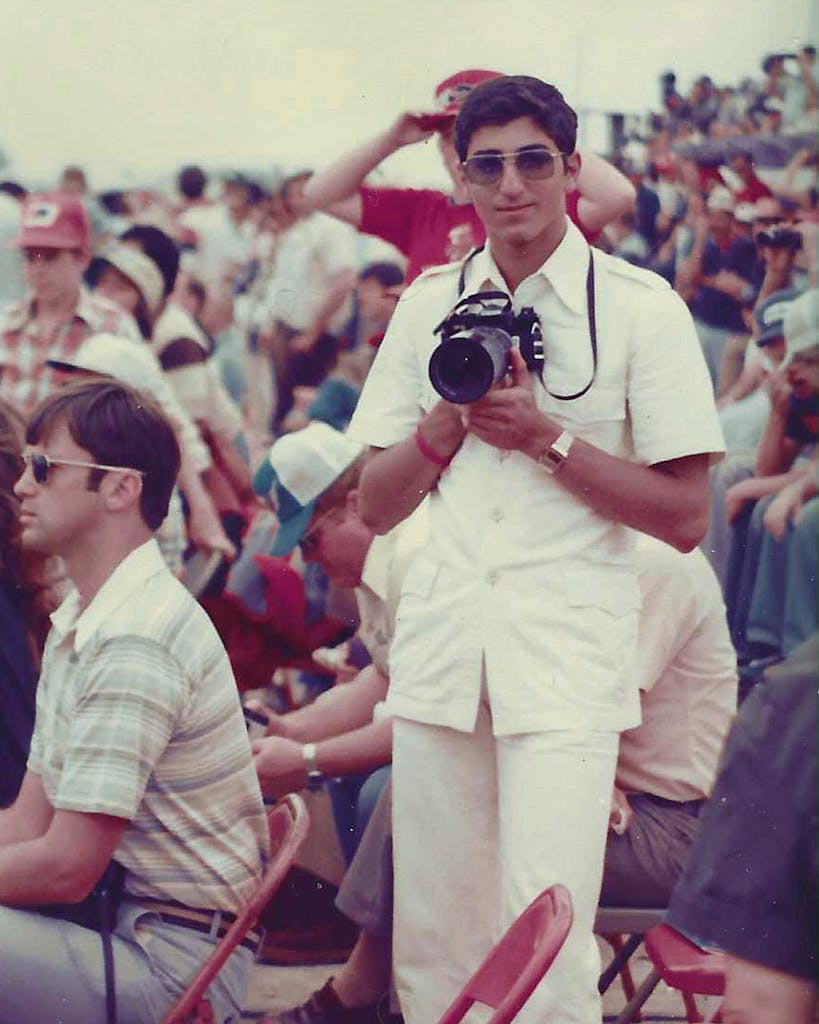 Pahlavi taking photographs at an air show at Reese AFB.Courtesy of John Thompson
Not everyone was charmed by the prince. Some in Texas Tech’s Iranian student community, which at the time was part of a record wave of roughly 51,000 Iranian students in the United States, viewed Pahlavi’s presence with unease. Gary Scoggin, a civil engineering student in the class of ’79, recalled Iranian classmates telling him about the repression they felt under SAVAK, the shah’s secret police—established with significant support from the CIA, including funding and training. They described a lack of basic freedoms and feared that speaking out, even from the United States, would put their families back home in danger, Scoggin told me.
Just a week after Pahlavi’s arrival, Texas Tech’s Iranian Students Association organized a protest in which roughly four hundred students gathered outside the crown prince’s Lubbock residence, chanting “Down with the shah.” Pahlavi was not home at the time, The Washington Post reported. According to The University Daily, Texas Tech’s newspaper, the student protesters sought to drive him out of Lubbock.
“I don’t say not to protest for change, and I don’t say my father doesn’t make mistakes,” Pahlavi told the press at the time.
The student paper offers a vivid record of how Iranian politics reverberated across West Texas in the year leading up to the revolution. When the university refused to allow protesters to wear masks, used to protect their identities and shield their families back home from retaliation, the ISA filed a lawsuit in response. A federal judge ultimately ruled that protesters could not be prohibited from wearing them, The University Daily reported.
That fall, an incident known as Black Friday marked a turning point in Iran and the beginning of the end of the shah’s reign. As thousands protested in the streets, government forces opened fire on the unarmed demonstrators, killing dozens. The crackdown accelerated the protest movement, which drew a wide coalition of students, leftists, and religious conservatives around its populist and anti-imperialist messaging. Ayatollah Ruhollah Khomeini, a cleric exiled for fourteen years under the shah, ultimately captured that movement, establishing the theocratic government that persists today.
By January, the shah had been overthrown, even as his son remained in pilot training. According to Thompson, the program—normally fifty weeks long—was compressed on his behalf. After about eight months of flight training, Pahlavi received his wings on a Friday in March. That Sunday, the son of the deposed shah left to join his now-exiled parents in Morocco, two pet dogs in tow. By Tuesday, three representatives of the Islamic Republic had arrived in Lubbock to seize the house he’d been living in.
At first, the Lubbock Police Department was asked to protect the prince’s former home by a local real estate agent serving as a trustee for the Imperial Iranian Air Force. Eventually, though, the cops relented. “Iran’s revolutionary government probably will be allowed to assure ownership of a $256,000 residence that was home to the son of the shah,” the Associated Press reported, citing a spokesman for the dwelling’s trustee.
That transfer never fully materialized. During the Iran hostage crisis, which began in November 1979 when a group of Iranian students seized American hostages in the U.S. embassy in Tehran, President Jimmy Carter severed diplomatic ties with Iran and froze all of the nation’s assets in the United States. The State Department subsequently took over management and operation of the property and leased it out.
By 1987, United Press International reported, the house had accumulated eight straight years of delinquent taxes, totaling nearly $47,000. Eventually, a Lubbock resident said, it would take on a much less regal afterlife, as a Phi Delta Theta fraternity house.
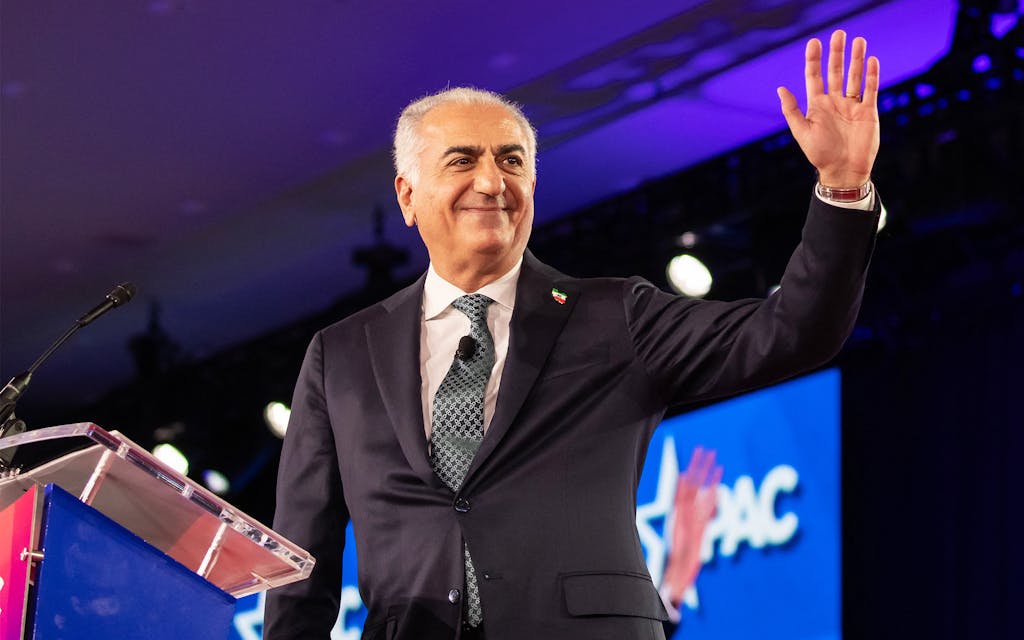 Reza Pahlavi greeting the crowd during the Conservative Political Action Conference (CPAC) in Grapevine on March 28, 2026.Leandro Lozada/AFP via Getty
In March, nearly fifty years after his stint in Lubbock, Pahlavi returned to Texas. This time his countrymen in the diaspora weren’t gathering outside his home to shout “Down with the shah!” The crowd at the Conservative Political Action Conference in Grapevine declared an altogether different message: “King Reza Pahlavi!”
Now 65, silver-haired and broader in frame, he has spent most of his adult life in an affluent suburb of Washington, D.C., delivering the same pitch—that the Islamic regime must be overthrown, and that he could help lead whatever comes next, while rarely acknowledging the violence carried out under his father’s rule.
Pahlavi had emerged as an unlikely headliner for the event, slated for the conference’s final day. By some estimates, nearly a quarter of the audience was Iranian. These weren’t just monarchists—long loyal to the exiled Pahlavi family—but also those newly radicalized by the events back home. In January, a government crackdown on widespread protests left thousands dead, with estimates ranging from roughly 7,000 to as many as 20,000, as authorities shut down the internet, causing a prolonged blackout. The incident became one of the bloodiest episodes in the regime’s history.
Though U.S. military intervention in Iran remains broadly unpopular among American voters, you wouldn’t have known it inside the halls of the Gaylord Texan Resort & Convention Center. Alongside Trump loyalists in glitzy Stars and Stripes regalia were Iranian Americans draped in the prerevolutionary flag: between its red and green stripes, a golden lion set against a rising sun—the emblem of the Pahlavi dynasty. Others wore “Make Iran Great Again” hats and carried images of Pahlavi featured alongside Israeli Prime Minister Benjamin Netanyahu and President Trump. By their logic, war was the only viable path to toppling the regime.
While some people I spoke with referred to Pahlavi as “my king,” others bristled at the title, describing him instead as a possible transitional leader if the regime were to fall—a figure who could prevent a power vacuum rather than restore the monarchy. They spoke of “finishing the job” in Iran, and many grimaced when I offered the possibility that the war could end without a regime change. “It’s our nightmare,” one recent Iranian immigrant told me.
Absent were Pahlavi’s many critics in the diaspora, who see him as a figure defined more by his name than by any real political experience, having spent most of his life in the United States, removed from the plight of those inside Iran. To them, he is willing to support a war against his own people in service of his political ambitions. Some critics also hold him partly responsible for the events of January, arguing that his calls for protest helped spur demonstrations that were met with deadly force. And while Pahlavi has significant support within the diaspora, the extent of his popularity inside the country is much less clear.
The packed conference room exploded into raucous applause as Pahlavi took the stage. He called for the dismantling of Iran’s regime. “Can you imagine Iran going from ‘Death to America’ to ‘God Bless America?’ ” he said, praising the Trump administration for its military intervention in Iran.
Trump, however, has shown little interest in Pahlavi as a viable leader. “He seems very nice,” Trump said of him in January, around the time he signaled interest in regime change. That rhetoric has since shifted, replaced by talks of negotiations with the existing Iranian government.
Decades after his family was sent into exile and his education abruptly cut short, the young prince who never became king still has something to learn about how the United States works.
Read Next