
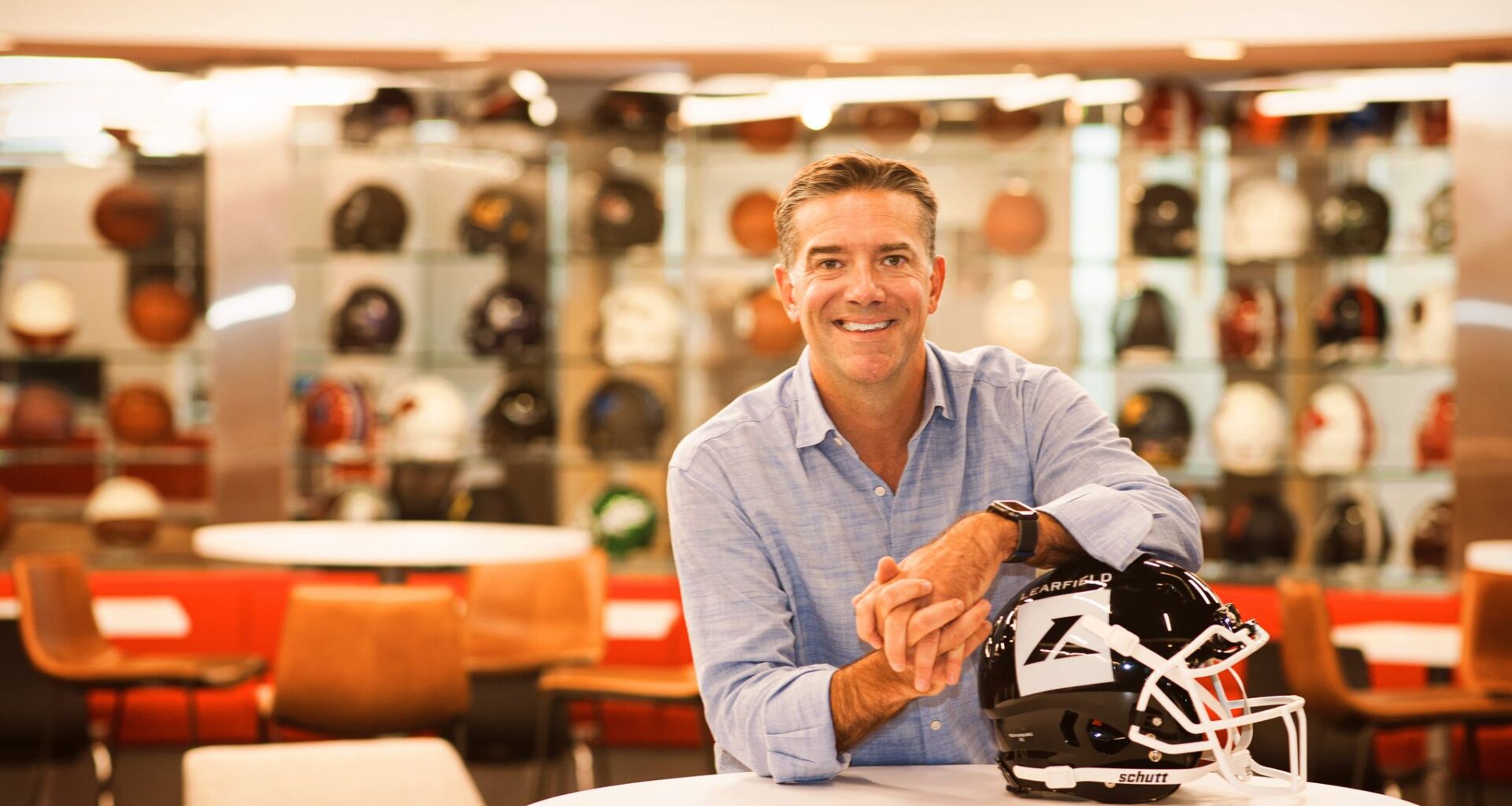
Cole Gahagan is president and CEO of Plano-based sports multimedia company Learfield.
Learfield
As Plano-based Learfield finalizes its multi-billion-dollar sale to private equity firm TPG, the chief executive of the prominent media and technology company remains bullish on the future of college sports, even as no one in the industry knows exactly what the model will look like a few years from now.

Cole Gahagan, Learfield’s president and CEO, rejects the notion that college sports is “broken.” He believes a model that gives college athletes a seat at the negotiating table is needed in the coming years. With its sale to TPG, Grahagan said Learfield will be best positioned to help schools tap into new revenue streams and keep fans at the center of its business strategy.
Article continues below this ad
The Dallas Morning News caught up with Gahagan on Wednesday to discuss a wide-range of issues, including how his company plans to help shape the college sports ecosystem on the heels of the sale to TPG, which reportedly will purchase a majority stake in the company for between $1.8 and $2 billion. Charlesbank Capital Partners will remain a minority investor in Learfield, whose other investors will exit their stakes as part of the transaction.
Gahagan lauded TPG, citing its vast investment portfolio, which includes Creative Artists Agency (CAA), DirecTV and Spotify, among others. Last year, the firm launched TPG Sports in partnership with golfer Rory McIlroy.
“Most people think of us as the sort of the sponsorship sales company of the last 30 years,” said Gahagan, whose company works with more than 100 colleges, including TCU, SMU and Texas. “The reality is we are a data-centric media and technology conglomerate that has five operating businesses in it, and those operating businesses span sponsorship, sales, content and media and technology. Having a firm like TPG, the breadth of their portfolio across media, sports and technology lends really well with who we are today and where we’re going.”
Make Dallas News a preferred source so your search results prioritize writing by actual people, not AI.
Add Preferred Source
The interview was lightly edited for clarity and context.
Article continues below this ad
Fans watch from Amon G. Carter Stadium as Stephen F. Austin plays TCU in the second half of an NCAA college football game Saturday, Sept. 12, 2015, in Fort Worth, Texas. (AP Photo/Tony Gutierrez)
Q: What was the rationale for the sale now and what convinced you TPG was the right partner?
Gahagan: “We have this highly unique moment and intersection of the company being performant and growing at record levels, and this unprecedented investor demand for college athletics right now. … A number of private equity firms have been sort of orbiting college sports for the better part of almost two years now, and considering investments in entities ranging from existing athletics departments to offshoots of the athletics departments, like what we’ve seen at several campuses like Utah and Michigan State and Kentucky, to investing potentially in the conferences themselves, what we saw with the Big Ten exploring as well as the locally with the Big 12 [exploring].
“One phone call and email led to five, which led to 15. And after a while, I sat down with our board, and I said, ‘Look, I feel confident that we’re always going to be performant. I don’t know how long this institutional investor demand is going to be hovering over college athletics, so that’s one variable that I can’t control. So taking that on the whole, now seems to be the right time to open the conversations and hear what people have to say.
Article continues below this ad
“We went into the process with a very clear-eyed and open-minded view on where we might land, which was essentially in three outcomes: potentially doing nothing. We could have landed with just taking on a new investor, if one of those private equity firms simply wanted to inject capital or invest in the business with their own theories or their own ideas for what we might do together. Or there was a third outcome, which is where we landed, of we may sell the company outright to a new buyer.”
SMU wide receiver Derrick McFall (20) is lifted by teammate defensive end Isaiah Smith (58) after McFall scored a touchdown during the first half of an NCAA college football game against California, Saturday, Nov. 30, 2024, in Dallas. (AP Photo/LM Otero)
LM Otero/AP
Q: We don’t know what the future college sports model will look like. So how do you define success for Learfield in, say, three years?
Gahagan: “When things are unstable and uncertain, there’s a flock to stable and trusted. And that’s what Learfield has been for 54 years, and we’ve certainly seen that over the last four or five years, that our schools are relying on us more than ever to help them strategize and navigate these uncertain times and maximize revenues along the way as expenses and costs continue to rise seemingly exponentially. Continuing to be the trusted, the stable partner to these schools in the years ahead is going to be paramount to anything else that we do together.
Article continues below this ad
“The second thing is, again, when the environment around you is chaotic and unstable, having partners in the mix who are able to focus on innovation and evolution is really important, and that’s our job. Learfield is helping to develop new products and services and capabilities that allow us to bring more fans to the mix, allow us to create better experiences for those fans, allow us to compete better and generate more revenue.
“We have the largest data platform in college sports. We have 130 million known fans in our data platform today, which is a byproduct of owning the largest ticketing technology company in college sports (Paciolan) and Sidearm Sports, which powers all the college athletics websites and apps.
“We launched Learfield Studios, which has quietly but quickly become the largest media platform in all of college sports. This year alone, we’ll do two and a half billion impressions of unique content that we’re creating with universities, brands and athletes. And now 70% or more of the NIL activations we’re creating for athletes on campuses all over the country is rooted in highly unique content that Learfield Studios is producing.
“So we were sort of ready for this moment because we invested in a data platform that allows us to reach all the college athletics fans out there, and because we invested in a media operation that allows us to create content that those fans want to engage with and create opportunities for the athletes and the universities and the brands that want to sponsor that content.”
Article continues below this ad
Q: Is the current college sports model sustainable?
Gahagan: “There’s a common misconception you often hear in all corners of college athletics, which is college sports is broken. I think decidedly college sports is not broken. You can’t have record attendance, record viewership and record revenues in areas like sponsorships and ticket sales while a model is broken.
“We have a flawed model right now, and I think that there are really good, smart people focused on how to remove as many of those flaws from the model as we can. I do think that means, yes, our industry will continue to evolve, we will continue to see changes that help to remove some of those flaws from the equation, whether that’s related to eligibility, whether that’s related to transfer rights of athletes, or whether that’s related to collective bargaining.”
Q: Athletic departments are confronting financial stress test like never before. What are some of the biggest untapped revenue streams in college sports now?
Article continues below this ad
Gahagan: “About a year and a half ago, the NCAA allowed for branding on the competitive surfaces of the football field and the basketball court … and that has unlocked meaningful revenue growth for many schools, and we’re still in the early stages of monetizing those assets across the entire country. The companion to that was jersey patches, that was also unlocked by the NCAA about 60 days ago. I think that will serve as one of the most meaningful new sponsorship assets and opportunities for schools in the history of college athletics, and we’ll start to see the first jersey patches come into market in the 2026 football season.
“One of the many differences between professional venues and college venues has been commercial naming rights in the professional sports world as a common practice for decades, and typically donor names on venues across athletics departments for decades. We’re now starting to see that shift to more consideration of integrating brands into the naming rights of those [college] facilities as well. Athletic departments are finding more ways to integrate brand sponsors into venue naming rights, while at the same time preserving a lot of these legacy donor names as well.
“We talked a little bit about Learfield Studios. We’re only scratching the surface in what I believe will be one of the most important sponsorship assets in the years ahead, which is highly unique content to put in front of fans. Where we’re going to go play is creating nuggets of highly unique content that can include the athletes and bring brands into the fold to sponsor that content, and then pushing that out in constant drip fashion to the fans.”
Q: An increasing number of stakeholders believe the collective-bargaining era needs to come. Do you agree?
Article continues below this ad
Gahagan: “In order for the industry to evolve the way that it needs to, and in order for there to be what I consider financial stabilization of the universities and, for that matter, the conferences as well in the decade-plus ahead, I do believe there is going to have to be some level of negotiating with the athletes themselves and with their representatives to try and stem the tide right now of ever increasing exorbitant expenses and costs to the to the universities.
“What that looks like, to me, is still a mystery. Is it, in fact, collective bargaining across the entire lot of the athletes in college sports? Does that include all sports, or only those sports that generate profits? Will they be unionized? Will they become employees? Those types of considerations, I think, are hard to solve. But as a starting point, yes, I do think that at some point there’s going to have to be negotiations with the athletes.”

By signing up, you agree to our Terms Of Use and acknowledge that your information will be used as described in our Privacy Policy.
Q: What role do you want Learfield to play in shaping the future of college sports?
Article continues below this ad
Gahagan: “Any sports property on the planet is well-served to continue to put its fans at the center of its focus in terms of its investments, in terms of its operations, and the benefit we bring to the table, and again, particularly because of those two businesses, Paciolan and Sidearm Sports, is that we have this extraordinarily robust and unique connectivity to all of the fans in college athletics.
“As we continue to put the fans at the center of where we invest and where we innovate, to help bring those fans closer to universities and help bring those fans closer to athletes as well, I think the most critical role we can serve is in strengthening those connectivities. And as a result of that, creating better experiences for fans around these college brands they love so much, creating better connectivity between the fans and athletes themselves, which has really sort of been an opaque relationship for the better part of 90 years in college athletics. And ultimately, as a byproduct of that, strengthening the relationship between the universities and these fans, so that universities best position themselves for success down the line.”