
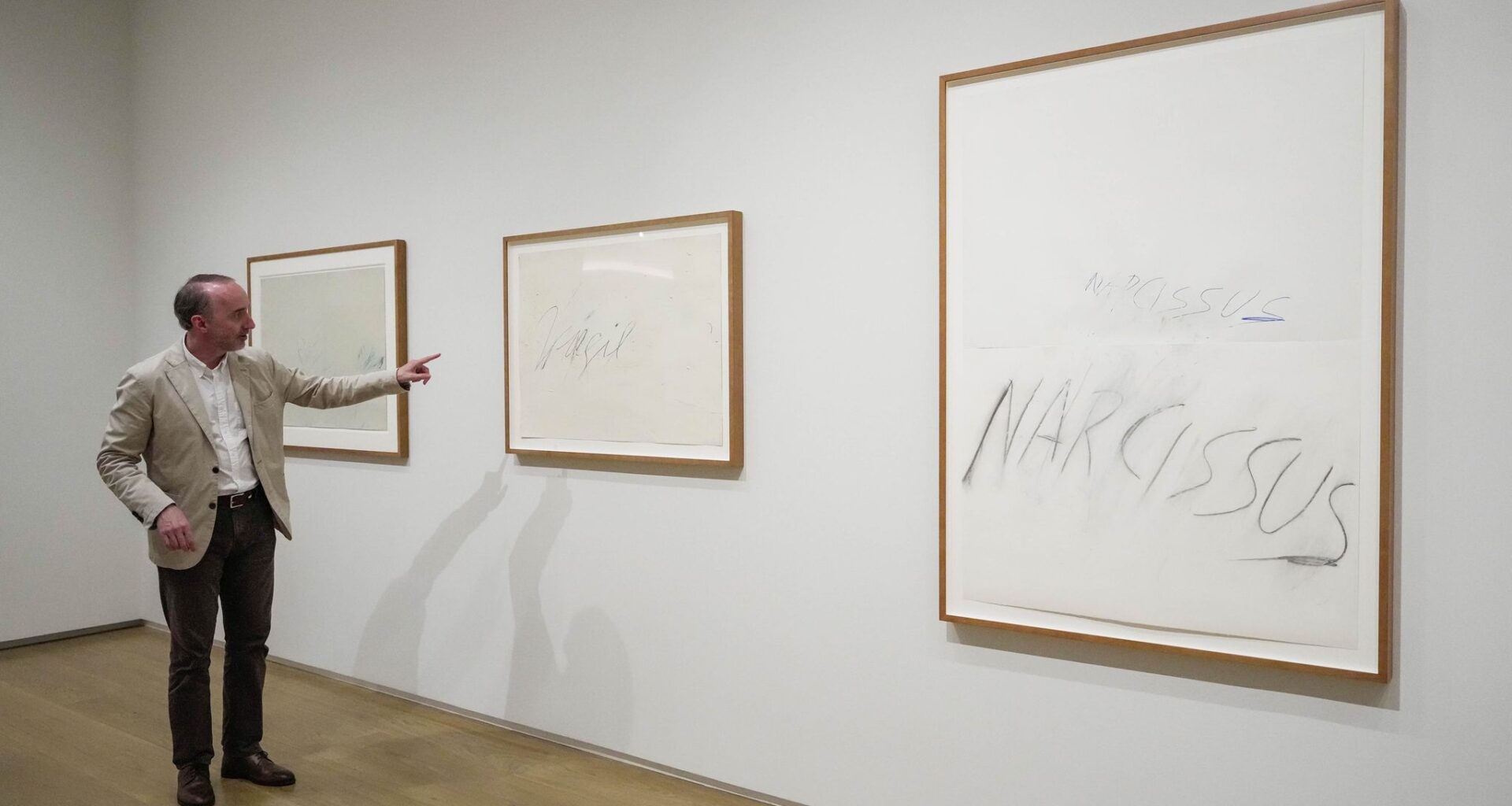
Curator Eduardo Kopp, speaks about a piece in the new “The Gift of Drawing: Cy Twombly,” exhibition at the Menil Drawing Institute in Houston, Thursday, April 23, 2026.
Raquel Natalicchio/Houston Chronicle
“The Gift of Drawing: Cy Twombly,” a new exhibition at the Menil Drawing Institute in Houston, Thursday, April 23, 2026.
Raquel Natalicchio/Houston Chronicle
“The Gift of Drawing: Cy Twombly,” a new exhibition at the Menil Drawing Institute in Houston, Thursday, April 23, 2026.
Raquel Natalicchio/Houston Chronicle
“The Gift of Drawing: Cy Twombly,” a new exhibition at the Menil Drawing Institute in Houston, Thursday, April 23, 2026.
Raquel Natalicchio/Houston Chronicle
“The Gift of Drawing: Cy Twombly,” a new exhibition at the Menil Drawing Institute in Houston, Thursday, April 23, 2026.
Raquel Natalicchio/Houston Chronicle
“The Gift of Drawing: Cy Twombly,” a new exhibition at the Menil Drawing Institute in Houston, Thursday, April 23, 2026.
Raquel Natalicchio/Houston Chronicle
“The Gift of Drawing: Cy Twombly,” a new exhibition at the Menil Drawing Institute in Houston, Thursday, April 23, 2026.
Raquel Natalicchio/Houston Chronicle
“The Gift of Drawing: Cy Twombly,” a new exhibition at the Menil Drawing Institute in Houston, Thursday, April 23, 2026.
Raquel Natalicchio/Houston ChronicleSarah Hobson/for the Menil Collection
Installation view of “John Akomfrah: The Hour Of The Dog.”
Mitro Hood/Photography BMA/The Baltimore Museum
“John Akomfrah: The Hour Of The Dog” co-commissioned by the Baltimore Museum of Art and the Menil Collection, Houston.
Courtesy Smoking Dogs Films and Lisson Gallery
“John Akomfrah: The Hour Of The Dog” co-commissioned by the Baltimore Museum of Art and the Menil Collection, Houston.
Courtesy Smoking Dogs Films and Lisson Gallery
A new show in the Menil Drawing Institute, “The Gift of Drawing: Cy Twombly,” is a bit of a tease. And a generous one, at that.
In 2025, the Cy Twombly Foundation bestowed 121 drawings and works on paper to the Menil Drawing Institute in acknowledgement of the museum’s mission. Chief curator Edouard Kopp is particularly proud of this.
Where: Menil Drawing Institute, 1412 W. Alabama
When: Through August 9
Details: Free; www.menil.org
‘The Hour of the Dog’
Where: Menil, main building
When: Through Oct. 11
Details: Free; www.menil.org
“It shows the significance of the drawing institute,” he says. “The only existing structure of its kind in the U.S.”
Article continues below this ad
On view, he’s exhibited just 27 works, or one-fourth of the comprehensive gift across two galleries. It’s satiating enough — for now. In celebration of the drawing institute’s forthcoming 10-year anniversary, Kopp plans to display more in 2028.
“The Gift of Drawing,” on view through Aug. 9, gives in other ways, too. Twombly fans will admire that the artist, perhaps best known for painting, was also a talented draftsman.
In the first space, which dips into Twombly’s practice from the mid 1950s to the early 1970s, flirts with the idea of a line, and his curiosity with the relationship between drawing and writing.
“Some words are legible, and others are partly legible. And there are words that are not words, but they are lines,” Kopp shares. “Handwriting can be a form of drawing, too.”
Article continues below this ad
Curator Eduardo Kopp, speaks about a piece in the new “The Gift of Drawing: Cy Twombly,” exhibition at the Menil Drawing Institute in Houston, Thursday, April 23, 2026.
Raquel Natalicchio/Houston Chronicle
With “Untitled” (1954), a trio of graphite on paper near the show’s entrance, Twombly tried to find new ways of drawing on sheets of paper. He would turn off the lights and scrawl away in the dark. The final product may resemble scribbles on the page at first glance, though regulars of the nearby Cy Twombly Gallery will recall their semblance to some of his early sculptures on view as part of the permanent collection.
For “Virgil” (1973), Twombly wrote the name several times, occasionally in paint between layers, to create a sense of patina.
“He once wrote that all historical art is, in a sense, contemporary art because the way of looking at it makes the experience immediate to the viewer,” Kopp says. “‘(Virgil)’ is an example of adding a patina of time. Even though the work is brand new.”
The work shares a wall with “Narcissus” (1975), which is technically a collage because the oil, wax crayon and charcoal span two sheets of paper. “It’s also just a couple of marks on paper,” Kopp notes. “Twombly loved the sounds of names as he pronounced them.”
Article continues below this ad
From that perspective, ‘The Gift of Drawing’ can be enchanting and bewildering. Twombly blurs the lines between drawing and writing, words and names, paint and pencil marks.
As the show veers west, so does the artist, into more whimsical and personal territory.
“Untitled” (1970) takes a detour in and around Naples. There are first-class train tickets and black-and-white photographs of leisure scenes. It’s a proper collage.
The work is flanked by Twombly’s responses to minimalism, “Untitled” (1969) and “Untitled” (1969). Following artist Donald Judd, and then-prince of the movement, gave a scathing criticism of a Twombly exhibition in 1964, describing the show as a “fiasco” with paintings that “had nothing to them.”
Another duo, “Untitled” (1970) and “Untitled” (1970), mimicks the style of grafitti with super-imposed, layered oil and wax crayon on paper that appears rubbed away by time.
Article continues below this ad
“These tie back to the ‘Blackboard’ drawing,” Kopp says. “We just framed them. They had never been for a show before.”
In the next gallery, “The Gift of Drawing” concludes with works from the 1980s that focus on nature and veer into wet mediums and watercolor.
“Scent of Madness” from the “The Gift of Drawing: Cy Twombly”
The head-turning pièce de résistance that can’t be missed is “Scent of Madness” (1986), a series of 10 portraits of flowers in different seasons of bloom. Kopps suggests the ‘madness’ title may be a reference to William Shakespeare. Twombly was well-read with a profound love of books.
“He uses paint in such an explosive way, it dissolves into abstraction. He tended to work quickly and decisively,” Kopp adds. “What really surprised us is that the underlying images are prints. He shows us what a great colorist he is. There are some lines here and there, but color is the protaganist.”
Article continues below this ad
Four surrounding acrylics and oil on Japanese paper, all “Untitled” (1986), are so saturated with paint that they buckle and bend within their frames. They conceal Twombly’s finger prints and reveal how physical his process could be.
Viewers may be reminded of Monet and Degas.
For Kopp and the drawing institute, the show’s dynamic finale is a gift that will keep on giving as more work from the collection is unveiled over the coming years.
“It will transform the way we present,” Kopp says.
Young Lives Matter
“The Hour of the Dog,” a 51-minute video by the British artist Sir John Akomfrah, occupies a space between film and immersive installation. Across six channels, the artist tells the stories of the American Civil Rights Movement with a focus on the young people who brought international attention to segregation in the South.
The exhibition’s title refers to time — specifically twilight, and the transition between day and night.
“There’s a democratic conversation of principle at work,” Akomfrah says of the multi-screen viewing experience. “Everyone chooses their own way.”
Through archives, documentary film footage, newreels and photography, “The Hour of the Dog” revisits non-violent marches, boycotts and protests.
Some of the faces who appear onscreen are recognizable. There are mug shots of arrested Freedom Riders, footage of the Little Rock Nine, and notable figures such as Stokely Carmichael (later known as Kwame Ture), and John Lewis.
Other characters are fictional composites of Akomfrah’s findings.
“I like reopening old files and seeing something else,” he says. “I’m particularly hopeful that people younger than me, who are activists themselves and think they are the ‘first,’ will see something, too.”
When Akomfrah initially started on the work, the Black Lives Matter movement was rippling through London.
“The Hour of the Dog” is co-curated by Menil Collection Senior Curator Michelle White and Baltimore Museum of Art Curator and Department Head of Contemporary Art Cecilia Wichmann. During Prospect.4 (P.4), a citywide exhibition across New Orleans, roughly nine years ago, Akomfrah shared with the Menil and Baltimore Museum of Art that a dream of his was to create something on the Civil Rights Movement.
His video, on view in the main building through Oct. 11, is the laborious product of that pitch.
“People always thinking of the big campaigns like the Selma to Montgomery marches and Birmingham. But it was the young people who were getting sprayed by water hoses; it was the young people being bitten by dogs; it was young people who sat in bus boycotts,” Akomfrah says. “I was interested in in-between moments. People moving from one life stage to another. This project is about the possibility of change and transformation.”