
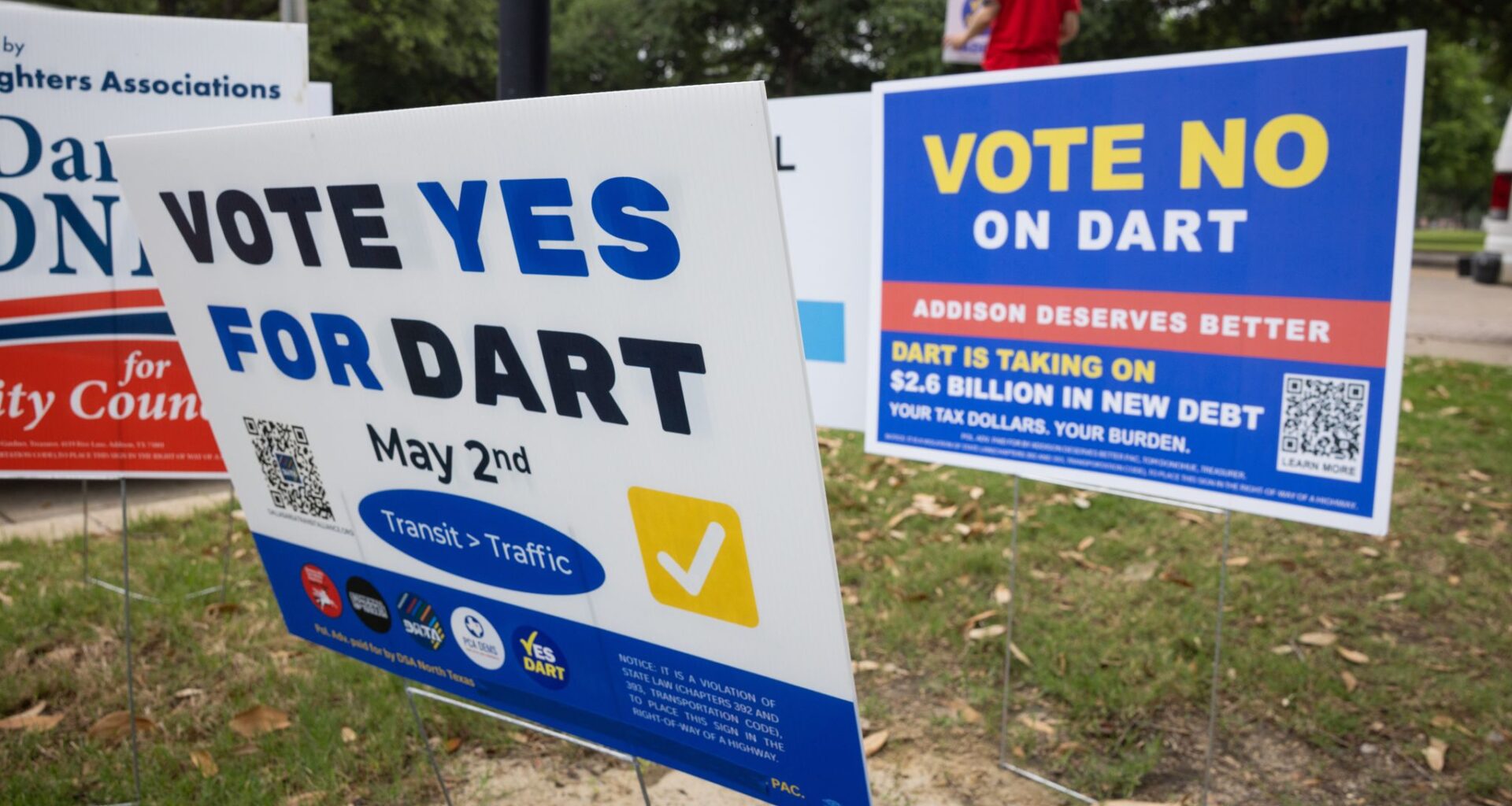
Political signs, including signs for and against the Dallas Area Rapid Transit, on display during the last day of early voting at Addison Town Hall in Addison, TX, Tuesday, April 28, 2026. Addison voters will decide whether DART service continues in the city or if trains and buses will move through without stopping.
Juan Figueroa/The Dallas Morning News
With voting in Addison, University Park and Highland Park already underway to choose their future with Dallas Area Rapid Transit, the agency laid out in stark terms what could follow if all three leave the system — including a billion-dollar financial cut over two decades, dozens of closures and hundreds of impacted riders.

In a report more detailed than any the agency has released before, DART’s staff outlined what’s at stake at the polls. The risks were presented at the board’s committee meeting in the last few hours of early voting Tuesday ahead of Saturday’s election.
Article continues below this ad
If any city elects to leave the system, DART is required to cease all services in that city the day after votes are canvassed. This official count of votes happens within two weeks of the May 2 election.
Cities are making plans to replace DART services with local microtransit if voters choose to sever ties with the agency. Addison Orbit, an on-demand service by transportation company Via, which also services Arlington and Plano, has already started picking up passengers in Addison. The rideshare-style service connects with DART stops outside Addison’s city limits.
Elections that succeed in parting ways with DART would result in “critical and massive” cuts to service, said Jing Xu, DART’s interim vice president of service planning and scheduling.
People in support of keeping Dallas Area Rapid Transit service in the city gather under a tent during the last day of early voting at Addison Town Hall in Addison, TX, Tuesday, April 28, 2026. Addison voters will decide whether DART service continues in the city or if trains and buses will move through without stopping.
Juan Figueroa/The Dallas Morning News
Fenced-in station, shuttered Silver Line stop
In Addison, the city’s newly opened Silver Line station would shutter. The agency reports more than 250 rides on average on weekdays and nearly 140 on average on Saturdays and Sundays, based on manual boarding counts at Addison’s Silver Line station. The nearby Knoll Trail Station in North Dallas will remain open regardless of the election outcome.
Article continues below this ad
Make Dallas News a preferred source so your search results prioritize writing by actual people, not AI.
Add Preferred Source
Addison would see 81 closures associated with 11 bus routes which have average weekday boardings of about 2,250, according to DART. All 11 routes would be realigned to Knoll Trail Station and Prestonwood Shopping Center “to preserve connections as the short-term solution,” according to DART’s presentation.
The Keller Springs GoLink Zone, linked with the city’s transit center, would be discontinued, and parts of the Farmers Branch zone that reach into Addison would be removed. A citywide GoLink zone, approved by DART’s board last year, would not be implemented if voters choose to leave DART.
Addison residents and businesses would lose access to DART’s transit center, including for the city’s events like Kaboom Town, and DART-owned overflow parking. DART facilities will be fenced in and secured.
Article continues below this ad
The Addison Junction, a planned $240 million mixed-use development near the Silver Line station, is projected to generate $300 million in annual economic output and support more than 1,600 permanent jobs, according to the city. A withdrawal from DART would jeopardize the partnership, Xu said, as DART owns some of the project’s property.
DART Board member Patrick Kennedy found the projections “incredibly disappointing” given the promises DART and local leaders have made to residents over the cities’ decadeslong memberships in DART. The swift discontinuation of service will be harsh, he said.
“I encourage voters to choose wisely,” Kennedy, who represents Dallas, said on the dais.
Article continues below this ad
The Addison Orbit rideshare service is hailed by riders through an app or by phone call. It connects to seven transit hubs outside the city, including Knoll Trail Station.
Addison Orbit began service on April 25 and includes paratransit services for eligible riders with disabilities within the Dallas area, as long as trips start or end in Addison.
Park Cities and DART paratransit at stake
If Highland Park voters cut ties with DART, the town would see 15 closures associated with one bus route, with average weekday boardings at about 35, according to DART. University Park would see 28 closures associated with two bus routes that average 115 boardings on weekdays.
Article continues below this ad
Highland Park and University Park GoLink coverage, plus connection to Dallas Love Field, would be removed.
DART and Southern Methodist University are still discussing the future of their shuttle partnership, including DART’s financial contribution to the shuttle, the transit pass price for students and agreements on access. The board of directors will consider action on the issue if an election is successful at dissolving DART in University Park.
“For the students, the employees, game day riders, FIFA would-be-goers, as SMU is a practice facility, if the city of University Park successfully withdrew … that service would end,” DART Board Chair Randall Bryant confirmed with DART staff Tuesday. “It would have to come back through a board action.”
Paratransit services, including trips within, to and from all three cities, would be discontinued if DART is voted down. In Addison, 11 riders use DART paratransit services within, to or from the city on an average weekday. In Highland Park, the weekday average for paratransit services is four riders, and in University Park, 28 riders.
Article continues below this ad
According to Highland Park’s website, the town council approved an agreement to implement a locally controlled microtransit pilot program to either complement or replace DART service, depending on the election. The pilot program has on-demand and paratransit-focused service components, according to the town.
The University Park City Council approved a contract with Via to provide paratransit service starting on May 13 should the city withdraw from DART, according to the city’s website.
The service, called RideUP, will offer citywide service plus rides within a one-mile radius of University Park. It will also provide paratransit for trips ending or starting within the city, according to the city’s website. The agreement includes the option to expand service to a broader microtransit model, such as on-demand rides within the community and nearby.
A sign directs voters during the last day of early voting in Addison, TX, Tuesday, April 28, 2026. Addison voters whether DART service continues in the city or if trains and buses will move through without stopping.
Juan Figueroa/The Dallas Morning News
Putting a price on an exit
Addison, University Park and Addison contribute nearly 4% of DART’s total sales tax collections. The agency receives a one-cent sales tax from each of the 13 cities that make up its service area.
Article continues below this ad
Cities that leave DART will still pay the sales tax until debts associated with their contributions are paid off, which could take several years. Then, cities would have the option to elect to put sales tax toward other uses, like economic development or public safety.
Over 20 years, the three cities are projected to contribute $1 billion in sales tax to the agency, according to DART, funds that will be slashed if voters in the three cities decide to end their relationship with DART.
“There is a significantly larger impact over the 20 year plan,” said DART CFO Jamie Adelman to the board.
DART is also offering cities some sales tax back for local transportation needs over six years, another blow to its sales tax collections.
Article continues below this ad
While a potential 4% cut as a result of withdrawal elections “is not a huge financial impact to the agency,” Kennedy said, “I can’t help but think about the people who ride the system to and from these cities.”

By signing up, you agree to our Terms Of Use and acknowledge that your information will be used as described in our Privacy Policy.
DART will no longer pay to service cities that withdraw.
“There will be savings by not providing services to some degree,” said former DART Board Chair Gary Slagel in an interview with The Dallas Morning News. “But not a lot. We’re still going to have to have our buses and trains running … It just won’t stop in those cities. There’s not a lot of savings in not stopping.”
Article continues below this ad
Election day in Addison, Highland Park and University Park is Saturday, May 2, and polls are open from 7 a.m. to 7 p.m.