
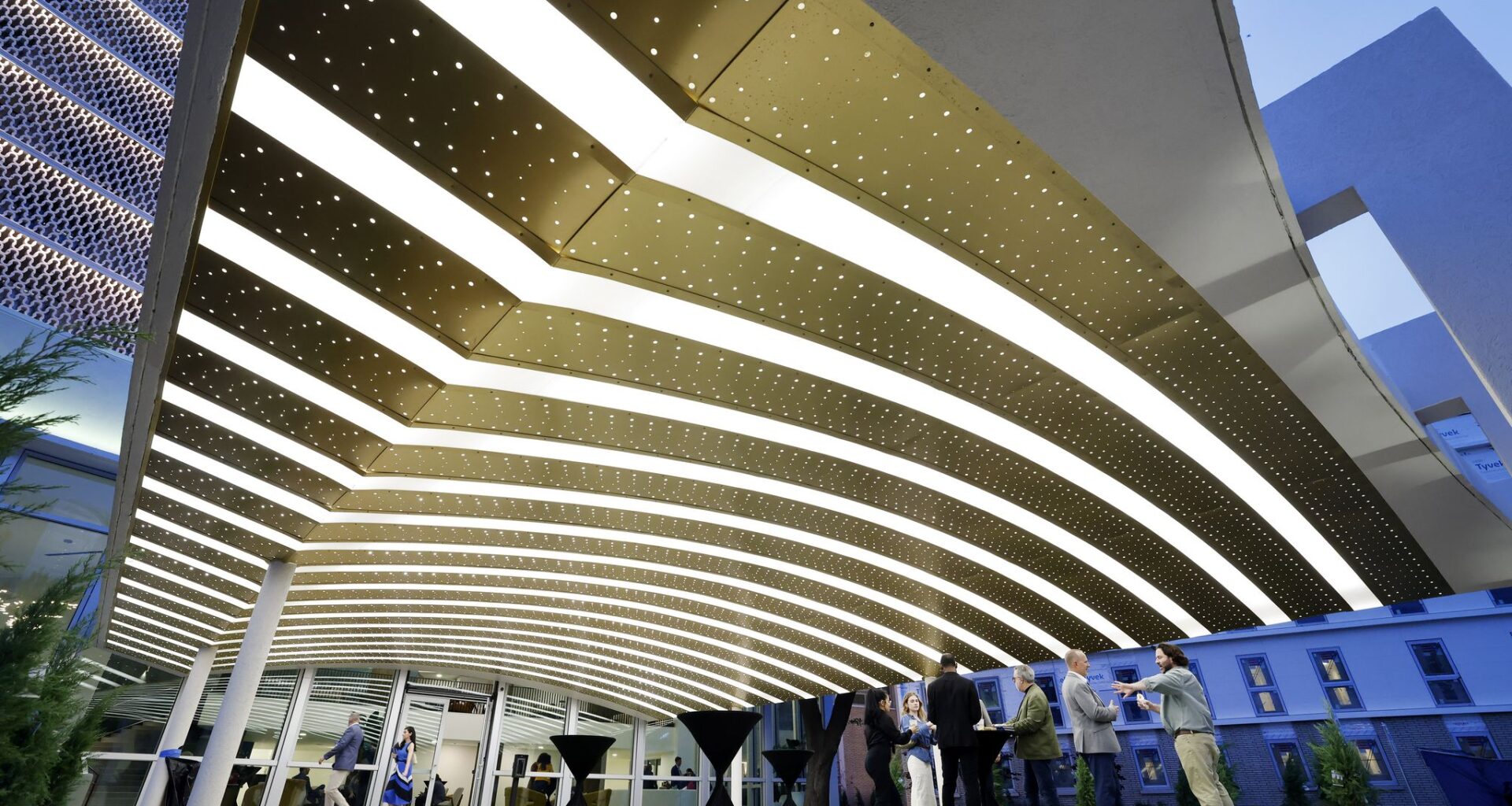
The restored entry of the historic Cabana Hotel.
Tom Fox/The Dallas Morning News
Q: What do the Beatles, Doris Day, Raquel Welch, the Teamsters, Katrina refugees, a jail, the Roman empire and affordable housing have in common?
A: Dallas’ remade Cabana Motor Hotel.

In January 1970, this paper ran a full page advertisement announcing “The Decline and Fall of the Cabana Hotel.” The iconic building, its screened facade a familiar presence along the Stemmons Freeway, was changing hands, and its Roman theme was going the way of that erstwhile empire. “We don’t have anything against statues. Or artificial grapes. Or purple and gold. Or fountains. It’s just they don’t seem to fit into this Age of Aquarius,” wrote the new owner, the Hyatt Corporation.
Article continues below this ad
More than half a century later, the Cabana has been resurrected once again. A $63 million conversion has transformed the historic but derelict Design District hotel into an apartment building with 40% of its 175 units reserved for low-income residents.
It is exactly the kind of project Dallas needs, one that preserves and celebrates the city’s architectural heritage while providing desperately needed affordable housing. Better still, there are several more like it on the way. Partners Zachary Krochtengel and Matthew Finn of Sycamore Development are engaged in projects that would transform downtown’s Magnolia Hotel, the Braniff Hostess College (at the foot of the Dallas North Tollway) and a West End loft building into mixed-income housing.
The Cabana Motor Hotel at the time of its opening.
Staff/Dallas Morning News
No building in Dallas can boast a more colorful history than the Cabana. When it opened, in January 1963, The Dallas Morning News called it the “epitome of modern hotel living” with “perhaps the most unique accommodations found in the Southwest.” That was not an understatement. Promoted as a “motor hotel” — combining the features of a hotel and motel — its 300 rooms were divided between a 10-story, wedge-shaped tower and an attached, 2-story, motel-style extension, or lanai. Out front, fountains shot water 30 feet into the air.
Article continues below this ad
Make Dallas News a preferred source so your search results prioritize writing by actual people, not AI.
Add Preferred Source
The third and largest of the Cabana chain properties (the others were in Atlanta and Palo Alto), the Teamsters-funded hotel was the brainchild of flamboyant Las Vegas developer Jay Sarno and would serve as the model for his most notable project, Caesars Palace. The design was by Melvin Grossman, a protege of Morris Lapidus, the Miami architect whose “too much is never enough” philosophy was exemplified in kitschy modern hotels like the Eden Roc and Fontainebleau.
The Cabana set a new standard in that extravagant direction, at least in Dallas. Its most distinctive feature was its decorative sunscreens, which shielded its east and west facades. These were composed of “Sarno Block,” bespoke hourglass-shaped concrete modules roughly the size of a cinder block that could be stacked to form a continuous grid pattern.
An exterior view of the redeveloped Cabana Hotel.
Tom Fox/The Dallas Morning News
The interior was equally opulent. The air-conditioned rooms were decorated in rainbow color schemes of plum, turquoise, orange, cardinal red, olive and putty. Every room had at least one fully mirrored wall. Celebrity guests — among them the Beatles, the Rolling Stones and Led Zeppelin — coveted the hotel’s 14 multilevel penthouse suites. For entertainment there was the Bon Vivant Club (with its 25-foot-long mural of cavorting nymphs) and the more exclusive Nero’s Nook (where Raquel Welch got her start as a hostess). The caffeine deprived could find relief in the Hav-a-Java coffee shop.
Article continues below this ad
The Cabana’s decline and fall was both precipitous and long-lasting. In 1965, it was sold to movie producer Martin Melcher, and when he unexpectedly died, in 1968, it was left to his wife, the actress Doris Day. When Hyatt purchased it in 1969, it had fallen into foreclosure, with Sarno accused of absconding with hotel funds.
The hotel changed hands several times in the following years — it became a Best Western in 1977 — but its time as a hotel, at least for paying guests, came to an end in 1984, when it was bought by Dallas County and transformed into a minimum security jail. In the years following it became a halfway house, temporary housing for Katrina refugees and a privately run prison for juvenile offenders. An effort, in 2014, to demolish it and replace it with a data center went nowhere.
When Sycamore acquired the property, in 2023, it had been sitting vacant for 10 years, with several developers having failed to bring it back to life. Sycamore did have several advantages on this front. The partners, who met as architecture students at Syracuse University, had an appreciation for the building’s New Formalist design and a clear-eyed vision for how it might be adapted. In developing it as mixed-income housing — as opposed to a hotel or a luxury property — they had access to tax credits available for such projects. Because the Cabana is registered as a historic place by the National Park Service, it was eligible for additional tax incentives.
The Sarno Block screen on the facade of the Cabana Hotel.
Tom Fox/The Dallas Morning News
While the building’s exterior was in fairly good condition, the interiors were almost entirely destroyed when it was turned into a jail. Working with the Dallas office of the architecture firm Gensler, the developers have revived at least some of the building’s original character. “We want this to be done in a way that’s authentic,” says Finn, the Sycamore partner. “We spent a lot of time looking at historic drawings, looking into news articles, trying to find as much of the photography as we could.”
Article continues below this ad
Those efforts are evident in the lobby, where the hotel’s original grand stair was reconstructed from scratch. Grossman’s sunken conversation pit, a typical mod-era feature, has been filled in — it was not compliant with the Americans with Disabilities Act — but lined with a distinctive border and different marble to mark its location, a subtle but appropriate homage. The former Nero’s Nook and Hav-a-Java will eventually be opened as retail spaces; the Bon Vivant club and ballroom have been deftly transformed into multilevel loft apartments.
The hotel’s Olympic-size swimming pool has been brought back to life, albeit with a slightly different shape, as have the three concrete parasols that provide shade to its deck. The adjacent motel-style rooms have been converted into two-story, townhome apartments. Overall, the 175 units are divided between studio and three bedrooms, and with the exclusion of the penthouses, the affordable and market rate apartments are mixed.

By signing up, you agree to our Terms Of Use and acknowledge that your information will be used as described in our Privacy Policy.
For better or worse, the interiors are fairly straightforward modern spaces, with the usual upscale amenities. No longer are there mirrored walls, and gone are the Venus-statue lamps with belly-button switches that once graced the Cabana’s rooms. The hotel’s “Roman” objects were auctioned off to benefit the Dallas Museum of Fine Arts (now the DMA) in 1970. Among the buyers was Lamar Hunt, who spent $10,500 on a trove including a statue of Bacchus, the Roman god of revelry.
Article continues below this ad
Even in its somewhat deracinated state, the Cabana remains its own unique self, a vestige of a moment of American exuberance. “These aren’t generic spaces,” says Finn. “If we can somehow celebrate history and bring it to someone’s everyday life, that’s kind of a win-win.”
May there be more such victories.