
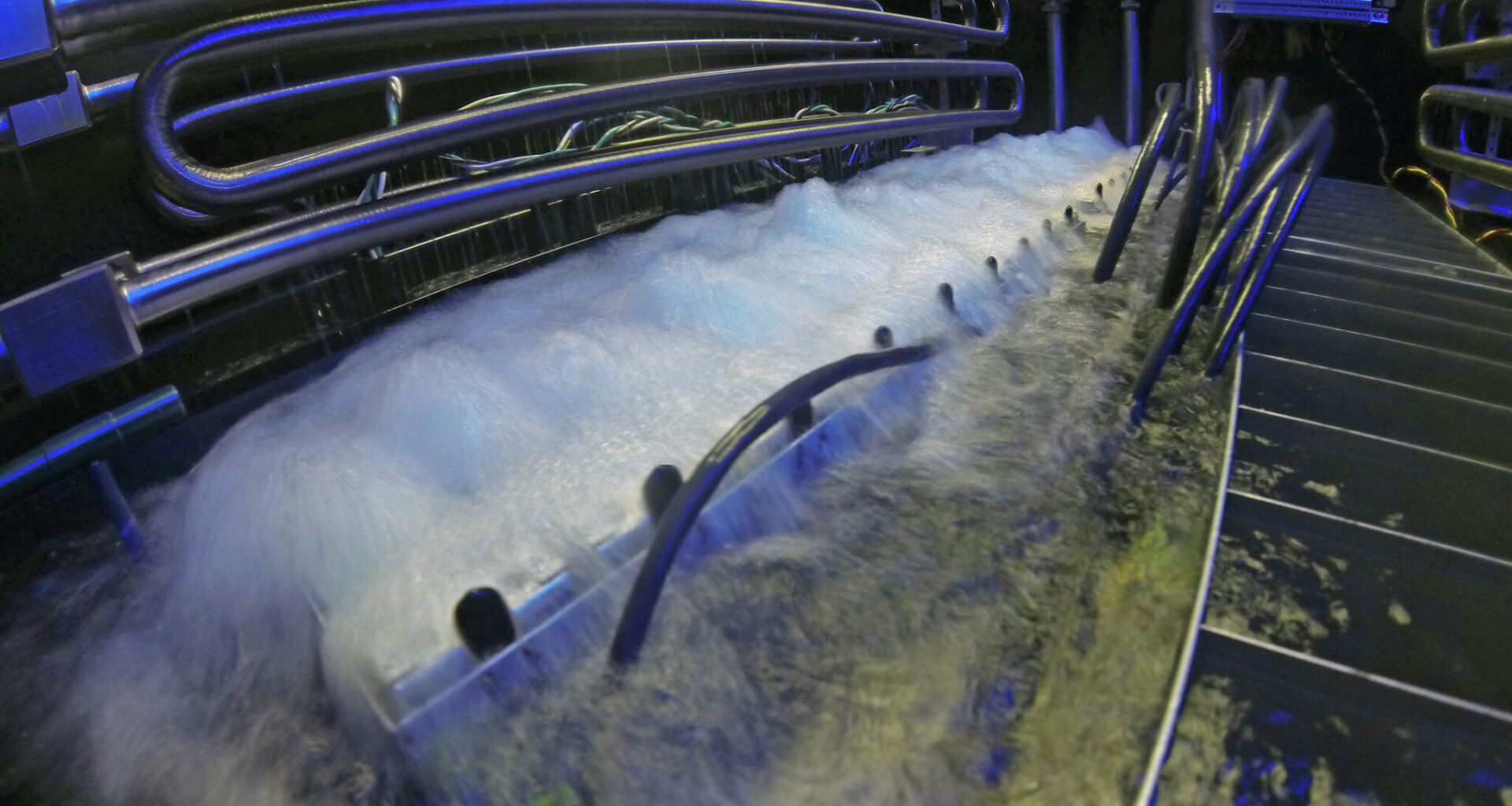
A high-tech specialty cooling fluid is used to cool computer servers. UT Austin will be testing several fluids to see how they perform for keeping data center tech cool.
Bruce Bisping/Star Tribune via Getty Images
Dunking racks of electronics into fluid could be key to reducing data centers’ use of electricity and water.

Researchers at the University of Texas at Austin’s Center of Electromechanics and the Bureau of Economic Geology are spearheading tests to compare synthetic coolants that could be used for immersion cooling systems to regulate the technology’s temperature. Using nonconductive, noncorrosive oil diminishes the water and power needs associated with traditional cooling methods that have added to concerns about the data center boom.
Article continues below this ad
“We can’t get away from it,” Mike Lewis, director of UT’s Center of Electromechanics, said of the expansion of data centers that support artificial intelligence, cloud computing and other needs. “But can we do it more responsibly?”
The computer chips that drive data centers have gotten smaller and more power dense as technology has advanced. But the more compact packaging means more heat — and an increased demand for energy and cooling needs. Higher temperatures cause system failures, so thermal control is central to a data center’s success.
READ MORE: Texas power demand to more than quadruple by 2032 as data center boom rolls on, ERCOT says
San Antonio Express News Logo
Make us a Preferred Source on Google to see more of us when you search.
Add Preferred Source
Despite progress in chip technology, thermal management has lagged behind, Lewis said.
Article continues below this ad
Initially, data centers were mainly air cooled, a power-intensive method that experts now consider inadequate. Next came indirect liquid coolant. Using the widely adopted cold plate method, heat is absorbed by a metal plate, then transferred to a liquid cooling system.
“That’s expensive in terms of the overhead for the data centers,” said Steven Villarreal, an energy consultant with Texas Consulting and Development. “And it’s expensive for the utility companies because they would have to provide additional megawatts to power a data center using this older type of technology.”
“Direct immersion cooling is the next evolution,” Lewis said. “It’s likely this is going to be the predominant pathway going forward.”
Shannon Strank, deputy director of process improvement at the UT center, said immersing AI array stacks into a cooling solution allows them to reach optimal efficiency and performance while using less energy and less water to cool the technology and the overall building.
Article continues below this ad
RELATED: Inside San Antonio’s AI-driven data center boom and what it means for CPS Energy
The closed-loop cooling system requires the fluid to be changed out every five to 10 years, which leads to water consumption being cut by as much as 90%, according to earlier research. Energy demand also is reduced, by about 50%.
Researchers from the University of Texas at Austin tour the Midas Immersion Cooling lab in Hutto to learn more about immersion technology.
Courtesy of Steven Villarreal
The UT Austin-led testing phase will compare different synthetic coolants for immersion technology. Villarreal explained that the study has engaged around a dozen of the top liquid coolant companies, working to provide objective evaluations on the effectiveness of the different coolants using performance indicators like viscosity and the corrosive effects on equipment.
Article continues below this ad
The integration of immersion technology has been slowed by barriers like upfront capital costs and the speed of the industry’s growth. While on the back end there is a total cost of ownership benefit and savings from energy and water reduction, on the front end, it’s a more expensive system and takes more time to implement.
The objectivity of the university’s research on a variety of coolants will help companies considering immersion technology by providing more data, Lewis said.
“A data center running an immersion cooling set of servers or racks likely does not want to change over fluids on a first-trial basis and then learn a lesson down the road,” Lewis said. “That’s where this university environment and test facility comes into play.”
READ MORE: S.A. City Council wants to weigh in on data center growth
Article continues below this ad
For UT Austin students, testing the coolants will allow for hands-on experience and expose them to cutting-edge technology that transcends a traditional classroom setting.
The research group also has reached out to the Electric Reliability Council of Texas in an effort to get the grid operator to participate in the process.
Lewis said the research also could lead to legislation that ensures data centers are operating as responsibly as possible — even if that means more cost on the front end.
Article continues below this ad
It’s no different, Lewis said, than Corporate Average Fuel Economy standards for vehicles, which regulate how far vehicles need to be able to travel on a gallon of fuel. While the current administration has reverted to lower standards, Lewis said that previous increases drove the hybridization and fuel efficiency improvements we’ve seen in vehicles for years.
“Hopefully, this shows a more responsible path forward,” Lewis said.