
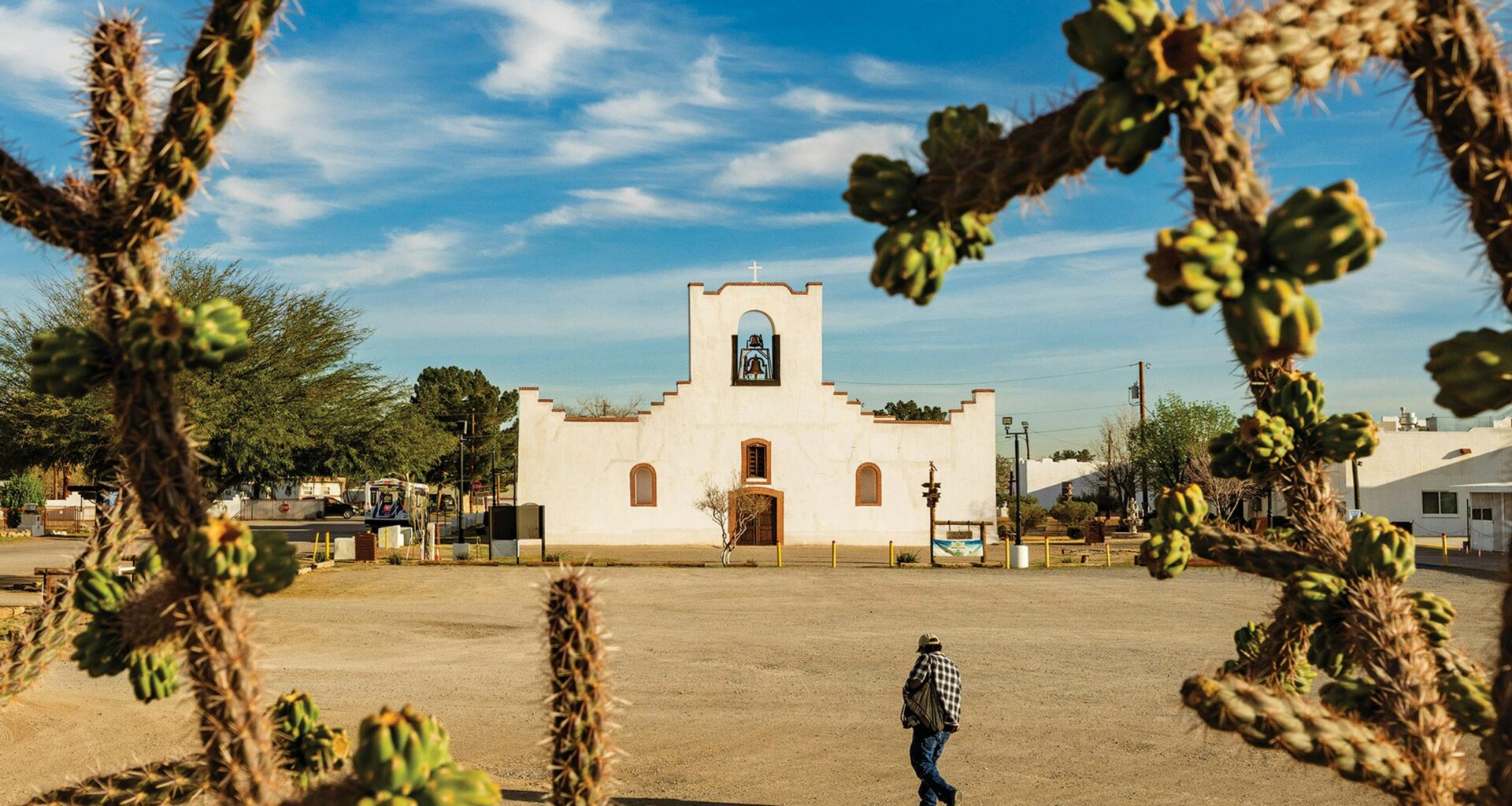
For decades, each Sunday at daybreak Samuel Trujillo carried his paralyzed father, José, from their home to the doors of the Socorro Mission, about twenty minutes southeast of downtown El Paso. The elder Trujillo insisted on greeting the sun as generations of his Indigenous Piro ancestors had before him. It climbed over the horizon, slowly lighting the white stucco-and-adobe structure and draping both men in reverent calm.
Father and son would then enter the church to celebrate mass, recalls Magda Maureira, the white-haired docent of the mission and Samuel’s niece. “[José] always sat under that big honorific beam . . . that runs underneath the choir loft,” she says on a cloudy January day, pointing to the ceiling. That seat was special, “reserved for the elders, the caciques, the chiefs, the leaders of the pueblo.” She tells me about her late uncle and grandfather in her soft tone, which melds breathy words with terms of endearment like mijo. She’s not just the caretaker of the church building. She also guards its stories.
Every Texan should try to visit old missions during their travels across the state, beyond the perennial field trip to the always-remembered Alamo. Adding stops to lesser-known missions breaks up the scrubby monotony of rural highways and might give you a renewed appreciation for our past. But these sites don’t always reveal much. Some are just a field and a historical marker. Some missions are mere rubble. And others, if you’re lucky, have low walls and arches or fuller replicas on their grounds. Yet every mission, no matter its condition, has value beyond its crumbling structures. The more obscure a mission, the more fulfilling it is to uncover its layers.
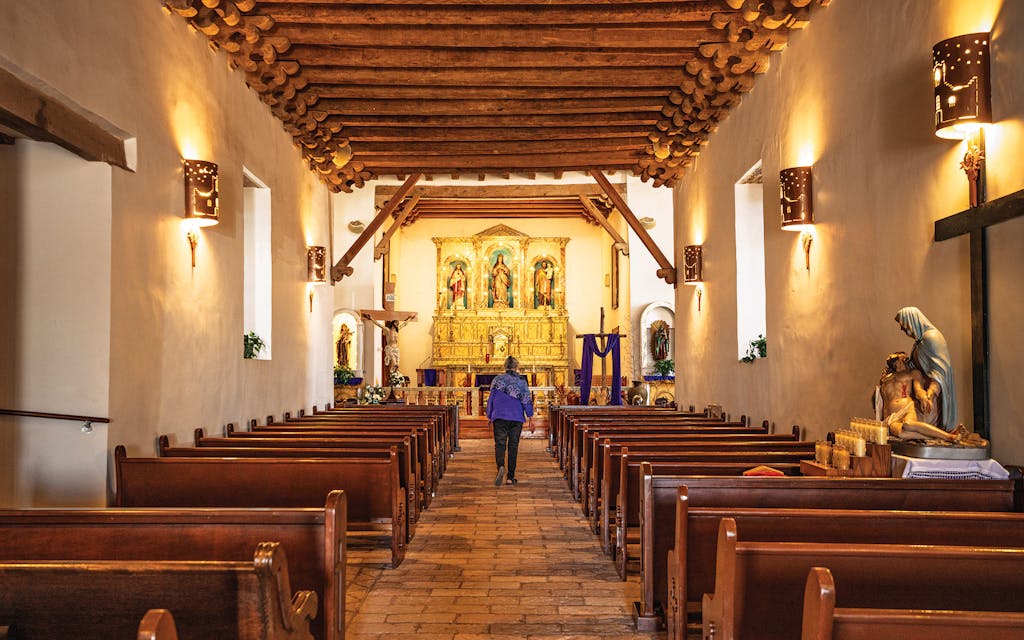 Inside the rebuilt church of the Socorro Mission.Photograph by Christ Chávez
The missions and presidios, often built near one another, were populated by the patchwork of people who laid the foundation of contemporary Texas. Those who settled there were of Indigenous or African descent or they were criollos, the Mexican-born children of Spanish colonists. Bradford Jones, director of the Texas Historical Commission’s archaeology division and the state archaeologist, says members of these groups tend to be lumped in with Spanish soldiers in the historical record, their identities erased. “But the soldiers themselves [were] almost never from Spain,” he explains.
The Socorro Mission, or La Misión Nuestra Señora de la Limpia Concepción de los Piros de Socorro del Sur, was established in 1680 by Spanish colonists and soldiers as well as Puebloan Piros from Socorro, New Mexico, who were fleeing the 1680 Pueblo Revolt. (The Piros of Socorro, Texas, are federally unrecognized tribal descendants of Indigenous New Mexicans who were relocated by the Spanish after the uprising.) It was one of the first missions to be built in what is now Texas, alongside the nearby Misión de Corpus Christi de San Antonio de la Ysleta del Sur, also named after a New Mexican pueblo and established in 1682.
What’s left of the first Socorro Mission site is a field in which locals and archaeologists believe Indigenous pottery and stone tools are still buried. It’s as sacred as the structure built around 1840 that’s still standing, a replica of the old church, about half a mile away. The Piros say the beam the Trujillos sat under for all those years, notched by centuries of parishioners, is a precious piece that was salvaged from the original structure after it flooded in 1829. Today the church is quiet, commanding reverence from all who enter. Its serenity is framed by the complicated, often violent stories of how such missions came to be. “It’s a very tortured history. It’s almost like we’re living contradictions,” Doña Magda says.
The presidio associated with the Mission Santa Cruz de San Sabá is a collection of stocky stone towers, swooping arches, and walls all begging to be climbed. It sits about an hour southeast of San Angelo, next to the Menard Country Club. When I first visited a couple of years ago, my quiet stroll across the grounds was interrupted by the unbridled laughter of children splashing in the club’s pool mere yards away. The San Sabá presidio and mission were burned down during a 1758 attack led by the Comanches on the Lipan Apaches and other residents, and only the presidio was rebuilt, in 1761. Archaeologists tried for decades to find the mission site; it was discovered in 1993, four miles downriver.
The mission to uncover more missions continues to this day. Tamra Walter, an associate professor of archaeology at Texas Tech University who was part of the dig team at San Sabá in 2012, says while there are at least 25 known mission sites within Texas, many others remain lost. “Most of them haven’t been excavated, and a lot of them haven’t even been located,” she says. Finding the forgotten missions is particularly challenging because about 95 percent of land in Texas is privately owned. Archaeologists—and amateur explorers such as me—may never see a pebble of the structures, much less piece together stories from the sites.
It took decades of relationship building with ranchers for Walter and her team to access the once lost eighteenth-century Nuestra Señora del Espíritu Santo mission, in Jackson County, which was excavated last December.
“Anytime that we find one of these lost sites, it’s rare,” Walter says. “When it happens, it’s like magic to me. It’s such an incredible privilege to be a part of it.”
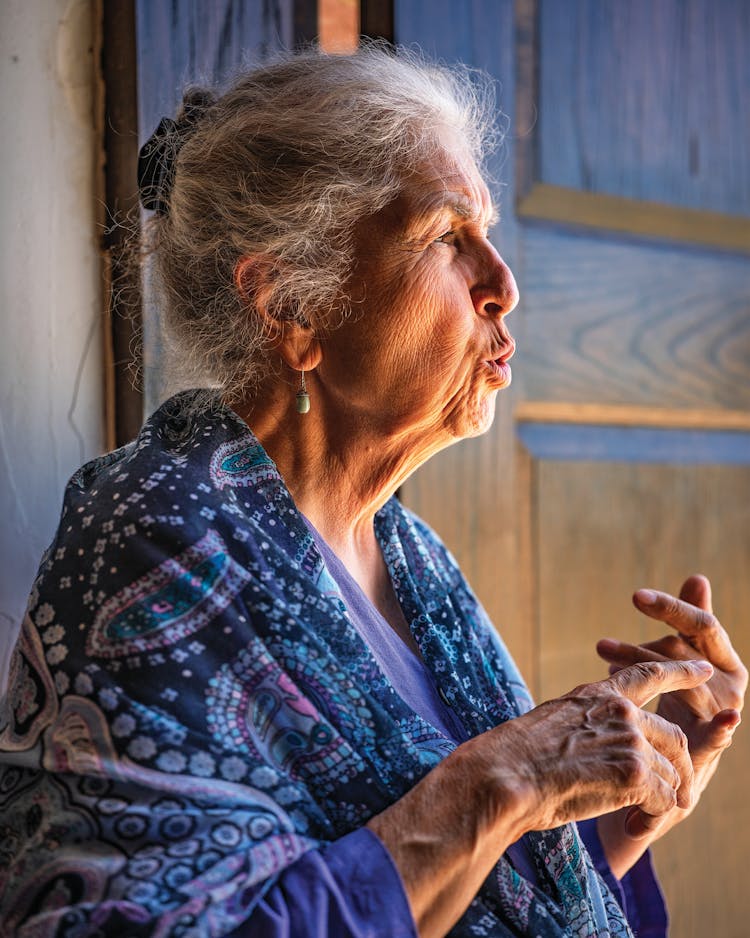 Magda Maureira is the keeper of the Socorro Mission’s stories. Photograph by Christ Chávez
 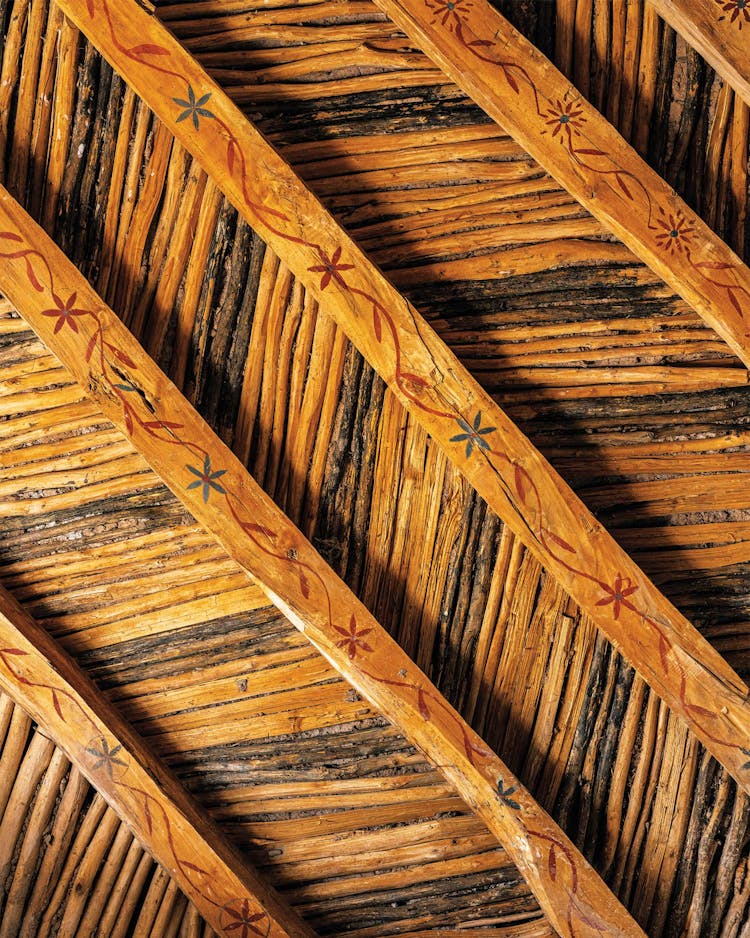 Beams salvaged from the original Socorro Mission. Photograph by Christ Chávez
If not for the Texas Historical Commission plaque or interpretive signs along a gravel path, Mission San Lorenzo de la Santa Cruz, in the Hill Country town of Camp Wood, would be an unremarkable smattering of foundation bricks, easily confused for the remains of a demolished family home and ripe for the picking by children interested in building a fort. During my January visit, I learned that Tlaxcalans, from an Indigenous central Mexico group allied with the Spanish, were relocated to San Lorenzo to serve as examples of good Christian converts and laborers. Missionaries struggled to feed residents because of frequent food shortages. Life in the mission was difficult, but it didn’t matter to the stronghold’s leader.
San Lorenzo de la Santa Cruz was an unsanctioned mission. Established on January 23, 1762, it was led by rogue Spanish soldier Felipe de Rábago y Terán. Rábago, a former commander of San Sabá with a reputation for violence, had been recently released from an eight-year stint in prison while under suspicion for murder when he was ordered by Joaquín de Montserrat, Marqués de Cruillas, the viceroy of New Spain, to settle land between San Sabá and New Mexico.
Rábago ignored Montserrat—the commander considered that landscape unsuitable and the directive a waste of his time. He was then persuaded by local Lipan Apache leaders, who wanted shelter and protection from Comanches, to establish San Lorenzo de la Santa Cruz. The viceroy in turn denied the mission financial support. Tensions between Rábago, the garrison, mission priests, and the Lipan Apache families who lived in the mission as well as attacks by Comanches culminated in the abandonment of the mission in 1770.
The commander helped start another unsanctioned mission during that time: Nuestra Señora de la Candelaria del Cañón, in what is now the Uvalde County town of Montell, was founded on February 6, 1762. It was abandoned in 1771. Today its presence is noted only by a narrow, short stone pillar and a nearby Texas Historical Commission marker. When I visited after my stop at San Lorenzo, I peered over a fence onto what looked like private property.
After leaving Candelaria, I embarked on the six-hour journey to see more missions in West Texas. Before the sun dropped that day I found myself gazing down at a sign in the desert, more headstone than historical marker. It read “Approximate Site of Mission San Francisco de los Julimes.” The mission was established in 1683 about fifteen minutes northwest of Presidio in what is now Ochoa, whose name is also the surname of many of the community’s residents.
Farther off the winding, dust-swept road is a metal-fenced cemetery where members of the Ochoa family are interred. Graves are marked with crosses, carefully placed fake flowers, ribbons, and hand-painted names. It’s so quiet, so haunting, that if a snake wended its way across the plot, it would make the loudest sound in the vicinity.
Ochoa is another mission unexplored by and unfamiliar to many Texans, even top researchers, though its history is recorded by the Texas Historical Commission, the Historical Marker Database, and the University of Texas at San Antonio’s Center for Archaeological Research. The uncle of the notorious Rábago reportedly passed through the area. The site is now dirt and stone like so many missions in Texas.
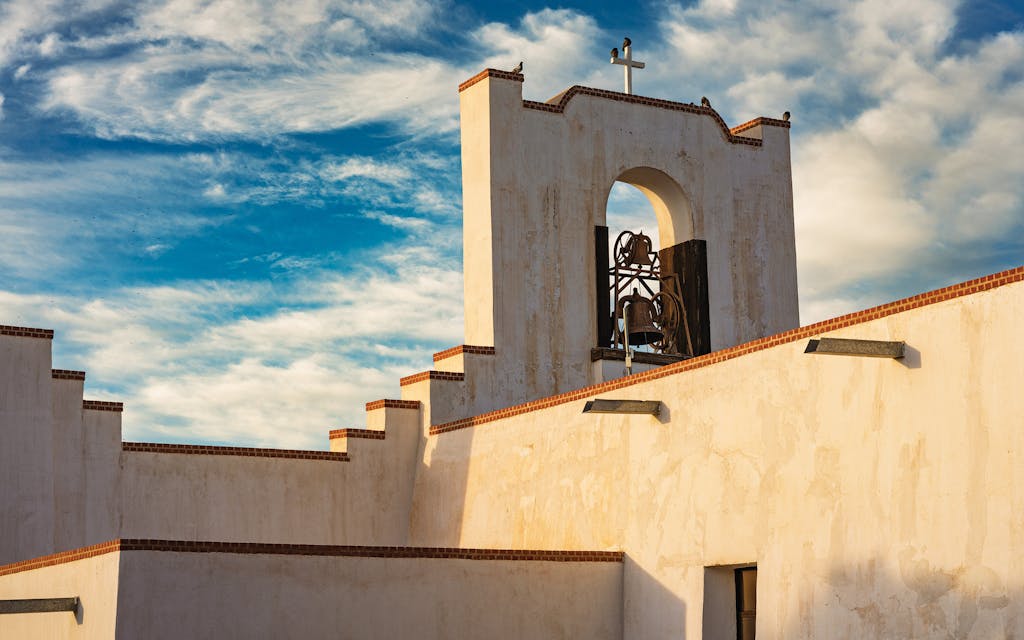 A bell tower added to the Socorro Mission church in 1847.Photograph by Christ Chávez
“These are the foundations of our identity at some level,” says Jones, the state archaeologist, about the many missions scattered throughout the state. “I see them as incredibly significant and important to understanding who we are, how we got here, why this place we all call home looks and feels the way it does.”
So here’s your quest. Next time you’re on the road, add a stop to a mission along your route. These visits are as important to me as the ones I make for my day job as taco editor of this magazine. You may not always be rewarded with much to see. I’ve often gazed at emerald-green grass where a structure, or its ruins, should have stood. In those moments, I try to put myself in that time and place. I imagine what the mission and its grounds looked like at their peak. I picture children playing and adults making music. I envision the sounds and smells. Of course, I like to think about what the people living there ate. And then I trek onward in the hope of finding any fragments of the past that may help explain the present.
This article originally appeared in the May 2026 issue of Texas Monthly with the headline “Here’s Your Mission.” Subscribe today.
Read Next