
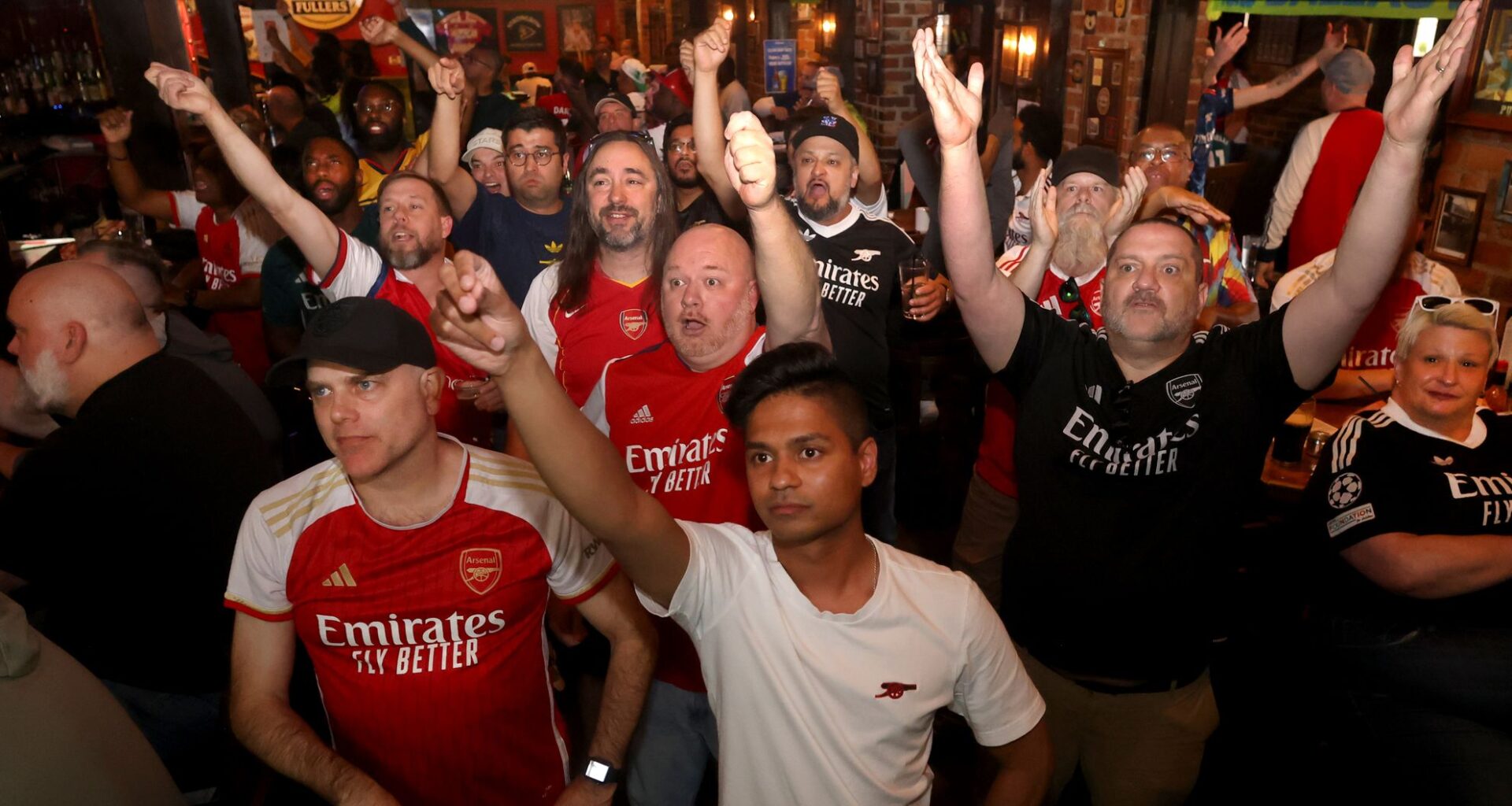
A large contingent of Arsenal fans cheered a developing scoring drive during second half action. English soccer fans packed into the familiarity of an English pub to watch and cheer for their favorite team as the Arsenal versus Newcastle soccer match was projected on the large screens at The Londoner, 14930 Midway in Addison, on April 25 2026.
Steve Hamm/The Dallas Morning News
ADDISON — The clatter of pint glasses and the low hum of British accents fill The Londoner, a pub that has become a second home for English football fans scattered across North Texas.

Charlotte Tate, the pub’s director of operations, moves easily between tables on this warm spring day, greeting regulars and introducing staff members who, like her, have built their lives around this unlikely cultural outpost.
Article continues below this ad
“The year I moved here was actually the last time the [men’s] World Cup was in the U.S.,” she says, hearkening back to the 1994 tournament. “Back then, soccer really wasn’t much of a big deal over here at all. They were handing out free tickets at my dad’s pub. Now they’re going for thousands of dollars.”
Thirty years later, the sport that once struggled for relevance in America is returning as a global juggernaut, and North Texas is preparing for the kind of month-long frenzy only a World Cup can bring.
Related: Which teams are playing in Dallas-Fort Worth during 2026 FIFA World Cup?
Make Dallas News a preferred source so your search results prioritize writing by actual people, not AI.
Add Preferred Source
The kind of frenzy that has sometimes put English fans in headlines for the wrong reasons.
Article continues below this ad
England will face Croatia at AT&T Stadium on June 17 in one of the marquee matches of the World Cup group stage. With them will come a wave of fans whose passion, history and reputation precede them.
“We, the English fans, are very passionate,” said Londoner owner Rosemary Tate. “Soccer’s been big as a family. We’d all sit around on a Sunday and watch Match of the Day.”
That passion is what Americans fans often admire, and sometimes fear.
The hooligans era
The English supporters arriving in North Texas in 2026 are a very different crowd from the ones who dominated headlines in the 1980s and ’90s. The hooligans era — the image many Americans still conjure when they think of English fans — has largely receded into history.
Article continues below this ad
“We’re actually now decades removed from a time when hooligansim would have been more visible,” said Michael Butterworth, director of the Center for Sports Communication & Media at the University of Texas at Austin.
Butterworth said that improved policing, heightened media attention and the growing financial stakes pushed authorities to impose strict security measures that ultimately brought the hooligan era to an end.
The professor, who has conducted extensive research on sports and national identity, said hooliganism was never a political movement because it lacked explicit demands. Instead, he said, it emerged largely as an expression of a particular socioeconomic class.
Related: FIFA officials discuss impact of Iran war, Mexico cartel violence on 2026 World Cup
Article continues below this ad
The stereotype of the English hooligan, fueled by decades of sensational headlines, still lingers. But according to John Williams, a professor in Sociology at the University of Leicester in central England, the reality has shifted dramatically.
“The English game has gone through a period of sociocultural and economic transformation,” said Williams, who has done extensive research on hooliganism.
Williams said once the Premier League arrived after 1989 — clubs upgraded their stadiums and changed how they handled fans in response to the chaos of the 1980s — hooliganism at the top level was pushed to the sidelines.
He points to pricing, all-seater stadiums and CCTV as factors that “effectively excluded” many hooligans from elite soccer.
Article continues below this ad
Supporter groups and the FA also helped redefine what acceptable support looks like.
“Hooliganism around national teams has not disappeared,” he said, “but its high point was probably 30 years ago.”
The North Texas pub
The Londoner’s Addison location opened in 1997, but the family behind it has been showing World Cup matches since 1994. Rosemary still remembers opening the doors at 6 a.m. for just a handful of fans.
Article continues below this ad
Today, those early mornings look very different. On a typical Saturday, 200 people might pack the pub for a 6:30 a.m. Premier League kickoff.
Newcastle fans react with great energy as they watched their team score late in the second half of heir match against Arsenal which would have tied the score. After an officials stoppage for review, the goal was disallowed. English soccer fans packed into the familiarity of an English pub to watch and cheer for their favorite team as the Arsenal versus Newcastle soccer match was projected on the large screens at The Londoner, 14930 Midway in Addison, on April 25 2026.
Steve Hamm/The Dallas Morning News
Supporters’ groups for Arsenal, Chelsea, Liverpool, Tottenham and others have made The Londoner their home base.
The pub’s staff has learned to navigate the chaos with a mix of hospitality and crowd management that would make a stadium steward proud.
Article continues below this ad
Related: World Cup tailgating will be restricted in some cities. What about Dallas?
“It’s a difficult shift because of how busy you are, but it’s always so much fun. You wear your jersey, your flag, and you get to work but also be a part of it,” Charlotte said.
This summer, they expect all of that — times 10.
A tented area will go up in the parking lot. Extra watch spaces will open at their other locations. Staff will work back-to-back shifts and the crowds will include not just locals but thousands of traveling fans who want to be near the action, even if they can’t get inside AT&T Stadium.
Article continues below this ad
“People are coming into town whether they’ve got tickets or not,” Rosemary said. “They want to see the match, they want to see the atmosphere, and they really want to be here.”
The modern English fan
Williams explains hooliganism was always about identity — “in-group/out-group,” as he puts it. “Defending our turf against your attempts to humiliate us on it.”
He points out that hooliganism was largely unarmed and often more symbolic than anything else. And while there were racial elements in national‑team support, he says those have mostly disappeared as well.
Article continues below this ad
The professor said that the modern English fan is more likely to be a middle-aged professional than a street-fighting youth. The cost of travel alone filters out the old guard.
Related: How local North Texas businesses are stepping up to participate in the FIFA World Cup
“The World Cup in the USA in 2026 is very expensive to attend,” Williams said . “This is a tournament for affluent holiday-makers and football tourists, not for committed European hooligans.”
Simon Hastley, an English fan from Blackburn who now lives in North Texas, hopes his fellow supporters will be on their best behavior during the World Cup, though he admits, “We do have a reputation.”
Article continues below this ad
The 38‑year‑old software business owner said English fans can “get a bit lairy,” but he doesn’t expect any major problems during their stay on American soil, since they’re well aware that violence in the U.S. carries serious consequences.
The England-Croatia match
When FIFA announced that England would play Croatia at AT&T Stadium, The Londoner erupted.
“I thought how fantastic it was,” Charlotte said. “We have a large Croatian contingent that already comes in. It’s a really fun rivalry for us in house.”
Article continues below this ad
Siobhan Foley, the manager of The Londoner in Addison, calls it “a genuinely good match,” noting that the teams met in the 2018 World Cup semifinal. “It’s great that such a high-profile game is here.”
Jorge Davila, a Dallas-born Arsenal supporter, puts it even more dramatically: “That pairing has the gravitas of a Final.”
A group of Newcastle fans react with jubilation after their team scored late in the second half of play against Arsenal. Following an official’s review, the goal was disallowed by game officials. English soccer fans packed into the familiarity of an English pub to watch and cheer for their favorite team as the Arsenal versus Newcastle soccer match was projected on the large screens at The Londoner, 14930 Midway in Addison, on April 25 2026.
Steve Hamm/The Dallas Morning News
What will English fans be like when they arrive in North Texas?
Article continues below this ad
Loud. Emotional. Loyal. And, above all, ready to enjoy themselves.
Related: Will the World Cup inject ‘rocket fuel’ into FC Dallas and Major League Soccer?
“They’ll find the nearest pub,” Hastley says. “That’s the M.O. of the British.”
If you come across English fans during the World Cup, you’ll quickly learn that they’ll sing — loudly. They’ll argue about penalties — passionately. And they’ll drink — enthusiastically.
Article continues below this ad
You’ll also see that they love chatting with locals, snapping photos and either soaking up the Texas heat or complaining about it. And they’ll spend money. Plenty of it.
“This is so much more than a Super Bowl,” Charlotte said. “People come for a week, two weeks, three weeks. They spend tourist money the whole time.”
The travel breakdown
Although there are no precise projections for how many England supporters will travel to the 2026 World Cup, historical patterns offer a useful benchmark.
Article continues below this ad
Roughly 1.2 million international visitors are expected to come to the United States for the tournament.
At recent World Cups — 2014, 2018 and 2022 — U.K. fans have typically accounted for 5–10% of all international attendees, based on ticket allocations and travel data.
For this summer’s tournament, however, the share of traveling England fans may fall toward the lower end of that range, given that travel costs to the United States during the tournament are extremely high.
“It’s exceptionally expensive to travel over to this World Cup,” said Geoff Pearson, a professor at the University of Manchester and an expert on football crowd behavior and policing.
Article continues below this ad
Related: Gov. Greg Abbott announces $116 million in grants for World Cup events in Texas
He added: “My suspicion is that a large number of those England fans will be ex-pats living in the United States rather than people traveling over from England.”
Pearson also emphasized that the era of English hooliganism is long past, and that supporters heading to Dallas for the match against Croatia at AT&T Stadium should not raise special concerns for local authorities.
“English football fans haven’t caused any problems at any international tournaments outside Europe ever,” he said.
Article continues below this ad
He explained that the disturbances seen at some European tournaments have typically stemmed from English fans being attacked by locals who want to test themselves against the “famous English hooligans.”
Pearson said that English clubs are largely trouble‑free. “The mass disorder we saw in the 1970s and 1980s is largely under control.”
The love of the game
In 1994, the World Cup helped put soccer on the map in the United States. In 2026, many believe it will cement the sport’s place in American culture.
Article continues below this ad
“I think it will solidify it,” said Hastley, who arrived in North Texas eight years ago.
“Since I got here, things have changed 100 percent. Football now has unprecedented coverage, and the World Cup will only help it grow even more.”
A family enjoys watching second half match play from a sports activity room. English soccer fans packed into the familiarity of an English pub to watch and cheer for their favorite team as the Arsenal versus Newcastle soccer match was projected on the large screens at The Londoner, 14930 Midway in Addison, on April 25 2026.
Steve Hamm/The Dallas Morning News
According to a 2025 analysis published by Samford University, U.S. interest in soccer has surged, with 50.3 million Americans now watching non‑U.S. soccer matches, a 60% increase over six years.
Article continues below this ad
Related: Dallas’ 34-day FIFA World Cup Fan Festival readies for opening kick
The English fans who arrive in Dallas this summer will carry the same pride, the same songs, the same flags and the same hopes their predecessors did. But they will not carry the same reputation.

By signing up, you agree to our Terms Of Use and acknowledge that your information will be used as described in our Privacy Policy.
The hooligan era is over — priced out, policed out and culturally outgrown.
Article continues below this ad
What remains is something far more enduring: a deep, generational love for the game.
“Football becomes something that’s so ingrained in our culture and our life,” Foley said. “It’s a massive part of our identity.”