
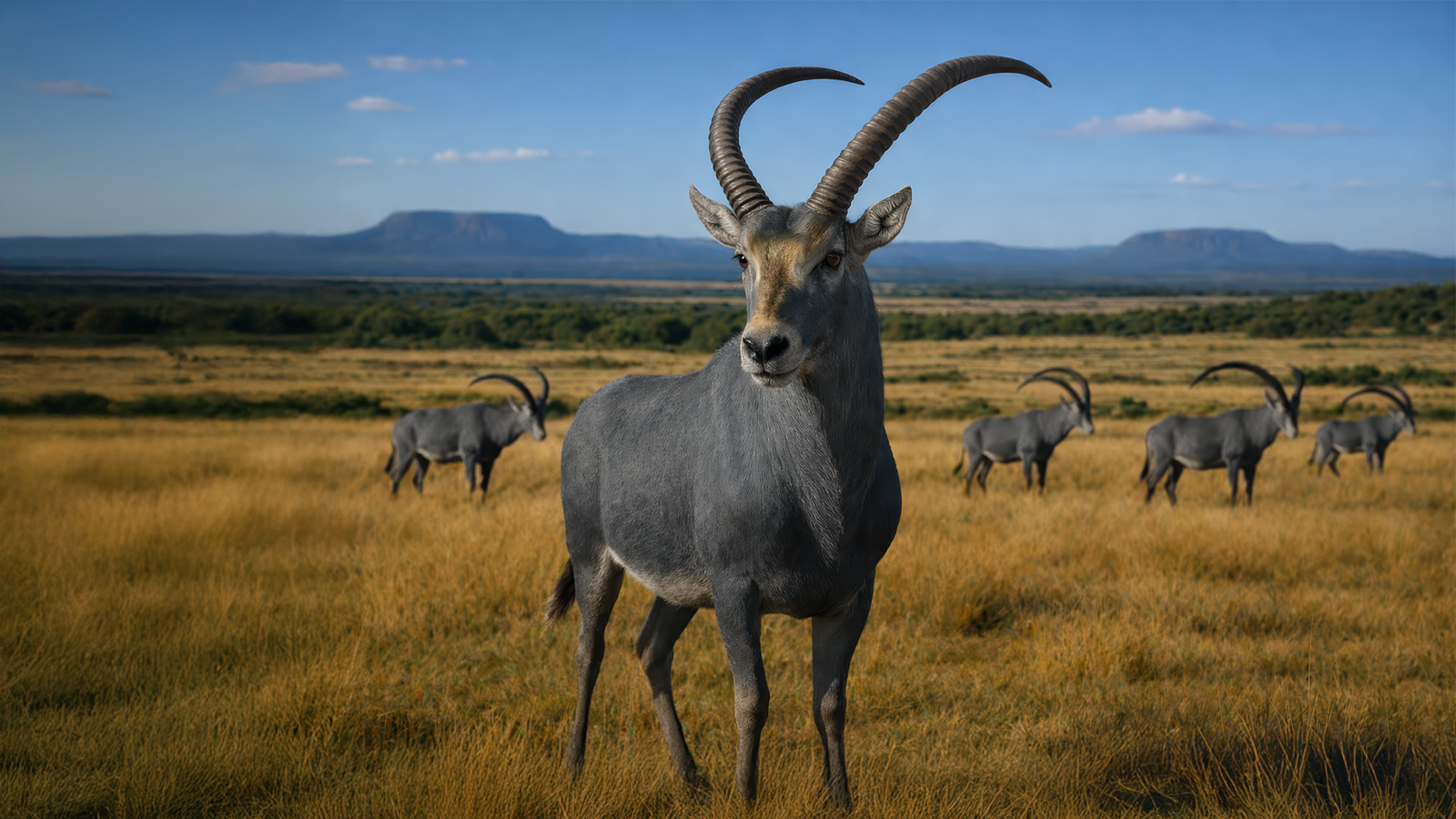
A rendering of the bluebuck, an extinct species of African antelope and the subject of Dallas, Texas-based Colossal Biosciences’ next de-extinction project.
Courtesy of Colossal
Dallas-based Colossal Biosciences announced Thursday its sixth and latest de-extinction project: the bluebuck. The company says the project has been underway since 2024, alongside its other de-extinction efforts, the woolly mammoth, dodo bird, thylacine, moa and dire wolf.

The bluebuck was a species of antelope native to southern Africa with a distinctive silvery blue-grey coat and long, curved antlers. It went extinct in 1800, just a few decades after European colonizers arrived in the area and hunted the antelope to extinction, though scientists note its population already exhibited signs of decline prior to colonization.
Article continues below this ad
Colossal aims to not only bring back the bluebuck from extinction, but use the project to develop tools that can help conserve other antelope species, which face a “growing endangerment crisis,” per a release.
“African antelopes have long been neglected in global conservation,” said Dr. Beth Shapiro, chief science officer at Colossal, in a release. “While other megafauna benefit from advanced reproductive technologies and extensive genomic research, antelopes—despite being among the most diverse and rapidly declining large mammals on Earth—have been left behind. The bluebuck de-extinction project changes that. We’re bringing back a species that played a vital role in its ecosystem, and building the scientific foundation for antelope conservation before more of its relatives are lost.”
Related story: Meet Colossal’s ‘woolly mouse,’ a breakthrough in mammoth de-extinction
Make Dallas News a preferred source so your search results prioritize writing by actual people, not AI.
Add Preferred Source
Colossal says it has already achieved major scientific and technological breakthroughs with applications for the project and larger antelope conservation. Those include bluebuck genome analysis; engineering the first induced pluripotent stem cells from the bluebuck’s relative, the roan antelope; and the first successful ovum pickup procedures in two antelope species, an advance in assisted reproduction technology. Colossal’s nonprofit, The Colossal Foundation, has also begun collecting and preserving genetic information from threatened antelope species as part of its BioVault initiative, and its working with the Endangered Wildlife Trust and Advanced Conservation Strategies on preliminary plans for rewilding the bluebuck in its natural habitat in southern Africa.
Article continues below this ad
Colossal Biosciences scientists work on an oryx, a species of antelope, as part of its newly announced de-extinction project, the bluebuck.
Courtesy of Colossal
“We recognize that bringing back the bluebuck is just the first step in a much longer, strategic journey,” said Colossal CEO and co-founder Ben Lamm. “Working with [ACS founder and director] Josh Donlan and ACS allows us to proactively address the complex ecological, ethical, and regulatory considerations of reintroduction long before any animals are ready for release. We’re committed to ensuring this project meets the highest standards of scientific rigor and regulatory compliance throughout the entire process.”
“The Endangered Wildlife Trust is committed to ensuring that any efforts to restore extinct species in South Africa are grounded in the integrity of the ecological system as a whole, and will not negatively impact existing indigenous wildlife and local communities in South Africa, but create meaningful benefits for both,” said Yolan Friedmann, CEO of the EWT.
Pictured are roan antelope, the closest living relative of the extinct bluebuck. Dallas, Texas-based Colossal Biosciences announced the bluebuck as its next de-extinction project.
Courtesy of Colossal
The bluebuck project is the most recent announcement from a company always making moves. In August, Colossal quietly spun out an AI startup, Astromech, that has since reached a total of $40.5 million in funding. The Dallas-headquartered venture seeks to apply advanced computing to biology, with applications forecasting evolution, predicting disease trajectories and analyzing pharmaceutical effects, and hit a $2 billion valuation in March.
Article continues below this ad

By signing up, you agree to our Terms Of Use and acknowledge that your information will be used as described in our Privacy Policy.
Related story: Colossal’s techy new HQ helps Dallas startup be ‘in your face’ with de-extinction mission
Colossal has also recently debuted a new headquarters, acquired an Austin-area cloning company and secured $60 million in funding for a permanent lab at Dubai’s Museum of the Future.
“De-extinction done well is an act of ecological responsibility as well as scientific ambition,” said R. Alta Charo, Warren P. Knowles Professor Emerita of Law and Bioethics at the University of Wisconsin-Madison and an advisor to Colossal. “Colossal’s work exemplifies this: advancing de-extinction science while simultaneously strengthening conservation for living species, with each effort reinforcing the other. That combination, pursued in an ethically informed and socially engaged way, is what responsible innovation looks like.”