
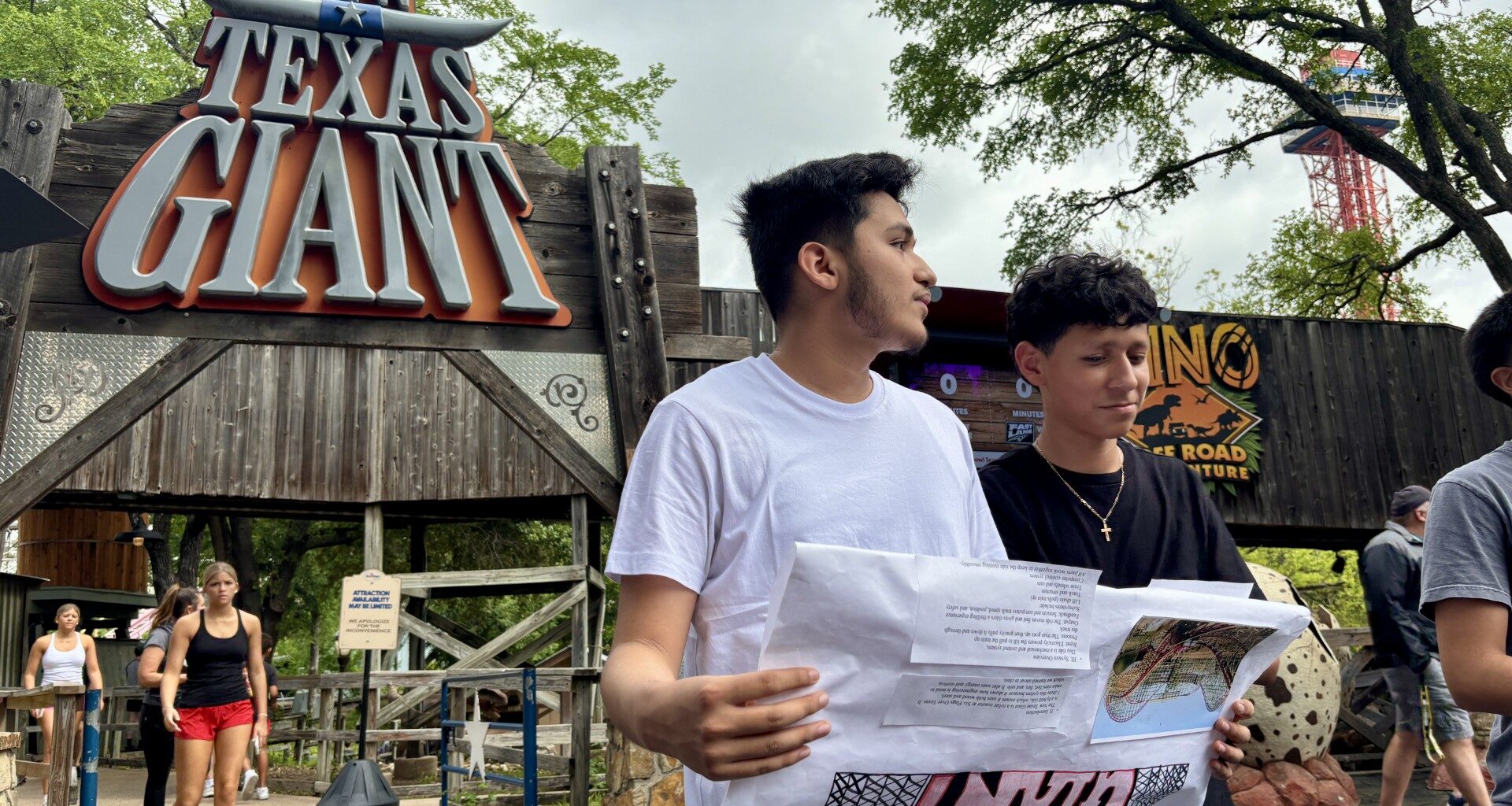
Josel Flores (left) and Rene Garcia (right) present their findings on the New Texas Giant, a roller coaster at Six Flags Over Texas in Arlington.
Jessica Ma/The Dallas Morning News
A colossus of steel and wood towered over a gaggle of rowdy teenagers, as screeching from tires — and lungs — roared through the air. On a humid Friday morning, the students converged to conquer a beloved ride at Six Flags Over Texas: the New Texas Giant.

But first, a recap on an engineering lesson.
Article continues below this ad
In this class of ninth graders from IDEA Southeast College Preparatory, three weaved their way to the front. They grasped a poster documenting all their research on the ride. They keyed in on a section titled, “Safety and Maintenance Analysis,” poring over the mechanisms built into the ride: lap bars, sensors and a block system.
“Based on your research, do you feel safe getting on the ride?” their engineering teacher, Brandy Jordan, asked.
No answer was needed. A swarm of teenagers bolted toward the ride’s entrance.
‘Let’s change the narrative.’
IDEA Southeast College Preparatory in Fort Worth, which is part of a national charter system, draws families with promises to land students in college, said Alexandria Greene, a college counselor. About 89% of its students are economically disadvantaged, according to 2025-26 state data.
Article continues below this ad
Make Dallas News a preferred source so your search results prioritize writing by actual people, not AI.
Add Preferred Source
“Let’s change the narrative of what’s possible for a very diverse population of kids, whether it’s racially or economically,” Greene said.
A college degree is considered crucial to earning a living wage. In Dallas County, a single young adult needs about $48,500 a year before taxes to cover basic needs, according to the Living Wage Institute estimates.
As North Texas is set to see its population soar, with millions of new residents expected to fill jobs in the region, workforce advocates want to see natives succeed. They hope to build a talent pipeline from K-12 schools to higher education institutions, especially to fill positions in high-demand fields, like STEM.
Article continues below this ad
Related: How can Texas’ public schools transform workforce readiness?
“The hope is that these kids can go learn things, become doctors, get their master’s, and come back and transform the schools or the area,” Greene said.
IDEA Southeast College Preparatory ninth graders took a field trip to Six Flags, which sought to expose them to engineering careers.
Jessica Ma/The Dallas Morning News
Engineering lesson plans
The ninth grade class introduces students to engineering principles, aiming to make the field as accessible as possible, said Pedro Carrizales, IDEA’s career and technical education curriculum manager.
Article continues below this ad
In one lesson, students used popsicle sticks to construct bridges, testing how the structure would hold loads. Another unit on robotics will guide students in building a hydraulic arm.
“One of the main things … is for students to understand that in engineering, there’s always going to be failures,” Carrizales said. “If you fail the first time, it’s okay.”
Each unit deals with a different field of engineering, spanning electrical, chemical and mechanical, he said. While this class went on a field trip to Six Flags, other students in the Rio Grande Valley are following the Artemis program and visited NASA.
In the coming decade, overall employment in architecture and engineering is expected to grow quicker than the average across all occupations, according to the U.S. Bureau of Labor Statistics. In 2024, median annual pay in these fields was around $97,300, compared to $49,500, the wage for all occupations. That year, agricultural engineers made about $84,600, while computer hardware engineers saw incomes of roughly $155,000.
Article continues below this ad
The engineering curriculum is still undergoing fine tuning. IDEA Southeast College Preparatory, which was founded in 2021, has not graduated a high school class yet, meaning school leaders are developing the engineering pathway as they go, said teacher Brandy Jordan.
While Jordan does not have an engineering background, a certification in the field is not required, Carrizales said. Curriculum managers, like him, develop the lesson plans, which revolve around the state’s learning standards. The charter system also hosts professional development sessions to train teachers in the content.
“This is my first time teaching the class,” Jordan said. “We basically will kind of try to learn it together.”
Related: High schoolers help restore World War II-era plane, taking aviation dreams to new heights
Article continues below this ad
To prepare for Friday’s field trip, ninth grader Brandon Oliver studied the roller coaster Mr. Freeze, which sends riders flying from a tunnel; then, hurls them around in a dizzying spree. In a mere 3.8 seconds, the ride accelerates from zero to 70 miles an hour.
While Brandon is here to observe roller coaster design, his true dream is to design buildings. He’s always been interested in engineering, he said, and the class has only “made me more interested.”
Conquering the Giant
The ninth graders, tingling with excitement, waited for their chance to board the New Texas Giant. (Unfortunately, even budding roller coaster engineers don’t get to cut the line.)
Article continues below this ad
As the one-hour mark approached, the students — to their relief — caught sight of the loading dock. One student called out with glee: “It’s the final stretch!”
Once strapped in, they were off. The coaster screeched, as it approached the peak — a formidable 147 foot drop. [cq]For 205 seconds, the students soared through a course of tunnels, twists, and turns, evoking a chorus of “AHHHHHHH”s.
Screams were aplenty, but that’s not unusual for a class of antsy teenagers, Jordan quipped.
“They scream even when they’re not on the ride,” Jordan said.
Article continues below this ad
Students Kaiden Jackson (left) and Brandon Oliver (right) were strapped into a roller coaster ride. College counselor Alexandria Greene snaps a picture of them.
Jessica Ma/The Dallas Morning News
This was ninth grader Rene Garcia’s first time riding a roller coaster. Not even researching the coaster could prepare him for the adrenaline rush.
As Rene exited the ride, he looked slightly dazed. “I feel like I’m going to faint,” he said.

By signing up, you agree to our Terms Of Use and acknowledge that your information will be used as described in our Privacy Policy.
He could not muster up the courage to throw his hands up in the air, admitting he “was holding on tight.”
Article continues below this ad
The DMN Education Lab deepens the coverage and conversation about urgent education issues critical to the future of North Texas.
The DMN Education Lab is a community-funded journalism initiative, with support from Bobby and Lottye Lyle, Communities Foundation of Texas, The Dallas Foundation, Dallas Regional Chamber, Deedie Rose, Garrett and Cecilia Boone, Judy and Jim Gibbs, The Meadows Foundation, The Murrell Foundation, Ron and Phyllis Steinhart, Solutions Journalism Network, Southern Methodist University, Sydney Smith Hicks, and the University of Texas at Dallas. The Dallas Morning News retains full editorial control of the Education Lab’s journalism.