
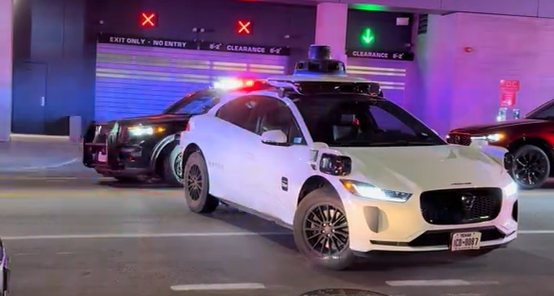
Waymo blocks traffic in Austin during a mass shooting.
Courtesy of Matthew Turnage/@turnage_realestate
Central Texas leaders are concerned about the safety of driverless cars operating in their city after multiple self-driving vehicles reportedly blocked emergency services during a deadly mass shooting last month. During a public meeting this week, Austin officials said at least five Waymo robotaxis may have interfered with ambulances amid the March shooting on West Sixth Street.

Austin City Council’s mobility and public safety committees held a special joint meeting on Wednesday, April 29, to discuss several incidents involving first responders and autonomous vehicles during emergency responses. Although city leaders reportedly invited all AV operators in the city to be a part of Wednesday’s discussion, reserved seats for Waymo and other companies remained empty.
Article continues below this ad
“It’s about making sure innovation does not come at the expense of safety,” Councilmember Zohaib “Zo” Qadri said Wednesday. “It’s about making sure that our community understands what’s happening on our roads and making sure that they have a voice in those conversations.”
In response to not attending Wednesday’s meeting, a Waymo spokesperson told MySA in a statement that “safety is fundamental to everything we do and that means taking responsibility and always improving based on what we learn.” The company added that it has “already had the substantive conversations this moment calls for, directly with all five requesting Council offices – including Council Member Qadri – more than 15 city officials, and the highest levels of state government.”
“In these briefings, we answered all questions related to the event and emergency response protocols, and provided a detailed and confidential overview of the event, including lessons learned and planned future operational improvements to Waymo’s emergency response procedures and capabilities,” the spokesperson said. “We will keep working with Austin’s leadership and first responder community, because ongoing collaboration is how we build the trust this city deserves and make Austin’s streets safer.”
Austin officials sound off over safety concerns of driverless vehicles
At the meeting, the Autonomous Vehicle Safety Working Group, made up of Austin transportation and public works, fire, police and EMS leaders, detailed a timeline of events, including two with Waymos from the March 1 shooting.
Article continues below this ad
Shortly after 2 a.m., when authorities upgraded the event to an active attack, first responders contacted all autonomous vehicle operators, asking them to “geofence around Buford’s and not allow the vehicles to enter the area. Minutes later, Austin-Travis County Safety Officer Roger Patterson said a Waymo blocked an ambulance response on Nueces Street, attempting to make a U-turn.
An APD officer quickly took control of the vehicle and moved it into a parking garage.
“What we do know from Waymo is that they did set up an initial geofence. We’re not exactly sure what time it was set up, but we do know that it was significantly smaller than the 1000-foot radius that we were expecting,” Patterson said. “They did expand the geofence, but that was not until over 40 minutes after the first 911 call was made and after repeated requests from communications on our site.”
Article continues below this ad
Between 2:10 and 2:30 a.m., Austin Fire reported “as many as 5” Waymo AVs blocking a response corridor set up for ambulances on Guadalupe at West Sixth Street. Austin Fire Battalion Chief Matthew Holmes explained that the first Nueces Street incident didn’t impact response time, but the Guadalupe incident led to traffic being backed up after a lead Waymo did not follow the officer’s hand signals, and ambulances got caught in the jam.
“Moving forward, we as public safety departments need to have a discussion about how large these geofences need to be, what we’re requesting of the AV companies and from the AV companies, we also need mechanisms to ensure that they’re setting up these geofences in a timely fashion, and they’re setting them up to the expectations that we have for them to be set up,” Patterson said.
Austin Police Lieutenant William White said there have been communication issues with Waymo, where it takes up to three minutes to connect with an agent. But this isn’t the first time Waymo vehicles have not followed traffic commands. Last year, Austin ISD reported Waymo vehicles illegally passing stopped school buses at least 20 times, which prompted a federal investigation in January.
A Waymo spokesperson said in a statement that the company has “a team dedicated to working directly with first responders to ensure they have the training and information needed to safely perform their duties and engage with our vehicles in an emergency situation.”
Article continues below this ad
“To date, we have trained over 35,000 first responders across the country, including thousands in Texas,” the company said. “We make our first responder guides and videos publicly available, and we engage proactively in the areas we service to ensure they have the training and information needed to engage with the vehicle in an emergency situation. Understanding hand signals from first responders is an important area of focus, and we are using advanced machine learning models to allow the Waymo Driver to detect and respond to these situations.”
Can driverless cars get tickets?
The City of Austin can cite AVs for moving and parking violations, but not by giving them a ticket. The responding officer must swear an affidavit and submit it to the court, and then the court must serve the complaint to the registered agent in Texas. Lieutenant White said this process is more time-consuming than issuing a regular ticket to a human driver.
Article continues below this ad
Since July 2023, police have noted that the AVs “struggle” with human hand signals and showed an example video during the Wednesday meeting of a Waymo vehicle following a green light traffic signal, but ignoring an officer’s commands and attempting to drive through a funeral procession.
Editor’s note: This story has been edited to include additional comments.