
Students listen to Phi Tran, a seventh grade math teacher, at Mount St. Michael Catholic School in Dallas, Wednesday, March 11, 2026.
Juan Figueroa/The Dallas Morning News
Sebastian Gonzales shyly gestured toward a poster hanging in the back of his second grade classroom. On this large slip of construction paper, he paid tribute to his namesake: Saint Sebastian.

With blue and yellow colored pencils, Sebastian filled in an outline of the saint’s robes. In loopy cursive lettering, he scribbled out a biography. In comic book panels, he etched out the religious figure’s life story.
Article continues below this ad
While critics are skeptical, Texas politicians pitch the school voucher-like program as a way to help low-income students access private school education. Schools, like Mount St. Michael Catholic School, are centered around a similar mission.
It’s assignments like these that get him excited for school. He and three of his siblings attend Mount St. Michael Catholic School, an academy tucked in Oak Cliff. Attending this “hidden treasure,” his mother, Angelica Gonzales said, is worth all the sacrifices.
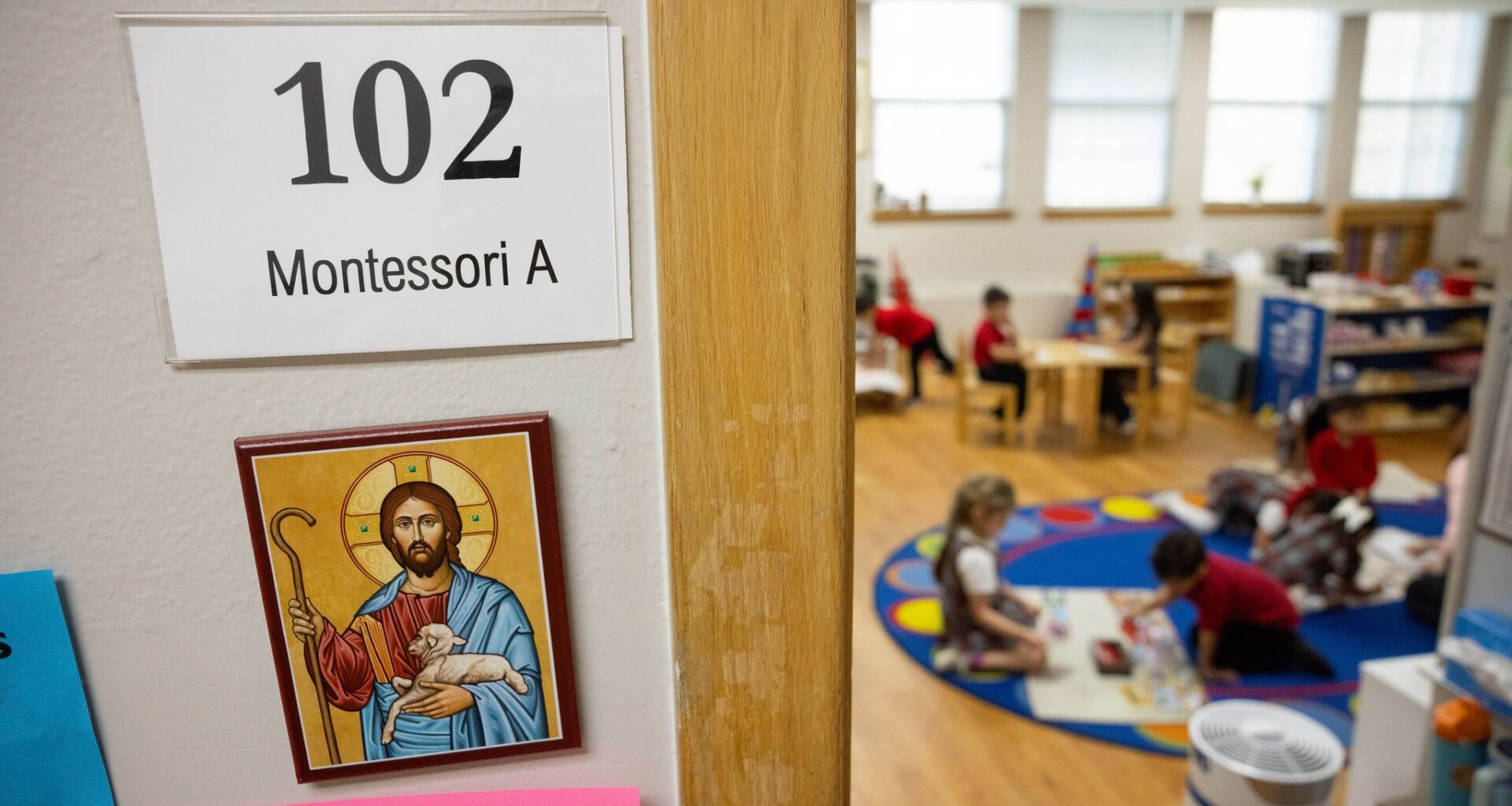
A Montessori classroom at Mount St. Michael Catholic School in Dallas, Wednesday, March 11, 2026.
Juan Figueroa/The Dallas Morning News
However, keeping a school up and running can come with challenges, especially for one like Mount St. Michael Catholic School, where roughly 70% of its students are lower-income. About a quarter of the school’s funding comes from donations.
Article continues below this ad
The school sees the Texas Education Freedom Accounts, set to launch this fall, as a lifeline and a chance for expansion. The school voucher-like program will give parents about $10,500 to support private schooling for their child. That’s enough to cover the entirety of Mount St. Michael Catholic School’s tuition — and leave extra for parents to spend on school-related items.
Make Dallas News a preferred source so your search results prioritize writing by actual people, not AI.
Add Preferred Source
As Gov. Greg Abbott’s signature school choice plan prepares for launch, there’s an ongoing debate over whether it really will be an equalizer, education experts say. While Texas Education Freedom Accounts promises to prioritize low-income students and students with special needs, critics are skeptical that TEFA will increase access to private schools and anticipate taxpayer funds will be distributed mostly to families already attending them. They worry TEFA will funnel money away from the state’s public schools, which serve more than 3.3 million economically-disadvantaged students.
Related: Over 42,000 Texas families get notified they’ve been picked for school voucher program
Article continues below this ad
Abbott pointed to small Christian private schools in his pitch for the voucher-like program. Schools geared toward low- and middle-income families, like Mount St. Michael Catholic School, say the program is the embodiment of their educational mission: to give Christian families, regardless of their economic status, an affordable alternative to public schools.
“It … will really close the gap for our family,” Gonzales said. “Just because you don’t have enough money, doesn’t mean your child cannot get a good-quality, faith-based education.”
The entrance to Mount St. Michael Catholic School in Dallas, Wednesday, March 11, 2026.
Juan Figueroa/The Dallas Morning News
For this Texas private school, high hopes for TEFA
Principal Melissa Castro wholeheartedly believes in the school voucher-like program.
Article continues below this ad
Drive onto campus, you’ll pass a large banner pronouncing “We Proudly Accept Texas Education Freedom Accounts.” Stop by a state-sponsored information session, you’ll see Castro stationed at a table with a spread of promotional materials. Tune into the radio, you’ll hear her excitedly tout the program.
“We want everybody to apply,” she told the Guadalupe Radio Network, which provides Catholic programming. “We want to send the message to the state that says, ‘We want this.’”
Signs advertising enrollment to Mount St. Michael Catholic School in Dallas, Wednesday, March 11, 2026.
Juan Figueroa/The Dallas Morning News
Abbott signed the $1 billion program into law last year, and it’s expected to be the largest of its kind in the country. Approved families will receive an education savings account, or state aid, to pay for expenses for non-public school education. Families can receive about $10,500 to support private schooling or $2,000 for homeschooling. Students with disabilities can get up to $30,000.
Article continues below this ad
While the program has enough money for 100,000 students, more than 274,000 students applied to receive state money, according to the Texas Comptroller’s Office, which runs the school choice program. Of the roughly 152,000 applications submitted in the first month of the application period, 76% came from students already in private school or homeschooling, or hadn’t started school yet, according to the Texas Center for Voucher Transparency. More than 700 schools in the Dallas Fort-Worth area have been approved to accept the voucher-like funds, according to a map released by the office.
The program “will alleviate some of the burden for our families,” Castro said.
The school’s annual tuition — about $7,500 to $8,700 per child — “is not how much it costs to educate a child,” she said. She estimates it would cost about $10,500 to teach each student.
Article continues below this ad
The school starts each year with a deficit and raises money from outside sources. A quarter of the school’s funding comes from donations. Of its 142 students, about 44% are on a form of tuition assistance. The school would not comment on the tuition the average child pays, because it evaluates each family’s situation to determine how much assistance to offer.
Since the school is hoping to accept more students, an influx of tuition dollars would allow it to increase teacher salaries and purchase more curriculum materials, Castro said.
“Right now, we have room [for more students],” Castro said. “We’d love to get to that point where we do have a waitlist and we are the sought-after school.”
David DeMatthews, a professor in educational leadership and policy at the University of Texas at Austin, said it’s hard to get a sense of how many private schools are funded similarly. Associations can keep records, but there isn’t a centralized database, like the state has for public schools, he said.
Article continues below this ad
TEFA doesn’t have data on the tuition that participating schools will charge yet, said program spokesperson Travis Pillow. The median tuition for Texas private schools was $9,400 for the 2024-25 school year, according to a Texas Private Schools Association survey.
“These schools are incredible assets to their communities, and they are pouring every penny that they possibly can into educating their students,” Pillow said. “We’re hopeful that this program will fuel more schools.”
While TEFA can help small private schools boom, supporting them financially, DeMatthews said, isn’t the same as ensuring access, accountability or quality.
Abbott made school vouchers a centerpiece of his reelection campaign, spending more than a year visiting private Christian schools to build his case. The King’s Academy, which serves Bonton and South Dallas families, was among those pit stops in 2022.
Article continues below this ad
Gov. Greg Abbott (left) speaks alongside Mandy Drogin, Campaign Manager for Next Generation Texas, after an education roundtable at The King’s Academy in Dallas, Thursday, Aug. 11, 2022.
Elías Valverde II/Staff Photographer
The school relies significantly on donations, setting a fundraising goal of $2.9 million this school year. The school taught 120 students from pre-K for 3-year-olds through sixth grade in the 2025-26 school year.
About 75% come from families at or below the poverty line, according to a school report. Parents pay tuition based on a sliding scale; some pay $20 a month, others pay $500 a month.
Shailendra Thomas, the head of school, calls herself a “proponent of all types of education.” Between public, home and private schooling, she said, each has its own advantages. It’s a matter of giving parents a choice of which one suits their child.
Article continues below this ad
“They call it school choice. But really, families that are upper middle class and upper class have had choice forever,” she said.
Will TEFA deliver for low-income families?
TEFA gives first priority to special needs children whose household income is at or below 500% of the federal poverty level — roughly $165,000 for a family of four. The second category is children whose households are at or below 200% — $66,000 for a family of four. The third group is between 200% and 500%.
Since the number of applicants exceeds the number of available spots, most, if not all, participants in the program’s first year, will be in the first and second priority tiers, Pillow said.
Article continues below this ad
The first batch of grants, which concentrated on Tier One students, went out in late April. Nearly half were already enrolled in private school or homeschooled. A lottery will be conducted to determine which families in the second category will receive funds.
An estimated 24,500 students will leave public schools for private schools in fiscal year 2027, increasing to 98,000 in 2030, according to a 2025 Legislative Budget Board document. Critics say an exodus will lead to loss in funding for Texas public schools, which serve roughly 3.3 million economically-disadvantaged students. Districts receive money based on student attendance.
DeMatthews questions whether the Texas education savings account program is designed to serve low-income families, pointing to how similar programs have played out in other states. He is doubtful those students will move out — and remain out — of public schools by utilizing the state dollars, citing transportation costs, remaining tuition gaps, admission policies and an uneven geographical distribution of private schools.
In the Phoenix-area, poorer ZIP codes saw fewer vouchers used, while wealthier ones saw more, according to a ProPublica analysis. Low-income families said they didn’t know much about the program, and others cited the transportation barriers in sending their child to private schools, which were disproportionately located in wealthier parts of the area. Some Arizona private schools also increased tuition by thousands of dollars, after the voucher program expanded eligibility to all K-12 students and removed the requirement of initial public school attendance, according to the Hechinger Report.
Article continues below this ad
“There’s reason to believe that that is exactly what will happen in the next few years in Texas,” DeMatthews said.
TEFA promises financial access, he said, without addressing capacity, guardrails and transparency.
Pillow pushed back on this characterization, saying Texas officials studied programs across the country to learn “how to run a great program.” Among lessons learned, he said, was to establish a “user-friendly” application process to minimize paperwork for overburdened families, as well as prioritizing low-income families and children with disabilities.
“Texas is not Arizona,” he said. “In the coming months, we will see the data on who’s actually participating … and prove the critics wrong.”
Article continues below this ad
A policy that Pillow promises will “expand opportunities” is one that DeMatthews describes as “well-packaged” and “flawed.”
A school worth the sacrifices, a parent says
Outside Mount St. Michael Catholic School, a few students tended to sheep grazing near a barn. Others crowded around a garden bed, plunging a metal frame into the dirt. Vines will eventually grow and wrap around the scaffolding.
Midnight walks toward the camera as students participate in ag teacher Shannyn Chance’s class at Mount St. Michael Catholic School in Dallas, Wednesday, March 11, 2026.
Juan Figueroa/The Dallas Morning News
Inside the atrium, students gathered around a carpet. They bent their eyes down for prayer before their teacher launched into the morning’s religious lesson.
Article continues below this ad
For Angelica Gonzales, the political debates feel distant.
Since several of Gonzales’ kids attend Mount St. Michael Catholic School, making the tuition can get tough. Upon learning of the proposal to establish education savings accounts, she thought to herself: “Oh yes, please Lord. Let it get approved.”
As of April, Gonzales, who is in the second tier, has yet to hear back whether she has been approved for the funds.
She once considered her family to be “upper middle class,” but now, they’re more “lower class.” Her husband, an architect, is struggling to find work.
Article continues below this ad
Unforeseen circumstances have required the family to reconsider what’s worth investing in.

By signing up, you agree to our Terms Of Use and acknowledge that your information will be used as described in our Privacy Policy.
“A better car or a better house,” she said, doesn’t compare to a better education.
The DMN Education Lab deepens the coverage and conversation about urgent education issues critical to the future of North Texas.
Article continues below this ad
The DMN Education Lab is a community-funded journalism initiative, with support from Bobby and Lottye Lyle, Communities Foundation of Texas, The Dallas Foundation, Dallas Regional Chamber, Deedie Rose, Garrett and Cecilia Boone, Judy and Jim Gibbs, The Meadows Foundation, The Murrell Foundation, Ron and Phyllis Steinhart, Solutions Journalism Network, Southern Methodist University, Sydney Smith Hicks, and the University of Texas at Dallas. The Dallas Morning News retains full editorial control of the Education Lab’s journalism.