
In their primary runoff for the Republican nomination for U.S. Senate, John Cornyn can say that Ken Paxton is divorcing his wife, that he’s alleged to have had multiple mistresses, that his own senior staff has accused him of corruption. All that is damning and true. But Paxton can make one charge that is more powerful than anything Cornyn can pin on Ken, and which may well push the attorney general over the line on May 26: John Cornyn was in office twenty years ago. There’s really no getting around that. It’s on his Wikipedia page.
To put a finer point on it, Cornyn has the stink of George W. Bush about him. The problem with the senior senator, as one representative online poster put it this week, is that he’s “a corporate hack who was an instrumental member of the Bush/Rove machine” and “the last vestige of those hacks other than [Greg] Abbott.” The problem for Cornyn is that the sentiment above wasn’t shared by a bleeding-heart Austin liberal with a long memory of the Bush years and a Coexist bumper-sticker, but by someone who identifies as a Texas conservative.
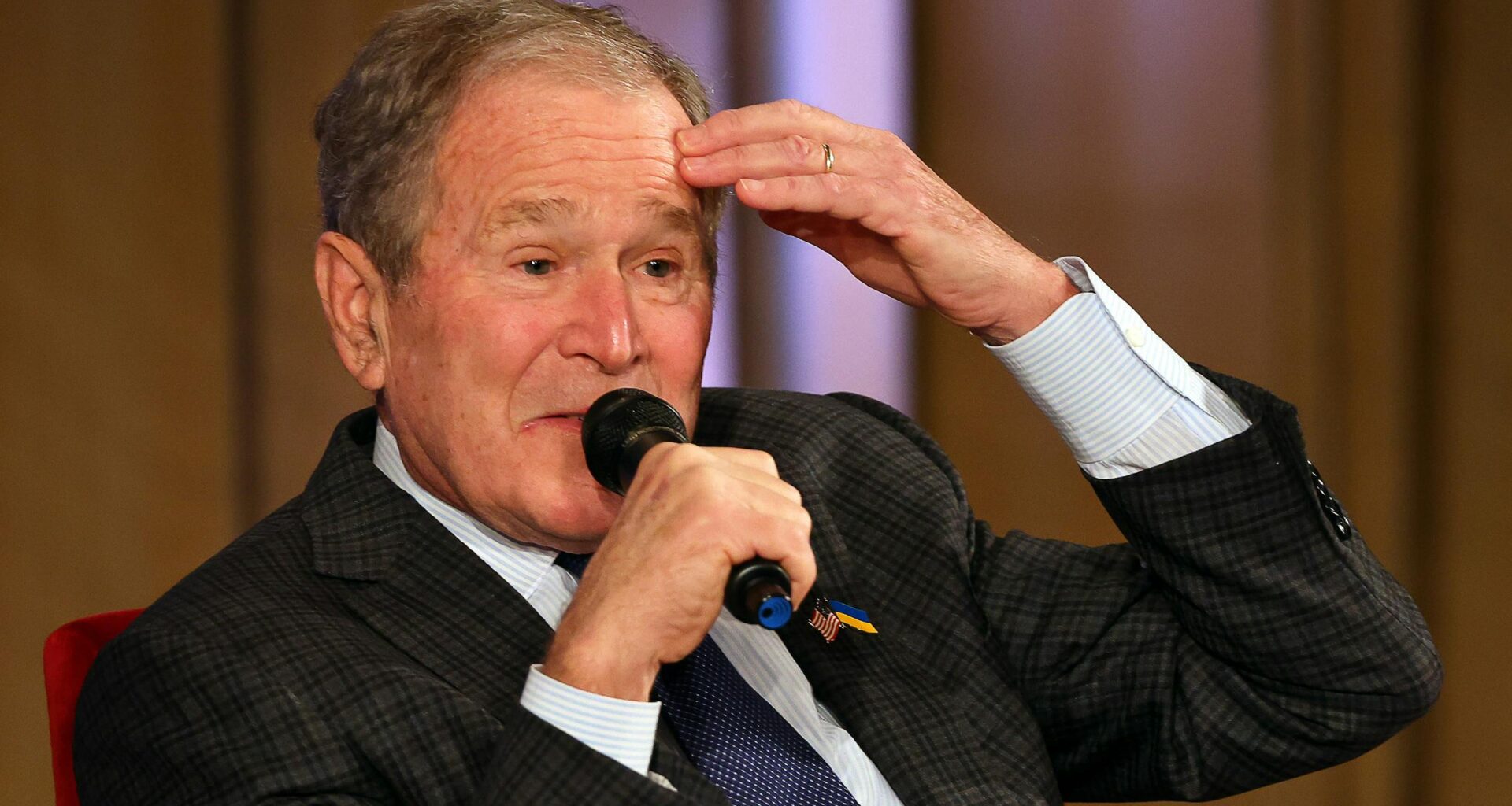
The expectation might be that the Texas GOP has golden statues to Bush in every place it meets. It does not. A substantial portion of Republicans in the state are out to seek and destroy any last trace of the party left over from the Bush era—between 1994 and 2004 or so. When it was reported on April 15 that Bush had donated $5,000 to Cornyn’s campaign, the signal fires went up through the right-wing movement. (Even though it was a minor sum from a private citizen in a very expensive race—pro-Cornyn organizations, along with his campaign, spent $17 million in the first quarter of 2026.) “[The] old guard is all over Texas trying to claw back control and push out America First candidates,” wrote Kambree Nelson, a pro-Paxton influencer. “Bring it.” Another MAGA influencer posted a picture of an aged Bush and wrote that “voting for this RINO twice and defending him for 10 years after he left office was the worst political decision I’ve ever made.”
That this is now the mood in a large faction of the GOP is a bit strange, because Bush’s party was one of the most savagely dominant political forces the state had ever seen. This is not properly appreciated today in part because Bush was the “compassionate conservative.” But the Bush-era GOP consumed the once-dominant Texas Democratic Party like locusts eat a field of wheat and made possible everything that came after.
For a century or so after Reconstruction, Texas was a one-party Democratic state. For maybe twenty years after that, it was a Democratic state where some Republican candidates could win statewide elections. When it flipped, it flipped quickly. The Republican machine led by Bush ran the progressive Governor Ann Richards out of office in 1994, then proved popular enough that the party was able to wipe out the last Democratic statewide officials in 1998.
On the basis of this track record, Bush would become president in 2000, leaving behind a handpicked successor—Rick Perry—whose party would consolidate control over the Texas Legislature during the first post 9/11 election, in 2002. By 2004, the permanent Republican majority was in place, and it has only been threatened briefly in the years since.
Part of Bush’s weakening legacy in his party comes, of course, from the fact that his presidency ended in failure. It was a particular kind of failure, though, that made his supporters feel like fools for supporting him. The country rallied around his foreign policy after 9/11, but by 2006, with the Iraq War looking like a massive mistake to most Americans, it was a political disaster. When the global financial crash came, small-government George blessed a massive, FDR-style bailout of the big banks. This saved the American economy from a Great Depression–style collapse, but it seemed like an ideological betrayal. By the end of his second term, Bush’s approval ratings fell into the twenties, indicating he was losing some of his strongest supporters.
Nationally, this left a vacuum in the GOP. The failure of the Bush administration was the kind that discredits the ideological factions that supported him. Neoconservatism was more or less dead as a going concern (until Donald Trump and Secretary of State Marco Rubio pulled it out of the ash-heap of history earlier this year). The Christian Right would be a more begrudging partner the next time a Republican president won the White House, and it would have to give their blessings and hosannas to a divorced New York real estate playboy who calls communion wafers “little crackers.” Free traders and free marketers would give way, in the upcoming Trump era, to protectionism and some kind of state capitalism.
In Texas, factions of the party commenced a power struggle. Business-minded moderates more of the Bush mold and further right ideologues began fighting for control of the Texas House. By 2010, Perry had effectively declared independence from the Bush machine and was throwing his lot in with the tea party—groups trying to write a new future for the party—in the hopes of riding it to the White House. The tea party wave crested with the elections of Ted Cruz, in 2012 and Lieutenant Governor Dan Patrick and Attorney General Ken Paxton, in 2014.
There was, of course, an ideological dimension to the dissatisfaction with Dubya. Bush-era Republicans were more like conservative Democrats of previous generations who saw the role of state government as facilitating economic development. Many of them, like Perry, had been conservative Democrats. As governor, Bush had presided over the early years of NAFTAization of the Texas economy, which made the state’s economy boom. But most of the benefit went to a new transnational business class. The state’s population exploded and foreign workers were a central part of the new economy and treated with sympathy. Bush was the guy who said “family values don’t stop at the Rio Grande.”
Just a few years later, it would be completely impermissible for a Texas Republican to speak like this. Metrics of success for the earlier generation—the doubling of the state’s population, the fields of warehouses and subdivisions, the highways full of trucks from Mexico, and the tremendous racial and cultural diversity of the state—started to look, to the newer generation, like the problem. The first waves of the new Texas Right emphasized their commitment to fighting illegal immigration and making the state government more avowedly Christian. Recent waves are more explicit in vowing to reverse the changing racial makeup of Texas.
Patrick, an early indicator of the shift, won the lieutenant governor’s race in 2014 with a campaign whose signature image was a white picket fence with a padlock. A top consultant on his team would go on to work for European far-right parties like the German Alternative für Deutschland, who are who you think they are. Today prominent Texas Republicans like Bo French, in a runoff to be the GOP nominee for a seat on the oil-and-gas-regulating Railroad Commission, freely warn that the state has absorbed too many Indians and Muslims—too much legal immigration in addition to illegal—and darkly predict that some kind of violent racial conflict lies ahead. Economic development hardly matters: The problem is that “our” state is being taken away from “us.”
As with power struggles more generally, it can be hard to tell whether the party split formed from ideological disagreement or whether the ideology is coloring a more fundamental fight for power between rival groups. As these things go, it’s usually a little of both. Perry told Debra Danburg, one of his colleagues in the Texas House, that he was becoming a Republican because he could jump up the ladder. (Danburg later told Perry biographer Brandon Rottinghaus that he’d said, “I can never go anywhere unless I switch parties, and they [Republicans] have made clear to me that if I did I would have all the money I’d need to run for whatever office I want.”.) He then sort of engineered a belief system to justify sticking with his new party as it changed over the years.
Paxton’s case is particularly instructive on this front. In the spring of 2005, when Bush was riding high, Paxton, a backbench state representative from McKinney with little else to do, authored a successful bill to put up big signs at the Texas state border welcoming outsiders to the Proud Home of President George W. Bush.” In the spring of 2007, as W’s star was sinking, Paxton wrote another bill to require the signs be taken down the moment the president left office. When a Republican civil war kicked off a few years later, the new, insurgent side offered opportunities for promotion to higher office that didn’t exist on his current track, and Paxton grabbed the ring. He ran against the Speaker of the House on behalf of the right-wing faction’s donor wing, and they then funded his rise to the state Senate. Once he was attorney general, he fought with Barack Obama, Texas Democrats, and the law. But he saved some of his strongest ire for older Republicans.
In 2022, Paxton defeated a primary challenge from land commissioner George P. Bush, son of former Florida Governor Jeb Bush and nephew of George W. A year later, in his impeachment “trial,” where the Senate heard charges of wrongdoing offered by the House, Paxton’s team of lawyers had to make a political argument—not a legal one—to get him off the hook. They settled on a narrative that the Bushes, and Rove, and Texans for Lawsuit Reform, a big-money group aligned with the older faction, were trying to do now what they couldn’t at the ballot box.
This had a very, very thin connection to reality. But it reflected something true, which is that the trial was a factional debate within the party over who holds power, and it gave the Republicans in the state Senate, who belonged to Paxton’s faction, a pretext on which to acquit. And it set the terms of the next debate: Paxton’s obsession with Cornyn seems to originate entirely from the trial, when Cornyn had the temerity to suggest that the charges against Paxton might have merit and needed careful consideration. Soon polling was popping up pitting the attorney general, who was refashioning himself as a man on a great crusade against the Bushes, against their last avatar.
There is a fundamental disagreement about the nature of politics going on here. Bush-era politicians were trying to win office in what was still, or was recently, a Democratic state. They were focused on the risks of losing a general election. In office, they would have to work with Democrats—Bush forged a close partnership with Lieutenant Governor Bob Bullock—to get stuff done, and the stuff they were trying to get done was, by design, broadly popular. Democrats were the party you beat, but they weren’t the enemy.
But this crew soon accomplished the destruction of the Texas Democratic Party as an institution. Once the opposition party was a nonentity, there was no real reason for the next generation of Republican politicians to do anything but work for the GOP base. The mechanism by which the party legitimates itself today—and revives its sense of purpose—is internal infighting. It’s electing new Republicans who are more up-to-date and hardline than the previous ones who have gone soft in office or moderated their views by contact with real power. The party of ten years ago is the enemy of the party now.
When a conservative activist today looks around and wonders why Texas is letting Cornyn represent the state with his pro-business and conciliatory ways, that activist is being both a little unreasonable—Cornyn’s record is very conservative—and entirely rational. There’s no reason for right-wing activists not to push for what they want until the Democratic Party starts posing a threat in general elections.
On social media and at most conservative rallies across the state, it will seem as if every conservative activist of note is a Bush-hater. It’s important to remember this isn’t the case. In the first round of the primary, Cornyn placed first, with 42 percent of the vote, against Paxton’s 40.5 percent. There are a lot of Republican voters out there, not just in Bush’s Preston Hollow retirement community, who are quietly supporting the “old” party.
But at some point, the old party will have to reckon with its signature problem: It doesn’t have a compelling plan for the future. Members of Young Republican clubs today are, by and large, kids who love Trump, not the Bushes. The moderate Republican candidate bench is thin. Some of their donors have passed away without obvious replacements. (A major new funder of Texans for Lawsuit Reform, the organization that backed Bush when he ran for governor, is Elon Musk, and his politics are, uh, a little unusual.)
It has to be a little dispiriting for Cornyn’s supporters to see the something less than a murderer’s row of supporters his campaign is dragging out to offer endorsements in the closing stretch. Bush, Rove, Perry—that’s one thing. But when Phil Gramm penned an op-ed in The Free Press, a publication that is friendly to some of the Bush-era conservative tendencies that are now in remission, announcing that he was “a strong supporter of John Cornyn,” it was wise of the editors to include “I Served in the Senate” in the headline, because a lot of Texans won’t remember that he did from 1985 to 2002. And it’s not hard to tell why the prominently featured endorsement of Georgian Newt Gingrich spends the first half of its run explaining who he is and what he did before even mentioning Cornyn’s name.
The Paxton-Cornyn showdown is, in some ways, the biggest fight in the Republican civil war. That conflict will backfire and create room for a Democrat to eventually win, but only a fool would call the year. It would be wise for Republicans, though, to remember the afterlife of one of the more famous Bushisms: “You’re either with us or against us.” That line sounded tough in 2001. In hindsight, it sounds a lot like hubris.
Read Next