
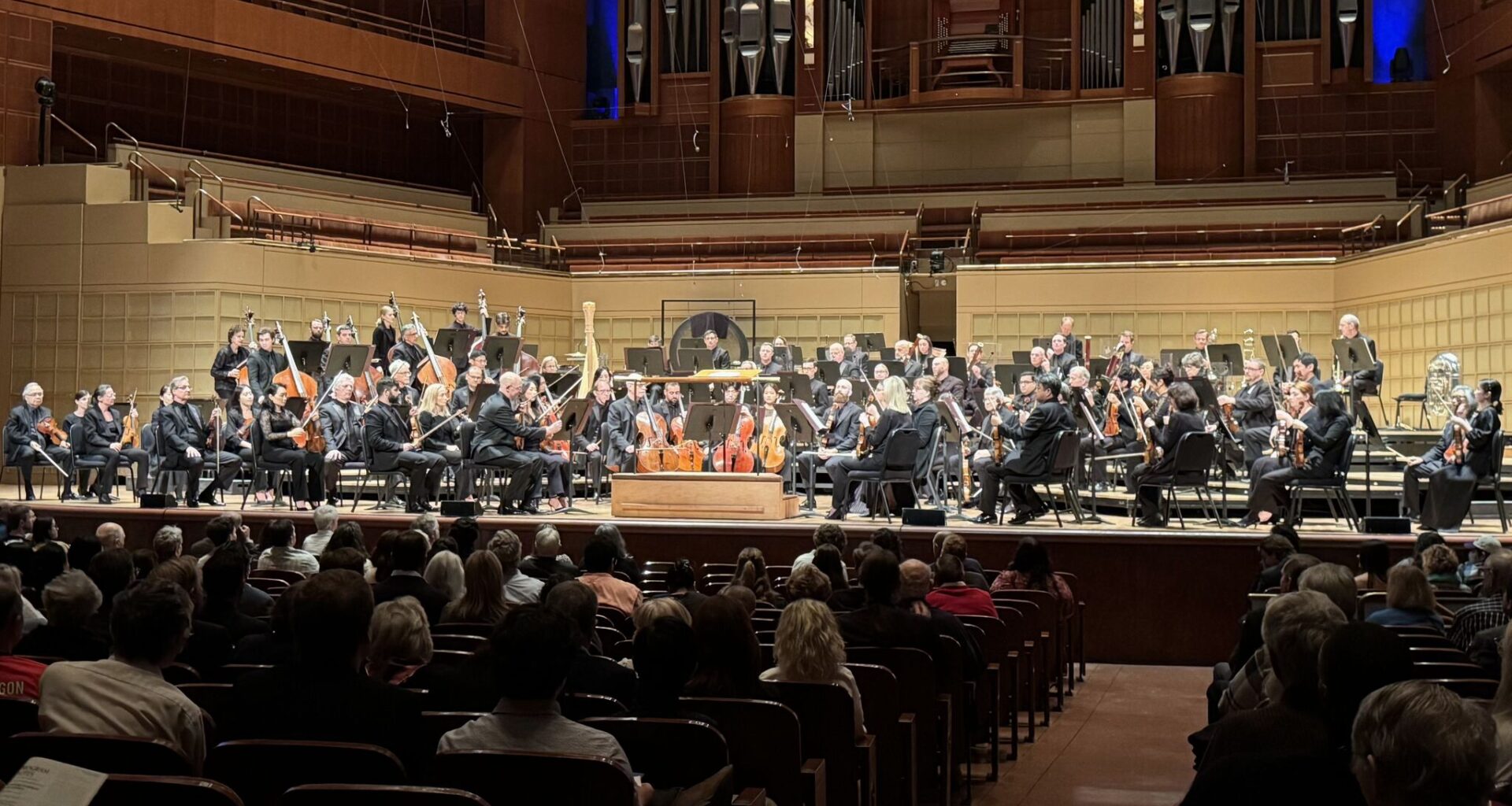
The Dallas Symphony Orchestra onstage at the Meyerson Symphony Center for a concert on April 30, 2026.
Scott Cantrell
Thursday night’s Dallas Symphony Orchestra concert was all Russian all the time. With music director Fabio Luisi conducting, the program spanned seven decades of music from tsarist times. All three works bore influences from Russian folk traditions.

Glinka’s Ruslan and Ludmila Overture prefaced Tchaikovsky’s Little Russian Symphony, with Stravinsky’s Firebird Suite (from the 1910 ballet, but in the 1945 revision) in the concert’s second half.
Article continues below this ad
Luisi’s at his considerable best in dramatic music, and he made the Glinka and Stravinsky riveting. I can’t think I’ve ever heard the Glinka, a flashy piece in virtually any performance, taken at such a frenzied clip. The DSO violins more than earned their pay for precise dispatch of those busy scurries.
To hear the Stravinsky was again to marvel at the brilliant orchestration — the dancing flutters, flickers, splashes and surges of sonic colors. Even the hushed pacings at the beginning were marvels, thanks to the Meyerson Symphony Center’s awesome bass response.
Luisi brought all this vividly to life, from knife-edge explosions in the Infernal Dance to edge-of-audibility glows in the Berceuse. Timing everything with sensitivity, he sustained urgency from first note to last.
Make Dallas News a preferred source so your search results prioritize writing by actual people, not AI.
Add Preferred Source
Among many beautifully executed solos were particularly eloquent ones from David Buck (flute), Mark Debski (oboe), Ted Soluri (bassoon), Daniel Hawkins (horn) and Alexander Kerr (violin).
Article continues below this ad
For music composed to illustrate balletic action, I always wish audiences could be given at least minimal supertitles to tell what’s happening. A St. Louis Symphony performance last November of the complete Firebird supplied big-screen projections of scenery and costumes from the original Ballets Russes production, with play-by-play descriptions of the action. Texts even pointed out an occasional detail of the orchestration. The DSO audience was left to its own imaginings.
In The Mikado, by Gilbert and Sullivan, the executioner Ko-Ko has “a little list” of annoying people. So, surely, must every veteran concertgoer maintain a personal list of compositions that never would be missed.
One of my entries would be Tchaikovsky’s Second Symphony. Its Little Russian sobriquet, acquired after Tchaikovsky’s death, perpetuates a Russian name for Ukraine. Visiting his sister there in the summer of 1872, the composer jotted down folk tunes he heard, incorporating three of them in the symphony’s first, second and fourth movements.
The middle movements are delightful: a lighthearted march and a restless scherzo of bright, shiny effects, with a suggestion of a danse macabre.
Article continues below this ad
The restless, nervous energy of the first movement has its moments, but some of the thematic material is pretty cheesy, with too much motivic repetition. There’s more of the same in the finale, after a portentous introduction, but a gently dancing episode offers welcome relief.

By signing up, you agree to our Terms Of Use and acknowledge that your information will be used as described in our Privacy Policy.
If one listener wasn’t entirely convinced, Luisi and the orchestra made a strong case for the piece.
Details
Repeats at 7:30 p.m. Friday and Saturday and 2 p.m. Sunday at Meyerson Symphony Center, 2301 Flora St. 214-849-4376, dallassymphony.org.